sIn recent years, there has been a burst of interest in Thucydides as a thinker who can help us understand world affairs. Chairman of the Joint Chiefs of Staff Mark Milley cited Thucydides to explain Russia’s invasion of Ukraine.1 Former White House advisor Steve Bannon has listed Thucydides as a favorite author.2 Former Ambassador John Feeley compared President Donald Trump’s worldview to the Athenians at Melos to express his dislike of what he viewed as an immoral foreign policy.3 Canadian Prime Minister Mark Carney referenced Thucydides at Davos to warn against complacency in the face of unrestrained aggression by great powers.4 Most prominently, Chinese President Xi Jinping publicly posed a loaded question to Donald Trump: “Can the US and China overcome the so-called Thucydides Trap and create a new paradigm of major country relations?”5
Xi was referring to a concept popularized by Graham Allison in his provocative book Destined for War: Can America and China Escape Thucydides’ Trap? Allison invoked Thucydides’ history of the war between the ancient Greek cities of Athens and Sparta to suggest the likelihood of war between China and America. In this framing, the US is a power in decline that must recognize its limitations and accommodate the rising power that is China. In a similar vein, Michael Desch has argued that Thucydides provides evidence for the dangers of US overextension and the relative advantages of contesting only the most fundamental challenges to the balance of power.6
Many of these arguments are flawed. The lessons most often drawn from Thucydides in the fields of international relations and military strategy are largely based on misinterpretations or selective readings of the text.7 While Thucydides declares his book a “possession for all time,” which will be “useful” for anyone interested in the past or the future (I.22.4), its usefulness is derived from an understanding of the war as a whole.8 And although it may be impossible to reconstruct with certitude what lessons—if any—Thucydides meant for his work to offer, by contextualizing famous passages in the broader narrative, we extract starkly different, richer, and more relevant lessons for the US today.9
There are better ways of applying Thucydides to the modern world than those that currently predominate. Thucydides is often cited as a structural realist and original thinker of amoral power politics who was also a critic of democracy’s inherent strategic ineptitude.10 Such readings not only neglect the nuance of Thucydides’ broader narrative of war, but overlook valuable lessons for modern policymakers and strategic thinkers.11 These lessons include the value of strategic communication, the importance of legitimacy on the world stage, and the way in which viewing international affairs through the lens of generic power politics neglects the key importance of national character to both decisions for war and the manner in which war is waged.12 Although Athens was ultimately defeated, its democracy demonstrated exceptional tenacity and resilience over many years of warfare. Rather than vaunting authoritarian advantage, Thucydides shows the exceptional strategic performance of Athenian democracy.
In short, in place of the tired invocations of inevitable war, procrustean power politics, and democratic fickleness, Thucydides offers insights into the importance of international legitimacy, national character, and democratic exceptionalism. By understanding these lessons, readers can avoid assigning the imprimatur of one of history’s great thinkers to simplistic—and often alarmist or bellicose—prescriptions about the world today.
Overview of Athenian and Spartan Strategy
Any reading of Thucydides or study of the Peloponnesian War must include discussion of the strategies employed by both Athens and Sparta, and ideally, the broad strokes of the major campaigns.
In the first phase of the war, conventionally called the Archidamian War, both Athens and Sparta relied on their strengths. Athens used its maritime power to raid the Peloponnesus, and Sparta used its land power to ravage Attica. Both cities also previewed important strategies that neither had the wherewithal, at least initially, to successfully employ. Sparta attempted to strip away Athenian allies through force or by encouraging rebellion, and Athens tried to box Sparta in with invasions of the Megarid, landings on the Peloponnesus, and naval victories in the Gulf of Corinth. Within a few years, both achieved outsize strategic effects from these efforts, via the Athenian campaign on Pylos and Sphacteria and the Spartan campaign in Thrace and Macedonia.
During the shaky Peace of Nicias that followed, Athens transformed its strategy at home and abroad. In Greece, Athens allied with Sparta’s rival Argos and challenged Sparta in a land battle. In the western Mediterranean, Athens invaded Sicily. In both cases, Athenian strategy failed.
In the last phase of the war, called the Ionian or Decelean War, Sparta took the initiative. The Spartans established a base near Athens that slowly bled the Athenian economy dry. The Spartan alliance with Persia allowed it not only to peel away Athenian allies in the eastern Mediterranean, but also to engage in a war of attrition with the Athenian navy, which had been badly mauled from the Sicilian Expedition. Athenian strategy became increasingly reactive, marred by inadequate responses to both defeats and victories, and was ultimately unsuccessful. A series of naval victories allowed the Athenians to cling to survival, but with no margin for error; conversely, the Spartans were able to rebuild and reman fleets with ease. After the eventual destruction of the Athenian navy and the isolation of Athens by land and sea, Athens surrendered to Sparta.13
Power Imbalance and the Outbreak of War
Thucydides’ description of how war broke out between Athens and Sparta has long been a wellspring of material for international relations theory. The Peloponnesian War was a favorite historical parallel for explaining US-Soviet conflict during the Cold War, particularly for realists but also for a wide range of scholars who noted the ideological and cultural dimensions of the conflict.14 More recently, scholars have mined specific passages for insight into what might be the likely causes of competition between the US and China boiling over into conflict, and what steps might be taken to prevent this outcome. This generation of engagement has been narrower and more superficial than its Cold War predecessors. Too often commentators look only at specific passages, and miss valuable context contained elsewhere. Bringing more of that context into two current, influential interpretations provides a more accurate picture of what Thucydides wrote, while providing better insights for US political and military leaders.
Thucydides in Context: Rethinking Recent Scholarship
As the US began its slow “pivot to Asia,” Allison popularized the idea of “Thucydides’ Trap” in his book Destined for War. Allison’s “trap” is essentially the tendency for conflict to occur between rising and established great powers. In his view, war is likely to occur between the US and China as a result of their shifting balance of power, just as it did between Sparta and Athens.15 Allison draws on Thucydides’ authorial judgment that the “real cause” of the war was the following: “The growth of the power of Athens, and the alarm which this inspired in Sparta, made war inevitable” (I.23.6). This line has long been a key source for realists and especially adherents of power transition theory.16 But it is a misreading of the Greek that misses three important points.
First, Thucydides does not claim the war was inevitable. The Greek does not quite say that the growth of Athenian power and Spartan alarm made the war “inevitable,” but that this combination “compelled” the Spartans to go to war.17 This may seem an academic point of translation, but it gets to an important distinction: Wars often break out when there is a perception of inevitability. That is why such perceptions are so dangerous. Whether this war was in fact inevitable is an important question that Thucydides reserves judgment on, and in so doing leaves it to his readers to ponder.18
Second, Thucydides did not see the war as monocausal. While the widely used Landmark edition identifies the “real cause” of the war as Spartan alarm at the growth of Athenian power—which implies that there was a single cause—recent commentators and translators have emphasized that the key word is more literally rendered as “truest” than “real.”19 The growth of Athenian power, then, is not the single “real” cause, but the “truest cause, though most obscured in speech.”20 The distinction between a singular “real cause” and a “truest cause” is significant. There may be a number of true reasons that interact in order to bring about war. Reducing war to a singular cause—in this case the power transition between Sparta and Athens—is more simplistic than what Thucydides actually wrote.
“There may be a number of true reasons that interact in order to bring about war.”
Third, Thucydides did not ascribe the war’s origins to “power” in the modern sense of the word. The Greek in this much-quoted passage does not say that the Spartans were alarmed at the growth of Athenian “power” but by “the Athenians becoming great.”21 Greatness and power may seem synonymous on the international stage, but they carry distinct implications. Greatness implies a certain level of distinction and importance; it distinguishes Athens from other Greek cities.22 While power may be a necessary condition of greatness, it is not a sufficient condition in the original meaning of the Greek word.
The common but misleading translation of this passage draws from Thomas Hobbes’ seventeenth-century rendition: “The growth of the Athenian power, which putting the Lacedaemonians into fear necessitated the war.”23 Hobbes wrote in the post-Baconian intellectual milieu and strove to develop a political philosophy that would have the precision of a material science. The idea of international relations as a balance of power is an early modern formulation, reflecting a distinctively modern notion that power can balance like a system of weights and measures, a notion not present in any ancient sources.24 Additionally, Thucydides’ narrative does not give any evidence of a shift in the material balance of power in the years immediately leading up to the outbreak of war, even though the Corinthians do their best to scare the Spartans about such a possibility (I.69.4). Although Sparta’s declining manpower or distortions of the Greek economy due to Athens’ access to precious metals are often cited as evidence in support of balance-of-power readings of the Peloponnesian War, these factors do not appear in Thucydides.25
This temptation to read Thucydides as a theorist of inevitable war dictated solely by relative power shifts can spur productive conversations about grand strategy and the long-term interests of nations that transcend individual leaders or crises, but it risks encouraging complacency in how we understand the beginnings of violence. If war is determined by “vast impersonal forces,” then we are likely to neglect the role played by leadership.26 Allison concludes with a plea for leaders to take the steps necessary to avoid war—a plea that may in fact complement Thucydides’ depiction of the outbreak of the war as a series of escalating crises compounded by obstinate leaders. Even if war was bound to break out at some point between Athens and Sparta, the war—as it happened and when it happened—resulted from multiple decisions, freely and intentionally made by leaders who chose war over peace.
Readers of Thucydides who focus on structural factors are not necessarily fatalistic about the outbreak of war. Desch has recently argued that Thucydides is, rather than Allison’s theorist of inevitable conflict, actually a balance-of-power realist cautioning against overconfidence and over-engagement. In his reading, Athens failed to understand the value of restraint, and instead either styled itself as a benign hegemon or aggressively sought to expand its power.27 Desch praises Hermocrates of Syracuse’s support of a successful non-aggression pact with Syracuse’s smaller Sicilian neighbors, as well as Pericles’ moderate imperial policy and defensive military strategy. In Desch’s reading, both leaders are “contingent restrainer[s]” who show that Thucydides’ lesson for the US is that it would be a mistake to seek to “maintain primacy” in East Asia, just as it was a mistake for Athens to do so in Greece.28 As with Allison’s reading, the lesson for the US is to accommodate China’s sphere of influence in the new balance of power, with dire implications for the US’s regional allies.
Both of Desch’s examples of supposedly model restrainers, however, seem less applicable when put in context. First, Hermocrates’ pleas for Sicilian unity represent a wartime contingency more than an example of proper hegemonic restraint by Syracuse. When Hermocrates advocated for a Sicilian non-aggression pact, he was worried about Syracuse’s inability to stand up to an Athenian invasion, not the appropriate balance of power required to maintain the Sicilian international system. This suggests that external factors, rather than a realist policy of restraint or retrenchment, are responsible for Hermocrates’ favorable reception—not that hegemonic restraint can prevent war from occurring.
Second, Pericles’ wartime strategy of restraint—that is, waiting behind Athens’ impregnable Long Walls and avoiding major engagements or expansion of the empire during the war with Sparta—was, like that of Hermocrates, a strategy of necessity. Pericles was precisely the leader who consolidated Athenian power in the decades leading up to the war (I.111, 114, 116–17), who favored a hard line against Sparta as communication between the two sides broke down (I.140–41), and who authorized expeditionary operations around the Peloponnesus in order to bring pressure to bear on Sparta and its allies (II.25, 31, 56). While restrained, this military strategy was the culmination of an aggressive foreign policy. Moreover, Pericles’ strategy did not offer a theory of victory for Athens. Athens could not afford to maintain a war footing indefinitely, and there is no indication that a restrained Periclean strategy could bring the war to a conclusion in the time frame Athenian resources could support.29
Although Desch offers a thoughtful attempt to relate Thucydides to contemporary challenges, his argument conflates wartime strategy with an overarching grand strategy of hegemonic restraint. His characterization of Athens’ conquest of Melos and attempted conquest of Sicily as unrestrained behavior is apt, although arguably only the latter is technically an example of overreach. Likewise, Desch may be right that the strategies recommended by Hermocrates and Pericles were less likely to result in overreach than other, less restrained options. But all of these examples are wartime strategies, not long-term grand strategic designs. A much stronger argument would have been that the lack of restraint in Athens’ actions prior to the outbreak of war (ironically by the same Pericles whose wartime strategy was held up as an example of restraint) compromised its standing among the other Greek cities, especially Sparta and its allies. The problem for Athens was not maintaining commitments to allies, but behaving with unapologetic aggression over a long period of time.
The Character of National Power: Maritime and Continental States
Both Allison’s and Desch’s interpretations of Thucydides also impose an anachronistic theoretical perspective. In much of international relations theory, it does not matter which state or which kind of power is under discussion—all powers can be modeled, measured, and analyzed as, at some level, equivalent.30 This is not the case for Thucydides, who did not offer a theory of “power” as such, but instead depicted different characteristics of different types of powers. In Thucydides’ narrative, for example, there is a basic distinction between land and sea powers.31 In the early section often referred to as the “Archaeology,” Thucydides linked the rise of Greek civilization itself to the rise and refinement of sea power, drawing a line from Minos through Agamemnon and Corinth to Athens.32
In his summary of the fifty years of peace between Athens and Sparta following the end of the Persian Wars in 479 BC and the outbreak of the Peloponnesian War in 431 BC, Thucydides explained why Athens, as a maritime power, more successfully consolidated and accrued power than Sparta, a land-based power. Because of the ability of maritime powers to create alliances and generate wealth (I.7–9, 13), Athens was able, over the course of a few decades, to transform its trade networks and its leadership of the Delian League into the Athenian empire. By contrast, Sparta saw its power remain stagnant from the end of the Persian Wars in 479 BC, when it walked away from the leadership of the Delian League (I.95.7), until the outbreak of war in 431 BC. Thucydides states that navies, not armies, were the route to power in the Greek world (I.15.2), and the events of the Peloponnesian War seem to bear out this assertion: Sparta’s final, decisive victory came against Athens’ navy, not its army.
Without this background, readers who jump into the crises that spark the Peloponnesian War may see Sparta, or its allies, as revisionist aggressors and Athens and its allies as status quo victims. Indeed, some have characterized Athens’ objective, even after the war properly began, as a return to the status quo ante bellum.33 But the very nature of sea power across early Greek history was disruptive and revisionist, and cities who invested in sea power were the primary drivers of this disruption. There was no such thing, in Thucydides’ account, as a maritime power that settled for less than unrivaled hegemonic power.
Continental powers appeared unable or unwilling to compete. Sparta’s absolute power remained unchanged for fifty years, but its relative power compared to that of Athens declined. As Archidamus lamented, Sparta began the war with no navy and no money (I.82–83), two of the factors Thucydides identifies as prerequisites for hegemony. Early on, Thucydides noted that Sparta had ample opportunity to nip Athenian power in the bud, but was too feckless to do so; the Athenian empire took shape only because Sparta, driven in part by a cultural aversion to the corrupting influence of the outside world, ceded leadership of the Greek alliance after the Persian Wars (I.95). Little wonder that Pericles was so confident that Sparta lacked the will to engage in the kind of protracted war needed to destroy Athens (I.141–43). Both Athenian confidence and Spartan apprehension at the outbreak of the war seem more rational when placed in the historical context that Thucydides provides.
Thus, rather than presenting politics through a theory of generic power, Thucydides suggests that the particular characteristics of national power are key to understanding international behavior. US political and military leaders ought to take his advice and consider not only how best to maximize the advantages and minimize the disadvantages of fighting as a maritime power, but also consider how their potential continental adversaries may see the world. The strategic culture of states, as well as the specific threats they pose based on their traditional ways of war, are downstream of the key difference between maritime and continental powers.34
Power Maximization and Power Politics
Today, as calls have increased for a steelier foreign policy in the face of rising challenges from revisionist great powers, Thucydides’ “brand” of realism appears to be ascendant. As noted above, political and military leaders invoke Thucydides as a sort of north star for navigating this new, more dangerous world. Yet Thucydides’ reputation as a realist among both military practitioners and scholars is based largely on two passages: the Melian Dialogue and the Athenian Thesis. Leaders’ ability to navigate security challenges would be improved by taking in more of the context surrounding these passages—context that clarifies the self-defeating consequences of a realist framing of foreign policy.
The Melian Dialogue and the Athenian Thesis
The most infamous passage cited as “realist” comes from the Melian Dialogue. It depicts a negotiation between the leaders of the small island of Melos and the generals sent from Athens to subdue them. At one point, the Athenians declare that “the strong do what they can and the weak suffer what they must” (V.89).35 According to realists, the implication is that power differentials allow some states to lead and force other states to follow; morality plays no role in these decisions. But the accuracy of that translation is pithily summed up by Jeremy Mynott as “much quoted and imitated but . . . not what the Greek actually says”36—yet it has played an exaggerated role in international relations theory. The popular phrasing slightly overstates the contrast between the strong and the weak, implies a connection between the two that doesn’t exist in the original Greek, and leaves out important but less quotable context. The Athenians’ declaration in full might be better rendered as: “In human speech, justice is judged among equals; possibilities, by contrast, are defined by what the strong do and the weak accept.”37 The Athenians are not so much making a claim that might makes right as they are contrasting what states can say with what they can do.
“In human speech, justice is judged among equals; possibilities, by contrast, are defined by what the strong do and the weak accept.”
This passage is also clearly not a statement about the degree to which states pursue power. Desch describes and astutely critiques such readings, paraphrasing John Mearsheimer: “For great powers the optimal grand strategy is to maximize their relative power.”38 But the statement that the strong do what they can does not imply that strong states always seek to maximize their power, or that they are motivated by the pursuit of power at all. The strong doing “what they can” could be in pursuit of any object—it certainly does not translate to “the strong seek to be stronger.” The urge to treat Thucydides as a thinker of “power,” then, has led international relations theorists both to place outsize importance on a single passage, and to misread the meaning of that passage, with dangerous implications. Namely, if we assume that all nations seek to maximize their power, we are more likely to misconstrue possibilities of de-escalation and mistrust international engagement.
Another passage commonly cited as “realist” comes from what is often called the Athenian Thesis.39 During the back-and-forth that preceded the outbreak of the war, an Athenian ambassador sought to justify Athens’ actions to a skeptical Spartan audience. He stated that Athens’ actions could be explained as due to “the pressure of three of the strongest motives, fear, honor, and interest” (I.76.2). Military strategists seem especially drawn to this explanation; multiple chairmen of the Joint Chiefs of Staff have cited this passage as an explanation for why states go to war.40 The thrust of this claim is that all states are driven inexorably by these three universal motivations.
Yet this declaration is not presented, in the context where it appears, as a comprehensive explanation of state behavior. The Athenian ambassador did not even seek to explain all Athenian actions, but rather focused specifically on why Athens “did accept an empire that was offered to us and refused to give it up” (I.76.2). This passage does not provide an overarching theory for why states go to war, why Greek cities go to war, or even why Athens and Sparta specifically might go to war; it offers an explanation for Athens’ conduct in the fifty years prior to the outbreak of war. Finally, and most importantly, this speech fails in its intended purpose of justifying Athenian behavior and persuading the Peloponnesians that they should not go to war. What should be read as an unpersuasive moment of self-serving rhetoric has been cited as authoritative wisdom by generations of readers.
To be clear, realists who cite these passages do so with some justification. Even in its more accurately translated form, the Melian Dialogue expresses a sentiment that bears striking similarity to modern ideas of realpolitik—that, in the real world, power is what really counts, and morality is a mirage. This idea, which the Greeks debated, can be the basis for fruitful reflection on the role of ethics in foreign policy. Likewise, the trinity of motivations that constitute the Athenian Thesis can be usefully reframed as the realist claim that imperial acquisitiveness results from universally recognizable and inherently amoral motivations.
Linking Thucydides to the modern conception of realism, however, should be done with two significant caveats. The first is that these remarks do not represent the author’s view—both passages are the reported remarks of a nameless Athenian speaker, not Thucydides’ own thoughts. If we read these remarks with knowledge of Athens’ subsequent downfall, they read more as a dramatic and ironic expression of Athenian arrogance and overconfidence than the author’s perspective.41 Second, in the context of the narrative, neither the Melians nor the Spartans were persuaded by these realist-sounding claims. The Melians chose to die rather than cooperate with the Athenians (V.112), and the Spartans voted for war after hearing their own leaders’ rebuttals (I.88). Both decisions produced outcomes counter to the Athenians’ stated aims: persuading Melos to surrender (V.84.3) and Sparta to maintain the peace (I.72.1). In other words, both were rhetorical failures that led to policy and ultimately strategic failure. It is thus ironic to cite both as the underpinnings of a realist theory of international relations that claims to be more pragmatic than the alternatives.
Desch makes a strong case that rhetoric such as the Melian Dialogue demonstrates Athens’ transition from benign hegemony to imperial overreach, and that the Athenians at Melos were very different from the Athenians at Sparta. He sees the biggest difference in how Athens used its power. The Athenian ambassador at Sparta, in Desch’s view, represented a benign hegemon, and even asserted this by describing how circumspect Athens’ exercise of power was (I.75.2). In contrast, the Athenian generals at Melos, speaking sixteen years into the war, represented what Desch sees as the inevitable fate of every power believing it can rule as a popular, benign hegemon—an overextended empire that must eventually abandon pretensions of benignity. Desch argues that any sensible state should therefore choose to be a balance-of-power realist instead of an overextended hegemon with delusions that projecting power far afield will be perceived as benign or can be sustained without evolving into grasping for primacy.
But Desch’s framing of the issue in terms of “power” obscures a larger point that Thucydides makes multiple times. Sparta and Melos are not offended by the Athenian pursuit of power per se, but by the unabashed amorality of that pursuit. The Melians respond to the Athenian assertion by noting, in a moment of dramatic foreshadowing, that the Athenians are violating a common practice of respecting standards of “justice” and “fairness,” which will make them a cautionary example for others should they someday be overthrown (V.90). The idea of unrestrained power politics is thus countered by a warning—itself almost immediately borne out by the Athenians’ humbling in Sicily—that the Athenians were incurring a reputational cost in their manner of acting and speaking. Athens’ comeuppance in Sicily was poetic justice for its transgressions, not simply a rational rebalancing, as Desch presents it.42 Once again, the urge to treat Thucydides primarily as a strategist of “power” results in individual phrases being assigned outsize importance, and misses the broader lesson about the costs of power politics in practice.
Legitimacy and Strategic Communication
These passages highlight another issue often obscured by realist readings: The Athenians had a strategic communication problem. Their largest failures stemmed from their use of the language of amoral realism. Such passages may (or may not) convey a fundamental truth about morality in war, but they also convey a truth about arrogance and the dangers of failing to speak to shared values between nations.43 Had the Athenians thought—or at least spoken—less like brutal realists, they might have built a more cooperative and lasting hegemony.44
Desch is right to identify a legitimacy problem for Athens, but overstates the case when he concludes that “the Athenians were naïve in thinking that they could ever make the Athenian empire ‘benign’ in the eyes of either their subjects or the other Greeks.”45 Yet if the Athenians had justified their empire in less brutally realist terms from the beginning, and appealed to the common Greek benefit of their empire rather than the supposedly universal but amoral motivations of “fear, honor and interest,” they might have burnished its legitimacy in the eyes of other Greeks and set themselves up for success against Sparta. Instead, however, the Athenians rejected the notion that they had any need to reassure the rest of Greece, and chose instead to brag about their unique military accomplishments while articulating an unapologetic theory of acquisitive imperialism. It is not difficult to understand why such a speech would fail to achieve its purpose. The key lesson is not that might makes right, or that international norms and moral considerations can be ignored, but precisely the opposite: Any prudent pursuit of the nation’s interest must also maintain its moral standing.
Sparta modeled a more effective strategic communication despite early missteps, especially failure to appeal to arbitration (as the existing treaty with Athens demanded) before starting a war. Notwithstanding its reputation for rhetorical ineptitude, Sparta was able to navigate its potentially fragile alliances, allowing them to draw on allied resources at key moments, benefit from proxy conflict in Sicily with minimal risk to itself, and eventually engineer financial sponsorship from Persia. This financial support gave Sparta a resiliency that Athens lacked, and allowed it to recover from several near-catastrophic defeats. Thucydides himself emphasizes this when he describes how Athens fell not just to Sparta, but to Sparta supported by Sicily, by Athens’ own rebellious subjects, and finally, by the Persian empire (II.65.12).
It is tempting to be somewhat dismissive of the long-term importance of strategic communication, or to believe that tough talk keeps potential competitors in line, and that great powers talk a certain way not only to one another, but especially to smaller powers. Using such rhetoric can be effective at disrupting a stale status quo, but it carries risks for the US, just as it did for Athens: It can compound problems of overextension by complicating partnerships and thereby, ironically enough, reducing coercion capabilities.
National Character and Decisions for War
By focusing too much on power—and the supposedly determinative effects of relative strength on nations’ behaviors—scholars such as Desch obscure a more profound lesson in Thucydides’ text: that one cannot understand nations’ behaviors without factoring in what we might call national character. National character—understood as a nation’s distinctive disposition or way of acting—is a vital aspect of Thucydides’ thought, but it is overlooked or mischaracterized by both international relations scholars and military strategists.46 Scholars who acknowledge the importance of national character for understanding state motivations in the Peloponnesian War sometimes reduce it to “domestic level variables” or simply another “level of analysis” that complements traditional realist frameworks.47 Others make the case for national character as a concept that defines all other national interests.48 Both those who ignore national character and those who elevate it, however, miss the mark and obscure a more constructive observation: The rhetoric of national character—that is, how leaders publicly rationalize policy in light of their country’s distinctive identity—shapes political and strategic behavior.
The war between Athens and Sparta was not a war between interchangeable great powers, but one between two cities of diametrically contrasting character. The Athenians were defined not only by their navy, but also by a reputation for daring success against all odds. The Spartans, a deeply traditional land power, proudly embraced their reputation for caution. From the first book of Thucydides’ account, we see discussion of the idea that national character influences the behavior of states (I.68–71). When the Spartans sued for peace after the capture of their prisoners at Pylos, they did so because losing these prisoners cut against the very fabric of Spartan identity as the undefeatable warrior state (V.15.1). When the Athenians launched the Sicilian Expedition, they embraced Alcibiades’ formulation of their identity as an imperial sea power (VI.18.4–7). Without considering the national characters of these two cities, we risk missing a key Thucydidean insight: Nations’ behavior is influenced not only by relative power, but by notions of collective identity.49 To understand why a nation behaves the way it does, we must look at how leaders justify their actions, and understand how a particular decision for or against war makes sense as part of a nation’s self-understanding.
Military strategists generally misconstrue the outbreak of the Peloponnesian War as a process grounded in assessments of relative military capacity. In doing so, they fail to read the leaders’ speeches as both politically necessary and culturally inflected. The Spartan king Archidamus and the Athenian general Pericles each delivered speeches to their domestic audiences, outlining their vision of the likely course of a war given their respective advantages and disadvantages. Military strategists pair these speeches and read them as paradigmatic “net assessments.”50 In this interpretation, each leader first describes the security environment and then proposes a strategy to maximize their strengths and minimize their weaknesses (and in some cases do the opposite for their opponent) to achieve their stated aims. This concept of “net assessment” is taught at various institutions of professional military education as a Thucydidean insight and a key rubric for translating knowledge of historical case studies to present challenges.51
“Today’s military strategists looking to glean insights from the Peloponnesian War would be better served by focusing not on which side had a better plan, but on which options were open to each side and what political and cultural pressures made those options attractive.”
While the military strategists’ framework of net assessment picks up on interesting parallels between the leaders of Athens and Sparta, pairing their speeches out of context strips away the political dimensions of their rhetoric. When Archidamus delivered his net assessment, he was not simply describing the security environment and proposing a strategy. He was answering the Corinthian ambassador’s charges that Sparta had let Athenian power grow to a dangerous degree (I.69), had let down its allies by not advocating for their interests (I.68), and had been generally slow to act and prone to stopping short (I.70–71). Archidamus also was anticipating the speech of his opponent, Sthenelaidas, who advocated for a headier rush to war (I.86). Archidamus’ assessment of the situation as one that required caution from Sparta was colored by the Corinthian ambassador’s denigration of Sparta as characteristically overcautious: Archidamus endeavored to present his strategy not as overcautious, but as just cautious enough. His speech was shaped by the challenge of defending Sparta’s characteristic caution and calming down dissatisfied allies.
Similarly, Pericles’ speech urging war functions, in the narrative, as a response to the Corinthian ambassador’s second speech—rather than as a straightforward Athenian counterpoint to Archidamus. To counter the Corinthian suggestion that the Peloponnesians (Spartans) would easily gain naval superiority by funding the construction of their own navy or by hiring rowers (I.121.4), Pericles pointed out that the Peloponnesians had neither experience with naval administration nor the funds to support it, and Athenian rowers were too loyal to switch sides (I.142–43). While his statement that “Athens is free of the defects that [he has] criticized in [Sparta]” (I.143.3) is often interpreted as overconfidence, it reflects the reality that Athens had both experience in naval administration and the funds to support it, whereas Sparta lacked both. Similar to Archidamus, Pericles’ speech was more a response to the Corinthian ambassador’s incorrect characterization of his city’s strengths and weaknesses than it was a war plan based on a sober analysis of the security environment.
Without the context of the first and second speeches of the Corinthian ambassador, Archidamus’ and Pericles’ responses can strike readers more like objective planning and less like the political maneuvers that they actually were. Archidamus was proposing a course of action that sought to satisfy an important Spartan ally and preempt an opposing proposal. Pericles’ speech making the case for war is similarly best understood not as a dispassionate assessment of Athenian capabilities, but as a politically savvy middle course. Pericles persuaded the Athenian assembly to refuse any concession to the Spartans, but also to engage in mainly defensive actions.
Implicit in this section are two other Athenian courses of action: to give in to some or all of the Spartan demands, as the Athenians tried to do once Pericles was voted out of office during the plague, or pursue the offensive more aggressively, as they did once Cleon and Demosthenes emerged as leaders. Rather than simply comparing the quality of the assessments of Archidamus and Pericles, putting these two speeches in their proper political context as one of several options open to the Spartan and Athenian assemblies encourages deeper discussion of alternatives to Spartan and Athenian conduct, as well as of the political realities both cities faced. The point easily missed is that Thucydides does not present a decision for war that results from a dispassionate net assessment measuring ends, ways, and means—in his telling, the decision is mediated not only by international and domestic politics, but also by a nation’s particular character and its leaders’ need to speak to this character. Perhaps the clearest indication of this is that the Spartan assembly was persuaded by the short speech of the ephor Sthenelaidas, who simply asserted that going to war in defense of allies was the only morally acceptable thing for self-respecting Spartans to do (I.88). Today’s military strategists looking to glean insights from the Peloponnesian War would be better served by focusing not on which side had a better plan, but on which options were open to each side and what political and cultural pressures made those options attractive.
In the case of US-China relations today, Thucydides raises an important point of caution: that neglecting particular characteristics of Chinese identity, decision-making, and communication could lead the US military to misunderstand and mishandle an incipient crisis. Similarly, the US should avoid assuming that China’s behavior in a military confrontation will be responsive primarily to US actions—it may very well be that internal political pressures determine China’s bellicosity, regardless of the details of US military posture in the South China Sea.52 That is to say, if US political and military leaders assume the US can deter conflict simply through imposing higher costs, or can avoid conflict through retrenchment, Washington would be guilty of imposing an overly simple net assessment framework and neglecting the decisive impulse of national character.53 American leaders should be aware instead that both the decision for war and the waging of war would be shaped by the distinctive, historically inflected perspective of China and the political goals of the Chinese Communist Party.
Similarly, any mapping out of the expected course of a war between China and the United States should factor in not only domestic political pressures in the United States, but the distinctively American narratives that might inform the nation’s resolve in war and its expectations for peace.54 Analyzing the outbreak of war through the lens of net assessments of relative strength and likely costs risks oversimplifying our understanding of leaders’ real-time calculations. It also puts blinders over the relevant Thucydidean insight about the centrality of national character to strategic behavior.
Regime Type and Strategic Performance
Thucydides is often associated—among both certain international relations scholars and many military strategists—with a skepticism of democracy and democracies’ ability to conduct foreign policy and wage protracted wars. These readers draw a general critique of democracy from their impression that Athens’ form of government put it at a disadvantage in the twenty-seven-year conflict. Thucydides seems to suggest that two factors were responsible for Athens’ poor performance. First, the irrationality of its fickle populace prevented it from making rational decisions. Second, the absence of a strong leader made it impossible to choose the best strategic option.55 The implication of this interpretation is that Athens could have been more successful, perhaps even won the war, under more authoritarian leadership. A closer reading, however, reveals that Athens was most successful strategically when it was most democratic. As the US navigates a potential conflict with China, policymakers and military strategists should be careful neither to equate authoritarianism with competence nor to assume that the US, as a democracy, lacks the will or discipline to sustain a costly strategy.56
In the modern history of realist thought, there has from the beginning been a default preference for the singular statesman over and against the people as the source of foreign policy. Influential realist Hans Morgenthau wrote: “Especially where foreign policy is conducted under the conditions of democratic control, the need to marshal popular emotions to the support of foreign policy cannot fail to impair the rationality of foreign policy itself.”57 Thucydides is often associated with such a disdain for democracy and a preference for stable and levelheaded leadership over popular fickleness. Indeed, the antidemocratic tradition has been linked to Thucydides since Thomas Hobbes, the great theorist of sovereignty and precursor of realist thought, labeled Thucydides a monarchist who “least of all liked democracy.”58
The idea that the Athenian people are irrationally passionate can be traced to two sources in strategic thought. The first source is Carl von Clausewitz’s seminal work, On War. Clausewitz describes war as a combination of three factors: reason, passion, and chance, which he says usually—but not always—correspond to the government, the people, and the military.59 Military strategists often equate “passion” with “the people,” despite Clausewitz’s caveat that the association is not a certainty. The second source is Thucydides himself, read through the lens of Clausewitz (as he often is in America’s war colleges, among other places).60 When Pericles fretted that the Athenians were “inspired by passion and not by prudence” (II.22.1), or when Thucydides ominously warns the reader about future Athenian strategy depending on “the whims of the multitude” (II.65.10), these passages (if read in isolation) reinforce the idea that “the people” cannot be trusted to make rational, long-term strategic decisions. These authors are often read early and in succession in strategy courses, giving the impression that Thucydides confirms a simplistic Clausewitzian linkage between irrational passion and popular rule.61
Rather than assuming Thucydides to be Clausewitzian, military strategists should consider the performance of the Athenian people throughout the narrative and judge them on their merits. While it is true that Pericles consistently denigrated the Athenian people as irrationally fickle and praised his own virtuous constancy (II.60), Thucydides does not necessarily share Pericles’ view. In most cases where Thucydides describes the people acting out of anger, their passion does not seem unreasonable. Early in the war, for example, Athenian farmers protested Athens’ inability to protect their homesteads (II.21)—and later, after the plague devastated their population, they voted Pericles out of office as an expression of discontent (II.59.2). Then, when they learned of the destruction of the Sicilian Expedition and the dire straits their city faced, the Athenian people vented their anger on the leaders and seers who had sold them on the expedition in the first place (VIII.1.1). But holding leaders accountable in the event of catastrophically misguided advice or unanticipated setbacks is not irrational—nor is it evidence of a fickle or out-of-control mob. Moreover, Thucydides does not describe any of these incidents descending to the sort of mob violence he so emphatically criticizes in other Greek cities and considers the norm in the Greek world during the war (III.82.1). Athenian domestic politics was, in fact, exceptional for its relative lack of violence.
The decision to launch the Sicilian Expedition—deploying a massive expeditionary force in an unnecessary, ultimately disastrous attempt to conquer Syracuse—seems to be the primary blunder Thucydides holds against the Athenian people. Much scholarship reads this as a moment of mass delirium because Thucydides notes that “everyone fell in love with the enterprise” (VI.24.3),62 but what is often missed is that the Athenians developed this passionate love for the expedition only after they decided to launch it. With respect to the decision-making itself, Thucydides indicates that the Athenians made the flawed but not entirely unreasonable calculation that it would provide high payoff for minimal risk.63 The decision to launch the expedition was therefore the result of overconfidence and skewed risk analysis, not popular “passions” run amok.64
Thucydides also does not write off the whole Sicilian Expedition as a mistake. Instead, he criticizes the Athenians’ lack of follow-through. In other words, it may have been a good strategy, poorly executed. He charges the Athenian people with inadequately supporting their forces in Sicily (II.65.11), foreshadowing the expedition’s eventual defeat. Even in this regard, however, Thucydides’ criticism is somewhat undercut by his own description of events. His text catalogues the multiple ways the people of Athens supported the expedition: They approved a larger initial force than requested (VI.26), kept the expedition well-resourced (VI.93.4), and even sent a massive influx of reinforcements, including their most experienced military leader, after receiving Nicias’ request for help (VII.16). Likewise, the recall of Alcibiades, the expedition’s star commander, is often taken as an example of popular paranoia undermining the city (VI.60–61). But this too was not a case of inexplicable mob passion—there was a widespread incipient oligarchic conspiracy against the democracy, waiting for the right moment to strike. The suspicion that led the people to recall Alcibiades was therefore misdirected, but it was not unreasonable—particularly given their knowledge of his character and allegiances.
Other moments of supposed popular passion in fact vindicate the Athenian people’s judgment. In the Mytilene debate (III.37–48), the Athenians reconsidered their initial decree to execute the men and sell the women and children of Mytilene, a formerly allied city that rebelled and was subdued. Thucydides portrays the Athenian people’s willingness to reconsider and be more merciful, with an eye to how the rest of the Greek world would view their actions, positively. In his account, Cleon, a celebrity demagogue, tried to whip up popular passions for a hard-line response, but failed to do so, while the more reserved Diodotus carried the day with a sophisticated appeal to mercy and self-interest.
Reassessment is a key aspect of strategy. Pericles was unwilling to engage in reassessment, even in Thucydides’ largely sympathetic portrayal. The Athenian assembly of the Mytilene Debate, however, models a distinctively reasonable—and distinctively democratic—reassessment that credits popular deliberation and judgment.65 If healthy decision-making involves open debate based on the substance of arguments rather than the identity of speakers, then post-Periclean Athens showed signs of improvement.
Finally, the aftermath of the Sicilian Expedition is easy to neglect, but forms a key part of Thucydides’ text. Athenian democracy’s resilience after the defeat at Sicily is nothing short of remarkable, as Thucydides takes pains to emphasize (VIII.1). Most other Greek cities assumed that Athens would quickly give up or collapse (VIII.2.1) and were rudely surprised by the Athenians’ ability and will to continue the fight. Rather than showing the Athenian democracy as fickle mob rule, Thucydides notes its unique resilience, resolve, and capacity for disciplined reform. His key lesson is not so much that the passions of the people undermine coherent strategy, but that nondemocratic regimes are likely to underestimate democracy’s strengths.
It is easy to view Thucydides as a thinker of authoritarian strategic advantage by reading too much into his praise of Pericles. Such interpretations assume that an extension of Pericles’ rule would have led to better strategic outcomes, insofar as he was the only leader strong enough to impose discipline and direction on the Athenian people.66 Thucydides suggests this idea in his eulogy of Pericles, declaring that he “was enabled to exercise an independent control over the multitude” such that “what was nominally a democracy was becoming in his hands government by the first citizen” (II.65.8–9). For this reason, it is easy to conclude that Pericles represented Thucydides’ view of the ideal leader, and that Thucydides believed that the best foreign policy was one dominated by the will of a single strong leader.67 Had Pericles survived the plague and retained his sway over Athens, this line of thinking goes, he could have led Athens to victory.
But assuming that Pericles was the answer to Athens’ strategic problems neglects the rest of Thucydides’ work. An implicit critique of Pericles’ unrestrained imperialism and distortion of democratic norms runs through Thucydides’ account.68 Thucydides depicts Pericles as a hard-liner, if not a warmonger, who drove Athens to war when peace might have been an option, and who launched Athens into an ultimately catastrophic conflict without a clearly articulated plan to bring it to an end. It is worth considering how much better off Athens might have been had they had a leader who opted to conciliate Sparta and its allies. This is particularly relevant if Thucydides did not, as argued above, see the war as predetermined. Thucydides presents Pericles as a leader of integrity who meant well—but does not assume that personal virtue translated to strategic efficacy.69
“It is worth considering how much better off Athens might have been had they had a leader who opted to conciliate Sparta and its allies.”
Students of strategy and readers sympathetic to Pericles tend to assume an ideal, hypothetical Periclean strategy in the period of the Archidamian War after his death, but it is difficult to see how Pericles would have improved on Athens’ performance.70 Pericles assumed that the Spartans would soon tire of ravaging Attica, but only the plague kept them away (II.57, 71). Equally ineffective were his piecemeal raids on the Peloponnesus (II.25–26, 30, 33), which neither deterred Spartan invasions nor produced the cumulative effects that the later Spartan presence at Decelea did.71 In fact, Athens became more successful after modifying his strategy (or at least finding a new application of it) than when slavishly following it.72
Athenian victory at the battle of Sphacteria in 425 BC achieved two strategic effects that Pericles could not: Sparta was deterred from invading Attica, and Athens was able to start pressuring Sparta from multiple directions. While the victory at Sphacteria involved a great deal of luck, the Athenian people understood the opportunity when it arose, and voted to commit precisely the necessary resources—both in ships and in archers and light troops—to enable unprecedented success against the Spartans.73 The Athenians thus concluded the Archidamian War on their own terms, having largely achieved the objectives Pericles laid out: They maintained their empire and refused to give in to Spartan demands. If one looked at the Archidamian War of 431–21 BC, it would be reasonable to assume a “democratic advantage.”74
Athens’ success was also not restricted to the Archidamian War. In the aftermath of the Sicilian disaster, as the Ionian War began, Athens enjoyed unlikely success in the eastern Aegean. Thucydides presents Athenian democracy as lacking singular strong leadership after the death of Nicias and the betrayal of Alcibiades, but here the Athenian people’s strategic judgment appears sound. Recognizing their predicament after the destruction of their navy and land forces in Sicily, they reformed their institutions both domestically and imperially, refitted and retrained their military, and reassessed their strategy (VIII.1.3–4). These actions, combined with strategic flexibility, led directly to the Athenian victory at the Battle of Cynossema (VIII.106). Counterintuitively, the Athenians appear to have been as capable of waging protracted war without a single strong leader as they were under Pericles, Cleon, Nicias, or Alcibiades.
Although Athenian democracy may have been more strategically successful than Thucydides initially suggests, it had distinctive flaws and produced some poor decisions.75 Some major decisions were not treated with appropriate seriousness, as when the assembly broke out laughing at Cleon’s braggadocio during what should have been a sober consideration of the military engagement at Pylos—but awarded him a generalship nonetheless (IV.28.5).76
Athenian democracy’s primary strategic shortcoming seems to have been its inability to successfully terminate the war despite the strategic advantages it had gained. Thucydides describes the Athenian people as “grasping at more,” and implies that the inability to quit while ahead is either a democratic or Athenian pathology, if not both (IV.21, 41.4, 65.4). But this problem might be reframed as a problem of leadership rather than one endemic to regime type. Pericles opposed the first peace effort in 430 BC (II.59), and Cleon later persuaded the Athenian assembly into voting against peace (IV.21). The only time Athens tried to make peace during the war, it did so against the wishes of its strongest leader (II.59.2). And while war termination might have been a problem for Athenian democracy, other regimes struggled with it as well. Sparta, far from a democracy, also refused to come to terms when Athens offered peace during its worst moments of the plague and the coup (II.59.2, VIII.90.2, 91.1). Even the Peace of Nicias, imperfect as it may have been, was undone more by oligarchic Corinth and the schemes of Alcibiades than by a specifically Athenian or democratic failing. In Thucydides, war termination was a shared problem for all belligerents, no matter their form of government.
Finally, any critique of democracy as a regime type in the Peloponnesian War should consider the performance of the alternatives. The oligarchic junta that briefly took control of Athens in 411 BC was the least coherent and capable government Athens had, and its strategy was the least effective. Its leaders were more divided and its policies swung more wildly than those of the supposedly fickle and passionate democrats. It even failed at its stated objective of making peace with Sparta, being too confused to either make a coherent peace proposal or even betray the city to the Spartans (VIII.70–72, 90–92).
Thucydides also seems to share the Corinthian ambassador’s view of Sparta’s shortcomings. Near the end of the war, he asserts that Sparta’s conservative mindset caused it to miss many opportunities to exploit its advantages, making Sparta a uniquely inept opponent as it faced democratic Athens (VIII.96.5). Rather than showing Athenian democracy to be incapable of fighting or winning a protracted war, Thucydides anticipated Churchill’s dictum that democracy is the worst form of government, except for all the others.
Some international relations commentators allow admiration of autocratic regimes to seep into their analysis. Allison adopts an admiring tone toward the purposiveness of the Chinese Communist Party, while John Mearsheimer offers the benefit of the doubt to Vladimir Putin in seeking to explain his aggression toward Ukraine as rational self-interested behavior.77 Admiration of the wisdom of singular leaders is clear in Thucydides’ laudatory accounts of various statesmen and generals. But that is not a basis for reading the text as proof of an authoritarian advantage. Rather, the opposite lesson impresses itself on the reader who considers the whole narrative: Athens was singularly tenacious and resilient precisely because of its popular form of government.
Conclusion
Thucydides’ history is one of the most quoted yet least comprehensively read texts in the Western tradition, with unfortunate consequences for strategy and statecraft. Reading the text in its entirety is not easy, but doing so provides a better basis for deep reflection on enduring questions relating to strategy, policy, and war. One of the reasons Thucydides’ text has endured through the millennia is its nuance, which allowed scholars at the outbreak of the Cold War to read him both as an unflinching realist and as a democratic idealist.78
Initial impressions of Thucydides—as a theorist of war as a structural inevitability, an amoral realist, or an authoritarian thinker denigrating the passions of the people—seem, on closer reading, to be simplistic, and to overlook some of his most incisive strategic insights. These include the basic behavioral distinction between continental and maritime powers; the fundamental importance of speaking to moral norms in effective strategic communication and international legitimacy; the politics of national character as a factor influencing the outbreak and the waging of war; the difficulty of war termination; and the idea of democracy as a regime defined not only by its distinctive pathologies, but also by its unparalleled potential. Only by reading moments of celebrated rhetoric in their full narrative context can these more complex and constructive insights emerge. Resisting the temptation of the easiest readings of Thucydides can broaden the horizons of strategic thought.
In an era of great-power competition, a better understanding of Thucydides can serve as a welcome corrective to some of the most dangerous tendencies and prescriptions framing the US’s posture toward China. Thucydides cannot be reduced to a theorist of power politics, as realists since Morgenthau have claimed: Thucydides neither theorizes power as such, nor does he endorse the Athenians’ oft-quoted pronouncements. Nor does he endorse a balance-of-power framework for international relations. In fact, Thucydides suggests that viewing the world as an arena of power politics where self-interest is defined as the pursuit of power is dangerous for its lack of nuance. Perhaps the most salient lesson for today is that the US can assume neither that China’s rise is a simple threat presaging inevitable war, nor that abandoning its alliances and international commitments would secure a lasting peace.
Thucydides highlights that politics is not reducible to power. To navigate the current great-power competition, then, US political and military leaders should read his text for the myriad other lessons it contains. Whether conflict can be avoided may depend on recognizing China’s and the United States’ distinctive national characters, on managing the rhetoric of moral and self-interested claims regarding allies and adversaries with an eye to legitimacy, on tempering the urge to equate authoritarianism with strength or purpose in order to draw on the advantages of democracy, and on avoiding misplaced confidence on how war will play out. Thucydides offers not a template for how to keep the peace, but a story of what happens when peace fails. This story is both a warning about the costs of war and a bracing reminder that nothing is predetermined.
Robert Stone, PhD, is an assistant professor of humanities at the University of Florida’s Hamilton School for Classical and Civic Education, where he teaches in the War, Statecraft, and Strategy program. He previously taught at the US Naval War College. His research focuses on Thucydides’ account of the Peloponnesian War for insights into strategic culture and democratic decision-making. His writings have appeared in journals including History of Political Thought, the Naval War College Review, and the Journal of the History of Ideas.
University of Florida, Gainesville, FL, USA, email: robertstone@ufl.edu
CDR Joshua Hammond, USN, is a naval aviator currently serving as military professor at the US Naval War College. He studied classics at the University of Michigan and for several years has taught, lectured, and run a war game based on the Peloponnesian War. His writing has appeared in the Naval War College Review.
US Naval War College, Newport, RI, USA, email: joshua.hammond@usnwc.edu
Acknowledgments: The authors would like to thank Michael Pavković, the William Ledyard Rodgers Professor of Naval History at the US Naval War College. Many of the ideas in this paper began in friendly arguments, seminar preparation, and classroom discussions as part of a teaching team for an elective on strategy, leadership, and ethics in Thucydides.
Opening image credit: lensnmatter, CC BY 2.0 via Wikimedia Commons.79
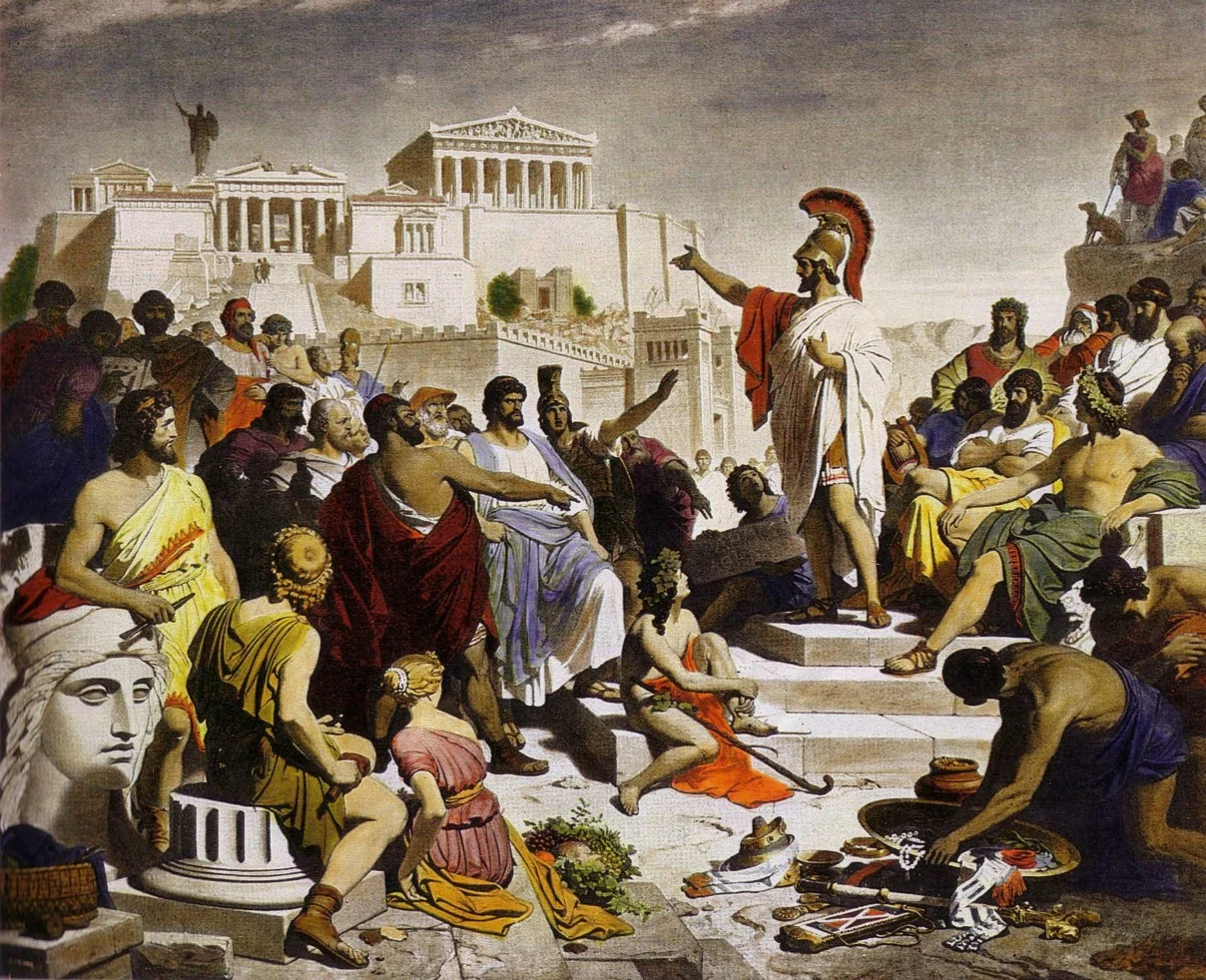
Mid-article image credit: Philipp Foltz, Public domain, via Wikimedia Commons.80