For more than a decade, states across West Africa,1 supported by regional organizations and international partners, have invested heavily in confronting violent militant groups.2 These states have increased resources, expanded military deployments, and developed new partnerships. Yet, with few exceptions, their efforts have not produced lasting gains on the ground. Armed groups affiliated with al-Qaeda and the self-proclaimed Islamic State have continued to spread, adapt, and embed themselves across large parts of the region. Extensive military activity has produced effects that are often limited and short-lived.
The limited effectiveness of counter-militancy operations is not the result of an absence of effort, but of the difficulty of converting military pressure into durable security: the ability to deny militant freedom of movement, protect civilians, keep key routes open, prevent reentry into cleared areas, and restore credible state presence after operations end. Across West Africa, forces often struggle to move quickly, maintain surveillance, reinforce exposed positions, and remain present after operations. Intelligence is collected but not consistently translated into timely action, while fixed deployments are bypassed, isolated, or attacked before support arrives. As a result, military operations frequently disrupt militant activity without preventing its return once pressure recedes.
These constraints are not merely technical. They reflect deeper weaknesses in how forces are organized, trained, led, sustained, and employed. Many militaries remain oriented toward static defense and reactive operations, while violent militant groups exploit mobility, local knowledge, cross-border networks, and tactical adaptation. The result is a persistent gap between activity and outcome: Forces deploy and respond, but often fail to deny movement, prevent reentry into cleared areas, or sustain authority over time. Closing this gap requires more than additional matériel; it requires changes in doctrine, training systems, leadership practices, force design, and the assumptions guiding the use of force.
Operational limitations are reinforced by strategic misalignment and insufficient local capacity for effective civilian security provision once military operations conclude. State and international responses have relied heavily on reactive coercion without sufficiently linking military operations to the broader security environment. Security operations may create temporary disruption, but they rarely produce lasting security unless followed by effective civilian security capacity: sustained presence, protection of civilians, dispute resolution, service delivery, and credible administration. Where populations perceive security forces as weak, distant, or unreliable, militant groups are better able to exploit fear, grievance, and abandonment. Where security forces are seen as capable, protective, and predictable, cooperation improves and militant groups face greater constraints.
These dynamics affect outcomes beyond the region itself. Consolidation of violent militant groups in West Africa threatens commercial routes linking landlocked states to Atlantic ports, disrupts access to strategic commodities, accelerates displacement toward North Africa and Europe, and expands permissive environments for transnational criminal and armed networks. This, in turn, draws in external actors who make the security landscape more crowded and complex: Russia has emerged as a prominent security partner in the central Sahel, while China, Türkiye, and Gulf states have expanded their roles through arms transfers, training, surveillance and intelligence support, investment, and political backing. This diversification has not produced more effective outcomes. Instead, it has often fragmented security cooperation, reinforced short-term coercive responses, and weakened incentives for institutional reform—widening the gap between expanding inputs and limited results on the ground.
More than a decade of counter-militancy efforts have therefore failed to deliver lasting security in West Africa. How has this gap emerged and persisted? Below, I clarify how operational and institutional constraints shape outcomes on the ground, and what changes might be required to convert military capacity into durable security effects. I draw on interviews with commanders, intelligence officials, border-security practitioners, and other security experts across the region,3 including Benin, Côte d’Ivoire, and Nigeria, as well as Ghana, Togo, Senegal, Mauritania, and the central Sahel.
Converting initial military success into sustained security involves four interdependent tasks: transforming presence into persistence, information into action, force into legitimacy, and national effort into regional effect. Together, these mechanisms reduce militant freedom of movement, strengthen the confidence of local populations, and improve the government’s leverage in any future negotiations, reintegration efforts, or local political settlements. Civilian protection therefore emerges as a central mechanism linking operational effectiveness to political authority across all four tasks. For external partners, the implication is clear: Assistance that prioritizes equipment, episodic training, or short-term outputs without strengthening underlying security governance reinforces the very gaps that assistance tries to address.
What Went Wrong
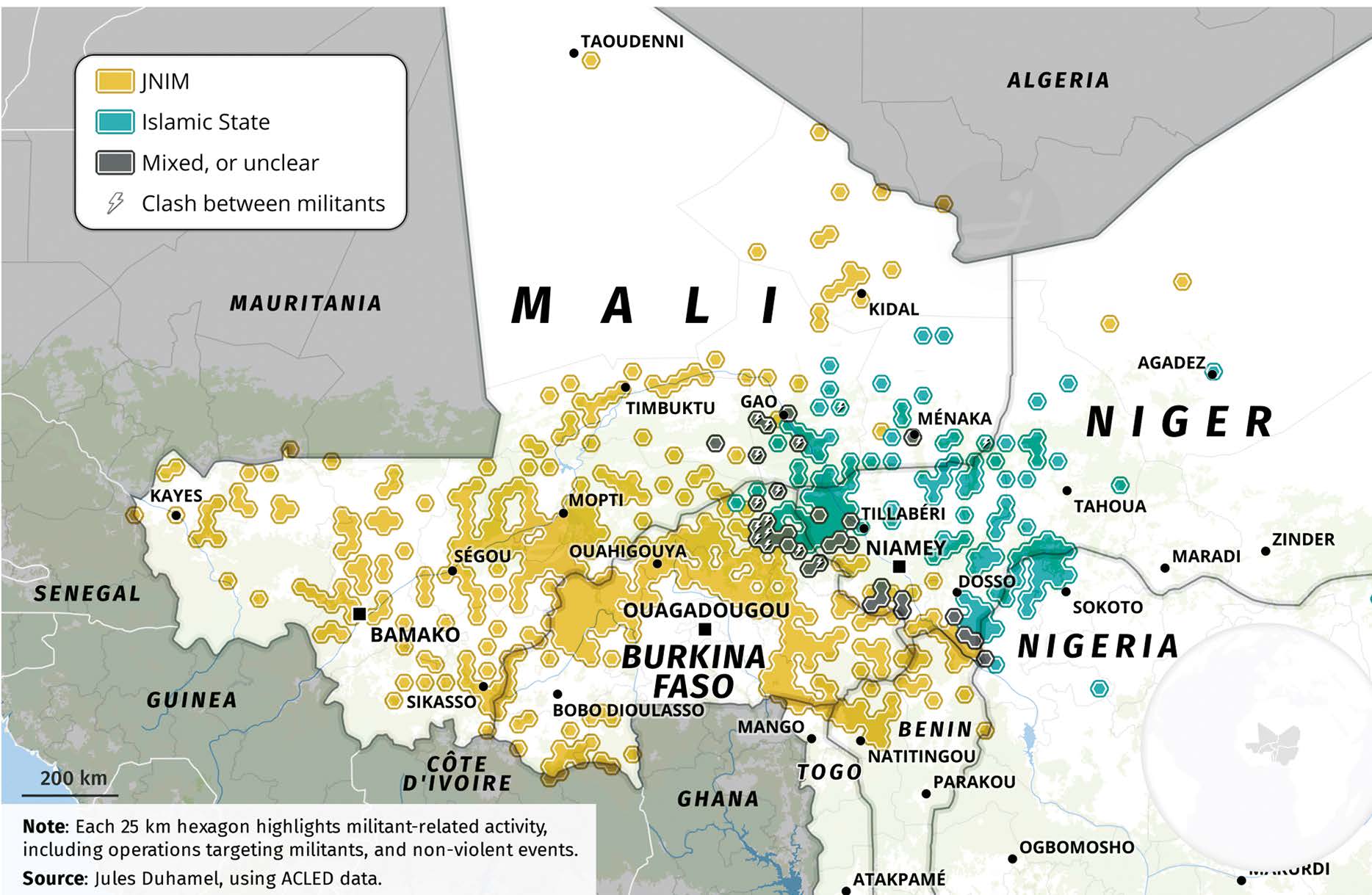
Despite international assistance, militant attacks have intensified and armed groups have expanded their reach across parts of West Africa. Figure 1 illustrates the geographic spread of Jama‘at Nusrat al-Islam wal-Muslimin (JNIM) and Islamic State in the Sahel (IS-Sahel) activity across the central Sahel—the landlocked subregion of West Africa—in 2025. The map shows how militant violence now extends across border zones, transport corridors, and areas where state presence remains uneven.
Figure 1. Central Sahel conflict map 2025—JNIM and Islamic State activity. From Jules Duhamel, https://www.julesduhamel.com/central-sahel-conflict-map-2025-jnim-islamic-state-activity/. Note: Each 25-km hexagon highlights militant-related activity, including operations targeting militants as well as non-violent events.
Three interacting dynamics help explain the intensification of militant violence in West Africa. The first is structural: Weak state capacity, fragmented authority, and unresolved local grievances create permissive environments for militant expansion. The second is operational: Security forces often struggle to combine mobility, intelligence, logistics, and coordination in ways that deny militant freedom of movement and protect civilians. The third is strategic: State and international responses have relied heavily on military force without sufficiently linking operations to civilian protection, effective administration, dispute resolution, and the management of local conflicts over land, grazing, trade, and political authority.
Structural Deficits
Militant expansion across the Sahel and West Africa is rooted in uneven state presence, contested local authority, and unresolved disputes over protection, livelihoods, and political inclusion.4 Limited administrative reach, uneven security provision, and scarce public services create openings for armed groups to recruit, intimidate local authorities, tax movement and commerce, arbitrate disputes, and present themselves as alternative providers of order, particularly in rural and border areas. Where these openings intersect with cross-border mobility and competing centers of influence, they create permissive conditions for militant penetration and entrenchment.5
These openings are reinforced by a political economy in which insecurity can serve the interests of some local power-holders. In affected areas, state officials, local authorities, business elites, armed intermediaries, and community leaders compete over access to livestock markets, artisanal mining sites, transport routes, customs posts, land, and protection arrangements. In such settings, instability is not only a symptom of state weakness—it also becomes a means of extraction, influence, and control. Public resources are diverted, accountability weakens, and institutions responsible for protection and service delivery lose credibility. Armed groups exploit this erosion by inserting themselves into disputes over security, justice, access, and livelihoods.6
These political economy dynamics also shape the security sector. Armed forces and police institutions operate within the same systems of patronage, bargaining, and weak oversight that affect civilian administration. Nigeria illustrates the institutional version of this problem. Formal civilian control has coexisted with politicized personnel decisions, fragmented authority, and heavy reliance on the military for domestic security missions. Appointment practices have reflected political bargaining as well as professional criteria, thus weakening professional incentives, reducing accountability, and blurring the line between civilian oversight and personalized political control in the campaign against Boko Haram.7
The operational consequence is direct. When appointments, command assignments, and resources are shaped by political loyalty, factional management, or regime-security concerns, armed forces can remain active without producing durable security.8 Commanders are not always rewarded for battlefield performance; capable officers can be sidelined; units can be deployed according to political priorities rather than operational need; and poor performance becomes harder to sanction. The result is a force that deploys, patrols, and responds to attacks, but struggles to sustain pressure on mobile armed groups, protect civilians after operations, keep routes open, and restore credible state presence in contested areas.
Militant groups have taken root within this environment by embedding themselves in local conflicts and social dynamics.9 Many of these armed groups, now associated with JNIM, Islamic State in West Africa Province (ISWAP), and IS-Sahel, did not emerge as fully formed transnational organizations, but evolved along distinct pathways—rooted in social and political grievances,10 livelihood insecurity,11 and secessionist conflict12—before later connecting to broader transnational militant networks. Over time, these trajectories converged as militant actors tied deeply localized conflicts over protection, authority, justice, land, and livelihoods to the transnational ideological projects of al-Qaeda central and Islamic State central.
Geography amplifies the risks that weak governance and local grievances generate. Long distances, porous borders, and difficult terrain limit state oversight. Violent militant groups exploit these conditions by moving between areas of weak control, circulating resources, and applying pressure without needing to hold territory permanently. Their advantage lies less in fixed control than in mobility and the ability to exploit gaps in state presence.13
These conditions also shape how local populations interact with militant groups.14 Cooperation is often driven less by ideology15 than by practical concerns like security, access to resources, and economic survival.16 Herders, traders, miners, and transporters may engage with armed groups to maintain livelihoods in uncertain environments,17 thereby allowing militant groups to insert themselves into everyday economic and social relations.
Taken together, these structural deficits lower barriers to militant entry, facilitate local entrenchment, and make it harder for the state to reassert authority once armed groups have embedded themselves in local systems of protection, coercion, and exchange.
Operational Gaps
If structural deficits explain the environment in which militant groups become embedded, operational gaps explain why security forces struggle to convert deployments into consistent territorial control. Across the region, the central challenge is the integration of mobility, intelligence, coordination, logistics, and command. Forces that arrive late, move predictably, reinforce slowly, or leave after short operations give mobile adversaries room to withdraw, regroup, and return.18
“Militant mobility and operational endurance pose significant challenges.”
Militant mobility and operational endurance pose significant challenges. Rapid-deployment units remain too limited to cover the region’s vast distances, leaving large rural and border areas unevenly secured. In Mali, militants have been able to pressure major transport corridors and supply routes, stretching the army across central, northern, western, and southern axes and limiting its ability to concentrate forces where territorial control is most consequential: the routes linking Bamako to Senegal through Kayes, to Côte d’Ivoire through Sikasso, and to Guinea through Koulikoro, as well as the central Mali corridors around Ségou, San, Mopti, and the Niger River. The broader operational problem is not simply distance, but dispersion. Militant pressure forces governments to defend many exposed points at once, while mobile fighters retain the initiative between them.
Limited or uneven infrastructure development exacerbates the challenge of distance. Government forces are often confined to a limited road network and move at a relatively slow and predictable pace, while militants maneuver more fluidly through secondary tracks, scrubland, wooded areas, and seasonal riverbeds.19 Weak infrastructure and difficult terrain constrain military vehicles, whereas fighters on motorbikes20 can bypass fixed positions, avoid chokepoints, and exploit gaps in state coverage. Under these conditions, even substantial deployments may struggle to reopen corridors or push militants back in lasting ways.21
Benin and Côte d’Ivoire show how mobility constraints translate into discontinuous territorial presence. In Benin, one military expert described the core weakness as the intervals between state positions: Security forces hold specific points, while armed groups move through the spaces between them to observe, strike, and withdraw.22 An Ivorian military commander made a related observation, noting that even their denser defensive posture remains constrained by poor roads, difficult tracks, and the challenge of sustaining patrols near the border.23 Across these contexts, the central issue is not the size of deployments, but whether forces can reposition, reinforce, and sustain presence quickly enough to deny militants freedom of movement.
Limitations in mobility are compounded by weaknesses in surveillance and response systems. Drones and light aircraft can improve visibility, but their value depends on whether they are embedded in a wider chain linking detection, analysis, decision, and intervention. A Beninese official emphasized that surveillance platforms without a functioning exploitation chain risk becoming little more than cameras, particularly when armed groups adapt faster than states can develop detection and response capacity.24 An Ivorian officer made a parallel point, stressing that even improved surveillance remains limited if operator training, force integration, and ground mobility do not allow information to be converted into timely action.25 These deficiencies have been especially consequential in Mali, where long distances, exposed borders, and shifting lines of pressure make persistent surveillance and rapid support particularly valuable.26 Across the region, the challenge is therefore not simply acquiring more platforms, but ensuring that surveillance, mobility, logistics, and command systems operate as a coherent whole. Where that integration is weak, state responses remain more reactive than anticipatory.27
These operational gaps are exacerbated by force-posture choices. As states concentrate troops and matériel in more defensible positions, they reduce vulnerability at fixed sites, but lose influence over the terrain between them. Tactical survivability does not produce territorial control; a posture centered on holding strongpoints may amount to strategic contraction if it grants militants freedom of movement. This dilemma is visible across the region, from Benin’s exposed northern border to Mali’s difficulty securing roads and supply routes through which violent militant groups isolate communities and apply pressure without seizing major urban centers outright.
The Nigerian case, in the Lake Chad basin, illustrates this problem. Difficult terrain, insecure routes, island and marshland sanctuaries, and limited riverine and amphibious capability leave remote positions exposed and hard to reinforce.28 This vulnerability was evident on January 24, 2025, when ISWAP fighters attacked the Nigerian army position at Malam Fatori associated with the 149th Battalion, killing at least twenty soldiers, including the commander, after hours of fighting. The episode underscored a broader doctrinal problem: Frontline positions are often expected to absorb attacks until reinforcements arrive, yet chronic shortages of mobility, air support, and operational flexibility mean that assistance frequently comes too late.29 Each lost outpost transfers weapons, momentum, and psychological advantage to militants, while eroding troop morale and public confidence. Static defense without rapid reinforcement capacity can thus turn tactical positions into strategic liabilities.
Mobility gaps are compounded by intelligence gaps. The problem is not only information scarcity, but conversion failure: Relevant fragments often exist across police, military intelligence, customs, immigration, financial intelligence units, local communities, and regional partners, but remain institutionally disconnected. The weakest point is often the middle of the intelligence cycle—processing, validation, triage, interpretation, prioritization, and dissemination—where raw reporting either becomes usable intelligence or remains inert.30 In rural and border areas, weak community trust, language gaps, and poor protection for informants reduce early warning. Inside government, mandate protection, overclassification, unclear sharing rules, and institutional mistrust slow the movement of information to those positioned to act.31
Ghana, Côte d’Ivoire, and Benin illustrate different parts of this conversion problem. A senior official at Ghana’s National Counter Terrorism Fusion Center noted that coordination often breaks down as agencies protect mandates, compete for credit, and resist sharing information.32 Côte d’Ivoire faced a similar problem before the creation of its counterterrorism fusion structure in August 2021, when bureaucracy and institutional rivalry slowed the movement of information into operational channels. In Benin, two intelligence officials described the tactical version of the same gap: Surveillance platforms and local reporting identify movement or risk, but without an integrated chain linking analysis, authorization, mobility, and follow-on presence, information does not translate into timely interdiction or sustained state presence.33
Other human and institutional factors widen these gaps. Rapid recruitment into counter-militant forces has often outpaced training and professionalization, leaving many soldiers without the discipline or technical competence to use modern equipment effectively.34 Interviews with officers in Benin, Côte d’Ivoire, and Nigeria suggest major challenges in terms of skill retention and institutionalization across rotations and changing operational environments.35 Without that, specialized assets are frequently underused, mismanaged, or captured by militants.36 Weak maintenance systems, poor troop welfare, insufficient rotation, and uneven combat exposure reduce effectiveness over time. Force expansion and matériel acquisition do not translate into operational effectiveness when training, sustainment, and organizational adaptation lag behind.
Recurring misallocation of military force also contributes to the challenges of territorial control. Because police and civilian security institutions often lack the reach, equipment, and personnel to manage routine protection, armed forces are pulled into substitute-policing roles, limiting their ability to focus on missions that require military capabilities. Nigeria illustrates the cost: Soldiers routinely perform roadblock, installation-protection, convoy-escort, and internal-security duties that consume the personnel, vehicles, fuel, and command attention needed for mobile patrols, pursuit operations, rapid reinforcement, intelligence-led raids, and disruption of militant logistics.37 The result is an overstretched force that remains visibly active but less able to deny militant freedom of movement, dismantle networks, or consolidate gains after operations. Areas cleared by soldiers remain vulnerable when police, gendarmerie, intelligence services, and local administration are not able to provide follow-on security, monitoring, and public authority.
Logistics and coordination underlie almost all of these operational constraints. Fuel, maintenance, resupply, communications, and medical support are often treated as secondary functions, but shape operational choices throughout. Ivorian units that cannot rely on secure resupply or functioning equipment become more cautious in their movements and less willing to remain in exposed positions.38 A Beninese expert on border security made a similar point, emphasizing that a border is lost when state presence becomes discontinuous; gaps in logistics, coordination, and trust are precisely the spaces in that armed groups settle.39 Mali’s armed forces underscore the same lesson: Acquisition of additional equipment, including air assets, has not translated into decisive advantage.40
Finally, problems of cross-border coordination reduce West African forces’ ability to exercise territorial control as well.41 Benin illustrates the problem along its northern border with Burkina Faso and Niger, particularly around the W-Arly-Pendjari complex. Beninese forces face JNIM-linked networks that use parklands, forested corridors, and border communities to move, recruit, and resupply beyond Benin’s reach. Cooperation has become more difficult since the coup-led governments in Mali, Burkina Faso, and Niger withdrew from the Economic Community of West African States (ECOWAS), weakening regional channels for intelligence exchange, cross-border pursuit, and joint planning. Without reliable counterpart arrangements across the border, Benin can patrol, reinforce, and hold positions inside its own territory, but it cannot deny militants sanctuary, logistics, and retreat routes outside its jurisdiction.42 The result is strategic depth for JNIM-linked networks and episodic pressure rather than sustained disruption.
Strategic Misalignment in Countering Violent Militant Groups
Structural deficits and operational weaknesses are compounded by strategic misalignment among both state and international actors. In Mali, Burkina Faso, Niger, and Nigeria, government responses to militant groups have repeatedly prioritized raids, strikes, emergency rule, auxiliary forces, and movement restrictions over sustained civilian protection,43 dispute resolution, and the restoration of public authority. Mali, Burkina Faso, and Niger have relied heavily on emergency measures, auxiliary forces, and restrictions on movement of people in response to rural insecurity. In northeastern Nigeria, repeated military deployments, checkpoints, convoy escorts, and cordon-and-search practices have often been substituted for durable policing, justice, and local administration.
This imbalance also appears in restrictions imposed on local economies, including curfews, market closures, limits on herder movement, and bans on local trade. Such measures are intended to disrupt militant logistics, but they often function as broad punitive tools that damage livelihoods,44 intensify resentment, and push some communities toward accommodation with armed groups perceived as more predictable or responsive to local needs.45
External partners have deepened this imbalance by approaching the problem primarily as a fight against violent militant networks rather than as a broader breakdown of local security and political authority. France’s Operation Barkhane, launched in Mali in 2014 and wound down in 2022 as relations with Malian military authorities deteriorated, reflected this limitation.46 The operation generated pressure on al-Qaeda– and Islamic State–linked groups, and helped remove senior militant figures, but it was focused on a narrow counter-militancy model: locating, pursuing, and striking designated targets.47
That model became increasingly mismatched to the conflict that was taking shape on the ground.48 Militant violence had become intertwined with communal retaliation, land and resource disputes, banditry, predatory local militias, and abuses by state-aligned forces—dynamics that targeted strikes were not designed to resolve. As insecurity spread from northern Mali into central Mali, Burkina Faso, and Niger, civilians faced threats not only from militant groups but also from criminal actors, armed community factions, and state-aligned forces. Communities saw national and foreign forces confront some militant actors while leaving other sources of violence largely unaddressed. By prioritizing the elimination of militant leaders over civilian protection, local dispute management, restraint of abusive auxiliaries, and restoration of credible administration, Barkhane produced tactical disruption without reversing the wider erosion of security and authority.49
Barkhane’s limitation was not simply that it relied too heavily on force; it was that the mission’s employment of force was designed for a different conflict than the one actually unfolding.50 Tactical gains did not produce durable stability because fear, grievance, impunity, communal insecurity, and weak governance continued to feed instability.
Military and political objectives were also poorly aligned. State and international actors consistently invoked legitimacy, service delivery, and the restoration of public authority, yet rarely integrated these objectives into operational strategy. While security frameworks formally linked military action to development and governance, civilian components remained too weakly institutionalized, unevenly financed, and politically subordinate to military operations to be able to take over effectively where needed. In practice, force remained the organizing principle, with governance as a long-term aspiration rather than an immediate strategic requirement.51
Such governance issues spanned both the security sector and the region’s political economy. Efforts to extend administration, deliver services, or rebuild trust have been frequently undermined by elite predation, corruption, and weak oversight, including within the security sector itself.52 At the same time, geopolitical competition expanded the range of external partners available to Sahelian governments without improving strategic coherence. Since the coups in Mali, Burkina Faso, and Niger, military-led governments have downgraded or expelled several Western and multilateral security partners while seeking alternative sources of military support, diplomatic backing, and regime protection.
Russia has been the most active external player, combining military assistance, information campaigns, and anti-colonial messaging with a willingness to engage on the terms desired by West African regimes and leaders.53 China plays a less direct but increasingly important role in this realignment.54 Its engagement combines affordable military equipment, training and maintenance support, police cooperation, surveillance technology, and broader economic and diplomatic ties. Chinese defense firms have become regular suppliers of armored vehicles and related systems in West Africa,55 while public-security cooperation has expanded through police partnerships, law-enforcement training, equipment transfers, and surveillance tools.56 Türkiye has engaged mainly through defense exports, especially drones and related training, while Gulf states have increased influence through finance, infrastructure, mediation, religious outreach, and selective security engagement.57
“Even where actors recognize that military force alone will not produce durable stability, they have failed to implement the institutional reforms, accountability measures, and sustained civilian investment required to make alternative strategies credible.”
This broader menu of partnerships has given West African governments greater flexibility, but has not produced more effective counter-militancy capabilities.58 More often, it has weakened incentives for accountability and reform, and further fragmented the security landscape. The result is a persistent gap between diagnosis and execution: Even where actors recognize that military force alone will not produce durable stability, they have failed to implement the institutional reforms, accountability measures, and sustained civilian investment required to make alternative strategies credible.
When force is not paired with consistent civilian protection, accountable administration, and visible improvements in governance, communities increasingly perceive the state and its partners as distant, coercive, and unreliable. Violent militant groups exploit these perceptions by presenting themselves as more dependable providers of order, arbitration, or protection in areas where official authority is weak or absent. Strategic misalignment therefore does not simply fail to halt militant expansion—it also widens the social and political space in which such groups consolidate.
West African governments, external partners, and practitioners have long recognized that battlefield pressure alone cannot secure lasting stability, but incentives and institutional habits continue to shape their strategic choices.59 Military action produces visible outputs, is easier to justify politically, and aligns with institutions oriented toward hierarchy, force protection, and short-term crisis management. Measures such as civilian protection, accountable governance, and local political engagement are harder to organize, slower to show results, and less immediately legible as success. The cumulative effect is one of diminishing returns: Coercion continues, legitimacy declines, and the erosion of trust creates the very conditions in which violent militant groups expand and build competing systems of authority.60
The Structural Foundations of Militant Resilience
In West Africa, JNIM—the region’s most adaptive transnational militant actor— and the comparatively less expansive but increasingly entrenched IS-Sahel have consolidated themselves where governance is weakest, security is fragmented, and state authority is contested. Within these vacuums, militant endurance rests on four mutually reinforcing pillars: revolutionary belief, revolutionary warfare, organizational structure, and transnational reach. Together, these pillars help explain not only how militant groups persist under pressure, but also why state efforts often struggle to translate military activity into sustained authority.
Revolutionary Belief
Revolutionary belief forms one foundation of militant resilience, shaping motivation, discipline, and the justification of violence.61 In West Africa, JNIM and its constituent factions, and IS-Sahel in a different register, frame their struggle as an effort to replace corrupt, abusive, or illegitimate state authority with a religiously based order that promises protection, justice, and moral discipline.62 This ideological claim gains force when it attaches to local grievances over state abuse, elite predation, land access, pastoralist marginalization, and exclusion from local authority.
Katiba Macina, a central Mali constituent of JNIM, illustrates the point. Under Amadou Kouffa, the group linked religious claims about justice and Islamic order to Fulani pastoralist grievances, disputes over land and status, and resentment toward state officials, local elites, and armed self-defense groups. Belief therefore becomes operational—it helps define enemies, justify attacks on state representatives and local authority figures, discipline supporters, and present militant coercion as a form of justice rather than simply violence. In fragmented sociopolitical environments, such claims allow militant groups to project influence beyond their material capabilities by making violence appear purposeful, morally authorized, and connected to a broader political-religious project.
Revolutionary Warfare
Revolutionary warfare provides the strategic logic guiding the militant campaigns of political subversion, violence, and territorial influence.63 Like other insurgent models,64 revolutionary warfare blends irregular attacks with ideological and administrative action to build authority from below, gradually shifting governance away from the state. In peripheral areas, militant groups displace state presence and establish parallel systems that tax, adjudicate disputes, regulate markets, and enforce order. This governance is sustained through a calibrated mix of coercion, protection, and limited service provision. As their influence expands, militant groups shift from hit-and-run attacks to more coordinated assaults on towns65 and security installations, financing operations through resource extraction from populations under their control. Their success depends less on battlefield dominance than on the ability to regulate violence—deciding when to escalate, when to restrain, and how to direct force toward political ends.66
JNIM’s use of localized blockades illustrates this approach. Rather than occupying territory outright, the group uses a classic guerrilla technique: isolating communities by restricting access routes, disrupting movement, and applying targeted force to induce shortages and pressure populations.67 As conditions deteriorate and state protection remains absent or unpredictable, communities begin to accept negotiated arrangements under JNIM’s terms in exchange for relief.68 Farabougou, in the Niono Cercle in Mali’s Ségou region, offers a clear example. After months under blockade beginning in October 2020, local representatives accepted a temporary ceasefire in March 2021 that reopened access routes, allowed displaced residents to return, and permitted militant preachers to enter surrounding villages.69 Similar local arrangements have often been negotiated under pressure and have included commitments such as the payment of an Islamic alms tax (zakat), dress restrictions, and acceptance of militant movement or preaching. This strategy allows JNIM to exert control without permanent occupation or overextension; relief becomes conditional on compliance, enabling militants to maintain pressure while conserving resources.
IS-Sahel has pursued a comparable approach, though with more limited success. Internal fragmentation, sustained military pressure, and competition with JNIM have constrained its ability to consolidate control beyond core areas.70
Organizational Structure
Translating ideology and strategy into sustained control depends on organization and leadership. In irregular warfare, effectiveness is shaped less by material superiority than by the ability to operate adaptively at the local level. Militant groups gain advantage by developing leadership within small units capable of coordinating action, maintaining discipline, and adapting to changing conditions.71 In West Africa, JNIM combines centralized strategic direction with delegated authority to regional commanders and local battalions (katiba).72 This structure allows for coherence at the strategic level while preserving flexibility across diverse environments.73 It has enabled JNIM to absorb setbacks, avoid fragmentation, and sustain pressure across zones.74
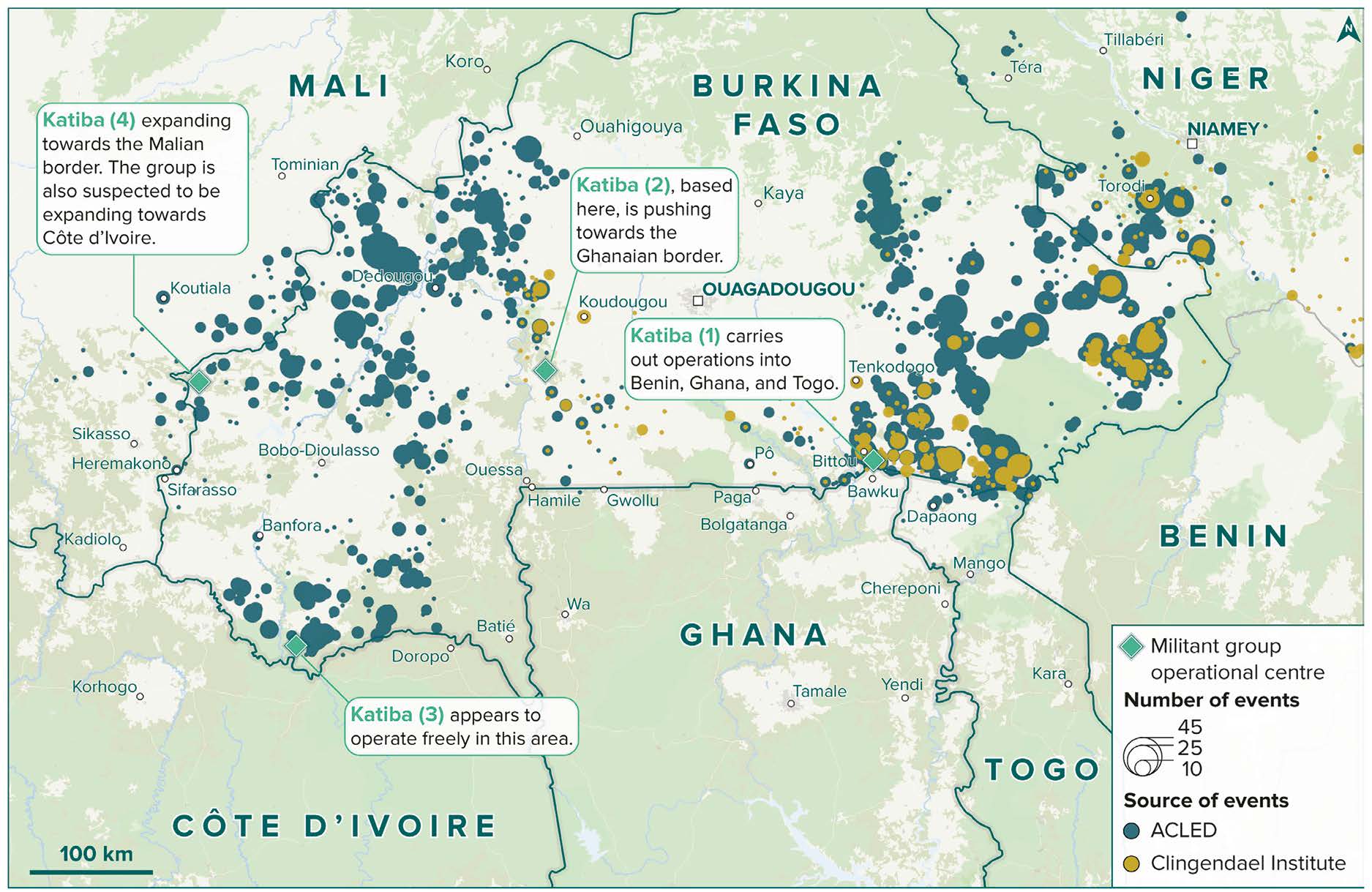
As figure 2 shows, JNIM-linked activity is distributed across multiple geographically rooted katibas and subordinate cells, illustrating how the group can expand across diverse border zones without relying on a single fixed territorial core.
Figure 2. Militant activity in the borderlands of coastal West Africa (2022–24). This map is reproduced from Kars de Bruijne and Aneliese Bernard, “Life on the Line: Summary Report,” Cross-Border Conflict Evidence, Policy and Trends (attributed to XCEPT, ACLED, Clingendael Institute), August 2025. In the map key, ACLED refers to the Armed Conflict Location and Event Data Project, an event-based dataset that tracks reported incidents of political violence and protest. The Clingendael Institute, or Netherlands Institute of International Relations, is a Dutch research institute that produces analysis on conflict, security, governance, and international affairs. The report’s mapping of JNIM activity across the coastal borderlands points to a dispersed organizational structure built around multiple geographically rooted katibas and subordinate cells, consistent with the paper’s characterization of JNIM as a decentralized but connected movement.
Equally important, JNIM’s structure supports the gradual assumption of governance functions. In areas where state authority is weak, governance is negotiated among local actors. JNIM inserts itself by co-opting some of these actors, intimidating or eliminating others, and reshaping local authority structures to its advantage. It assumes quasi-state roles—resolving disputes, collecting taxes, and organizing security—within a system grounded in coercion, protection, and compliance.75
JNIM’s authority does not rest only on the charisma of individual commanders such as Iyad ag Ghali or Amadou Kouffa. It is also reproduced through more durable organizational practices: delegated authority to local katiba, enforcement of internal discipline, religious adjudication, taxation, punishment of collaborators, and messaging that links local grievances to al-Qaeda’s broader political project.76 That project rejects existing secular states and foreign-backed political orders and seeks to replace them with a militant political order grounded in the movement’s own interpretation of religious authority and armed governance. These practices give JNIM a degree of continuity across different local environments even when commanders are killed, displaced, or forced to operate under pressure. As a result, JNIM operates as a hybrid armed actor seeking not only to regulate violence, but also to shape economic life, and embed itself into political life.77
IS-Sahel has adopted elements of a similar model but with more uneven outcomes. Following leadership changes in 2021, it reorganized along zone-based lines and sought to reflect local ethnic dynamics. It has also attempted to impose governance structures, including religious regulation and market control, enforced through a combination of coercion and messaging. IS-Sahel’s resilience draws on diversified funding sources—kidnapping, extortion, cattle theft, mining, and smuggling—alongside continued links to transnational Islamic State networks.78 However, internal rivalries and sustained military pressure have limited IS-Sahel’s ability to embed militant governance beyond core strongholds.79
Transnational Reach
Transnational reach provides militant networks with strategic depth, enabling them to move fighters, resources, and ideas across porous borders when doing so confers an advantage.80 Weakly regulated borders between Mali, Burkina Faso, and Niger—and increasingly coastal West African states—serve as corridors for arms, fuel, gold, and other illicit commodities. These flows are reinforced by long-standing smuggling networks and kinship-based mobility. Under pressure, militant units can disperse across borders and reconstitute, limiting the effectiveness of state responses that remain confined within national boundaries. Connections to broader al-Qaeda and Islamic State networks further enhance these units’ capacity by providing ideological framing, organizational branding, tactical learning, propaganda channels, and access to wider militant narratives. These links help local militant actors present local disputes as part of a wider political-religious struggle, signal prestige within militant circles, circulate tactics and justifications across theaters, and sustain a sense of movement continuity even when individual units come under pressure.
Together, these four pillars enable militant groups to absorb setbacks and transform localized grievances into durable, cross-border insurgencies. These pillars generate the self-reinforcing logic of expansion shown in figure 3: weaken state presence → regulate civilian life → extract resources → finance operations → extend pressure outward.
Figure 3. Self-reinforcing model of militant expansion. Figure by author.
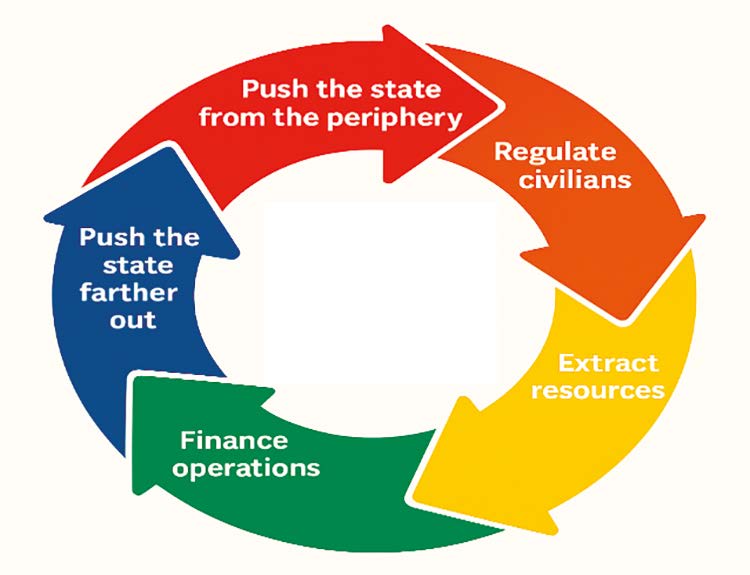
This process, however, is neither linear nor uniform. Where the state cannot be fully displaced, militant groups may accommodate selected officials, tolerate limited service provision, or otherwise adapt governance strategies to local conditions. At the core of this model, however, lies the fusion of violence with civilian control. Violence offers militant groups entry points into governance, and governance sustains further expansion of these groups through resource extraction, recruitment, and renewed operations. Over time, force and administration merge into a system of parallel authority sustained not by decisive victory but by the gradual normalization of militant rule.
The Operational Playbook of Militant Expansion
The four pillars of militant resilience explain how transnational militant movements endure. Once embedded in areas of weak governance, groups such as JNIM and IS-Sahel convert resilience into control through a phased and adaptive cycle—infiltration, contestation, consolidation, and projection—that is shaped by ideology, organizational design, and cross-border mobility. This sequence is not rigid, nor does it produce uniform territorial control. Rather, it captures a recurring pattern through which militants expand their presence, weaken state authority, and build varying degrees of coercive and political influence across West Africa.
Phase 1—Infiltration and Embedding
Militant entry rarely begins with open confrontation. It usually starts with quiet, probing: movement through border zones, forests, markets, grazing routes, and transport corridors; identification of local intermediaries; and the creation of small logistical networks. At this stage, militants are testing the terrain rather than openly contesting it. They map supply chains, assess state response times, identify vulnerable communities, and determine which actors can be recruited, paid, intimidated, or used for concealment.81
This pattern appears across several border zones. In northern Côte d’Ivoire, armed men were reported in forests, border villages, and areas around Comoé National Park before attacks became more visible in 2020–21.82 In Benin, militants similarly used preaching, trade, and movement through border communities to establish contacts and logistics before escalating violence.83 In western Mali, JNIM followed a comparable approach, probing routes and cultivating facilitators before applying more direct pressure on communities and security forces.84 By the time attacks became visible in these areas, militants had often already identified intermediaries, mapped supply chains, and inserted themselves into local economic and social systems. This early embedding made later recruitment, taxation, and territorial entrenchment easier.
Phase 2—Contestation and Coercion
After militants have tested routes, built contacts, and established small logistical footholds, they begin to contest state authority more openly. Violence in this phase is selective and calibrated. Militants strike security posts, patrols, convoys, and border personnel; introduce improvised explosive devices (IEDs); and pressure local figures suspected of cooperating with the state. The purpose is to make state protection appear uncertain, raise the cost of collaboration, and show communities that militants can punish opposition even without holding territory.85
Côte d’Ivoire shows this shift clearly. After earlier signs of militant movement in northern forests and border areas, the June 2020 attack at Kafolo marked a more visible turn toward confrontation. In 2020 and 2021, violence spread across parts of Bounkani and Tchologo, targeting security-force positions, customs and military posts, and convoys.86 Militants also moved through border villages and areas around Comoé National Park, where contact with civilians included religious messaging, intimidation, threats, and occasional abductions. Their presence remained uneven rather than permanent, but it was sufficient to unsettle local authority and force communities to reassess the risks of cooperating with the state.
Benin followed a similar trajectory along its northern frontier. After militants had used cross-border movement, preaching, trade, and local contacts to gain familiarity with the terrain, attacks increased around the W-Arly-Pendjari complex and nearby border zones. Security forces, park personnel, and state-linked actors became targets, while the use of mines and IEDs made movement more dangerous and reduced the state’s ability to reassure isolated communities.
In western Mali, JNIM’s low-profile penetration of transport corridors and local economies was followed by more direct pressure on communities, roads, and security positions. Threats, intimidation, and attacks made state association more costly, while militant enforcement became more predictable in areas where state presence was intermittent.
This phase does not yet amount to consolidated rule. It is a coercive transition. Militants use violence to weaken public confidence in state authority, isolate local opponents, and prepare the conditions for later recruitment, taxation, dispute resolution, and more durable forms of control.87
Phase 3—Consolidation and Rule
Consolidation begins when militant presence becomes routine enough to shape local behavior. At this stage, armed groups are no longer only passing through an area, building contacts, or attacking state targets. They begin influencing who moves, who trades, who pays, who cooperates with local authorities, and who faces punishment.88
The depth of this control varies sharply. Côte d’Ivoire shows an interrupted trajectory. After armed groups probed northern forests and border villages and escalated attacks in 2020–21, the Ivorian state pushed them back before they established durable systems of local rule. Militant activity remained closer to movement, refuge, and logistical support than to open administration.
Benin shows a more partial and contested pattern. In northern border areas, militant-linked actors inserted themselves into local economies around Kourou-Koualou and nearby border zones.89 Fuel traffickers paid for protection. Hunters supplied food and other goods in exchange for permission to operate. Other intermediaries used contested spaces for movement and profit. These arrangements did not create a full militant administration, but they gave armed actors influence over who could move, trade, hunt, and operate in insecure border spaces.
Mali shows the deeper version of this phase. Where JNIM has sustained pressure over time, civilians encounter militant authority through taxation,90 movement controls, religious adjudication, warnings to local leaders, and market regulation. Livestock owners, traders, transporters, farmers, and village authorities face demands for payment or compliance. Teachers, preachers, chiefs, and customary authorities operate under scrutiny, threat, or replacement. Disputes that once moved through state courts or customary systems are redirected toward militant-linked adjudication.
This authority becomes consequential through routine enforcement: Taxes are collected, movement is regulated, disputes are settled, and punishment becomes predictable. Over time, militant presence becomes less episodic and begins to function as an alternative form of local authority.
Phase 4—Projection and Expansion
Once militants consolidate influence in peripheral areas, they project force toward strategic corridors, supply routes, and population centers. The objective is not always to hold these spaces. It is often to stretch state forces, disrupt logistics, damage public confidence, and show that the political center is vulnerable.
Mali illustrates this phase most clearly. JNIM’s July 2022 attack on the Kati military base, near Bamako, signaled that the group could strike sites close to the state’s military core. The September 2024 attacks on Bamako’s gendarmerie training center and Modibo Keita International Airport reinforced the same message: Even heavily secured spaces could be penetrated.91 The April 2026 offensive marked an even sharper escalation. JNIM and the Front de libération de l’Azawad (FLA)92 launched coordinated attacks across widely separated locations, including Bamako, Kati, Gao, Kidal, Mopti, and Sévaré.93 The killing of Defense Minister Sadio Camara and the recapture of Kidal, the northern regional capital near the Algerian border, showed that the offensive was not merely tactical. It challenged the junta’s claim to have restored sovereignty and territorial control.
This phase shows JNIM’s ability to concentrate effects rather than forces. By striking several distant locations in a compressed period, militants stretched Malian and Russian-backed responses, disrupted defensive coordination, and exposed gaps in intelligence, mobility, and command. Cooperation with the FLA also revealed the movement’s pragmatism. JNIM did not need ideological convergence with Tuareg separatists to benefit from their territorial familiarity, northern networks, and political positioning. The result was a temporary but powerful alignment between actors with different end goals and a shared interest in weakening Bamako.94
“Militant networks often adapt faster than the states confronting them.”
Phase 4 therefore marks a shift from local pressure to national disruption. JNIM does not need to hold Bamako, Kati, airports, or major garrison towns to gain strategic effect. By striking them, it exposes intelligence gaps, stretches security responses, challenges official claims of control, and signals that insecurity has moved from the periphery into the state’s core.
Learning and Adaptation
Militant groups display a recognizable playbook: Embed within local systems, weaken state presence, establish limited governance, and project power outward through disruption and targeted attacks. This model evolves through experimentation and adaptation.
Militant networks often adapt faster than the states confronting them. They refine tactics, diversify funding, and integrate low-cost technologies to enhance coordination and effectiveness. Once reliant primarily on small arms and guerrilla tactics, these groups now incorporate commercial drones, encrypted communications, and digital propaganda into their operations.
Drone use illustrates this adaptation.95 Commercial drones that initially served reconnaissance and propaganda functions have increasingly been adapted for offensive operations.96 In May 2025, IS-Sahel carried out drone strikes in Eknewan, Niger, killing forty-one soldiers,97 followed by a JNIM attack on Boulikessi in Mali a week later that reportedly left over a hundred troops dead.98
The technological evolution of militant warfare is matched by the increasingly sophisticated use of digital media. In Mali, JNIM uses online communication to frame battlefield events before the state can fully control the narrative. After major engagements, the group releases claims, edited visuals, and images of weapons, vehicles, and positions captured or destroyed during fighting. These materials circulate through encrypted channels and social-media platforms, including Telegram, WhatsApp, Facebook, and X, and are sometimes tailored linguistically for local audiences.99 The effect is to extend the life of an attack beyond the moment of combat. A raid becomes a demonstration of reach; seized matériel becomes evidence of state vulnerability; and battlefield imagery becomes a means of intimidation, recruitment, and psychological pressure. The Malian army has responded with its own official statements, casualty figures, battlefield images, and reassurance campaigns, creating a parallel struggle over credibility and control.100 For JNIM, media visibility is therefore operationally useful—it turns tactical violence into a wider political signal and allows the group to contest the state’s claim to authority even when it does not hold the ground it attacks.
Vulnerabilities of Transnational Militant Networks
The same characteristics that make transnational militant movements resilient also generate inherent vulnerabilities. Networks aligned with al-Qaeda or IS are intensely ideological, transnational, and expansionist—traits that sustain endurance but, over time, can strain cohesion, generate internal tensions, and provoke counter-mobilization. These vulnerabilities create openings for states, but only when military pressure is targeted, sustained, and followed by civilian protection, restored administration, and credible local governance.
Ideological commitment provides purpose, cohesion, and a basis for recruitment. Yet when doctrine hardens into absolutism, it narrows appeal, encourages excessive coercion, and creates openings for factional rupture. The Lake Chad Basin illustrates this vulnerability. Under Abubakar Shekau, Jama’atu Ahlis Sunnah Lidda’awati wal-Jihad, commonly known as Boko Haram and referred to here as JAS, embraced a more expansive logic of violence, treating broad categories of civilians, Muslim communities, local authorities, and rival militants as legitimate targets. That approach sustained fear and discipline among loyalists, but it also generated dissent over command style, civilian targeting, and the conduct of war. This dissent contributed to a factional rupture that produced ISWAP, which challenged JAS not only militarily but also through a competing model of insurgent rule.101
Coercive governance deepens these pressures. Armed groups need revenue, supplies, intelligence, and compliance, but the practices used to obtain them often strain the relationships on which durable influence depends. Taxation, forced recruitment, livestock seizure, kidnapping, road control, and interference in farming, fishing, mining, and trade routes sustain operations in the short term while generating resentment over time. The JAS-ISWAP rivalry shows how disputes over civilian targeting, predation, discipline, taxation, and the organization of rule can produce competing models of insurgent authority as well as internecine fighting.
JNIM’s current expansion presents a related danger. Al-Qaeda in the Islamic Maghreb, or AQIM, offers a warning, not least because JNIM emerged in 2017 from the merger of AQIM’s Sahara branch with Ansar Dine, al-Mourabitoun, and Katiba Macina. The lineage matters. JNIM inherited not only al-Qaeda’s ideological frame and regional networks, but also the organizational dilemmas that accompanied earlier Sahelian expansion. As AQIM pushed into West Africa, it gained reach, revenue, and sanctuary, but it also became more dependent on semiautonomous commanders, smuggling relationships, kidnapping economies, and local alliances that were difficult to control from above. Over time, those advantages contributed to fragmentation and rivalry.
JNIM has so far managed expansion more effectively, but the underlying pressures remain. Moving into new borderlands gives the movement recruits, supply routes, fallback zones, and additional fronts against state forces. Expansion also increases dependence on local facilitators, revenue brokers, commanders, and community arrangements that can pull the organization in different directions.102 The danger for JNIM is that expansion gradually multiplies the actors, interests, and local bargains that central leaders must manage to keep the movement coherent.
Whether JNIM’s expansion produces durable gains depends on whether it can manage these internal strains while converting territorial reach into stable authority. Other transnational militant movements suggest that lasting control usually depends on two broader conditions. The first is external sponsorship. During the 1980s, external backing helped sustain Afghan mujahideen103 resistance to the Soviet Union; later, Pakistan’s sanctuary, training, and material support proved critical to the Taliban’s resurgence after 2001 and eventual return to power in 2021. Yet this outcome was also contingent on state fragility. Afghanistan’s over-centralized political system, weak governance, and dependence on external support had already eroded legitimacy.104 When external protection receded, the Taliban capitalized on an existing vacuum.
JNIM and IS-Sahel lack comparable levels of sustained external backing. Their links to al-Qaeda and Islamic State networks provide ideological affiliation, branding, propaganda value, and channels for tactical learning, but they do not amount to a protected rear base, state sanctuary, or large-scale material pipeline comparable to the Afghan mujahideen and Taliban cases. Their endurance depends instead on local taxation, illicit economies, captured weapons, cross-border logistics, coercive governance, and relationships with local intermediaries. This makes their expansion vulnerable to pressure on revenue systems, supply chains, commanders, facilitators, and the local arrangements that allow them to operate.
The second pathway rests on localized adaptation. In Syria, militant groups extended their control by maintaining ideological credibility with core supporters and simultaneously adapting to local political realities to broaden their base of operations. In December 2024, a broader rebel coalition, anchored by Hay’at Tahrir al-Sham (HTS) but involving a wider set of armed factions, toppled Bashar al-Assad’s regime. HTS’s role in that outcome reflected years of political and organizational adaptation, not battlefield strength alone. After breaking from the Islamic State in 2013 and distancing itself from al-Qaeda in 2016, the group repositioned itself as a locally rooted political-military actor. Its leadership pursued a pragmatic approach that emphasized administration, alliance-building, and local integration over rigid ideological expansion.105
JNIM has moved partly along this second pathway, but not to the same degree. In parts of Mali, it combines coercion with dispute resolution, taxation, and pragmatic engagement with local armed actors. Its coordination with the FLA also shows tactical flexibility when cooperation serves the shared objective of weakening Bamako. But JNIM has not completed an HTS-style transformation. It remains formally tied to al-Qaeda, and has not built the kind of localized political-administrative apparatus or public posture that allowed HTS to present itself as a governing authority in northwest Syria. Its trajectory is adaptive but incomplete.
In West Africa—where neither sustained external sponsorship nor comparable ideological moderation has yet emerged—governments retain a strategic window to exploit these vulnerabilities. Doing so, however, will depend on whether states can apply sustained, intelligence-led military pressure in selective places, while protecting civilians and rebuilding governance in contested areas once militant presence has been reduced. The latter task remains essential to disrupting militant entrenchment and reversing the expansion of these groups’ parallel authority.
Operational Effectiveness, Civilian Protection, and Durable Authority
Militant expansion in West Africa has been uneven, and state responses have been as well. Although the pattern is not one of uniform failure, states have struggled to translate tactical and operational success into long-term progress against violent militant groups. Troops are deployed, but only temporarily; warning occurs but is not translated into timely action; equipment is procured but not absorbed into functioning systems; military pressure is used, but rarely consolidated into durable civilian protection and effective provision of security on the ground.
To address this key weakness, the region’s military forces must do four things: convert presence into persistence, convert information into action, convert force into legitimacy, and convert national effort into regional effect. Across all four tasks, civilian protection emerges consistently as the strategic center of gravity, and the key indicator of whether force is being translated into durable authority.
Together, these shifts could transform operational capability into sustained political success against violent militancy and durable political authority that leaves no room for militant groups to re-penetrate. The four tasks also reinforce each other. Forces that can deploy, remain, and consolidate control enable sustained pressure. Intelligence that moves rapidly across institutions supports timely decision-making and targeted operations. Civilian protection strengthens cooperation, improves information flows, and anchors authority locally. Aligned, these elements give West African states an opportunity to contain, and then gradually reverse, militant group expansion.106
Converting Presence into Persistence
To convert presence into persistent political authority, West African states must rethink their deployment models. Despite significant investment in forward operating bases and northern defenses in places like Benin,107 security architecture remains insufficiently robust. Officers consistently point to a thin operational footprint in key border zones, overstretched supply lines, and installations positioned too far from high-risk areas to enable rapid reaction, all of which militants exploit through hit-and-run tactics.
A consistent distinction emerges between infrastructure and persistence. Forward bases alone do not produce control unless they are embedded in systems that link mobility, logistics, and command authority to sustain presence under pressure.108 As several officers noted, reaching a contested area is insufficient if forces cannot remain, protect civilians, and consolidate gains.109 Practitioners emphasize the need to shorten decision cycles, strengthen forward command posts, and pair mobility with credible strike-and-hold capacity.
Sustained presence also requires mobility: Units must operate across difficult terrain with real-time intelligence, decentralized logistics, and the autonomy to act quickly. This is particularly evident in the Lake Chad Basin, where militants exploit waterways and marshlands as protected staging areas. Effective deployment in such environments depends on closely linked forward bases supported by riverine and amphibious capabilities.110
In Côte d’Ivoire, partial adaptation toward these objectives is underway. Following attacks in 2016 and 2020, the country has shifted toward a more integrated defensive posture under unified operational command, improving territorial coverage and contributing to a significant decline in attacks.111 Crucially, improved presence has been tied not only to force deployment but to coordination, intelligence integration, and continuous posture adjustment. Moreover, mobility has been improved not just by having vehicles, but investing in the systems that sustain them—roads, maintenance, fuel, medical support, and technical capacity to operate in difficult terrain. Persistent impact has therefore depended as much on enabling infrastructure and organizational coherence as on troop numbers.
In Nigeria, by contrast, misallocation of manpower and suboptimal deployment choices have limited the state’s efficacy against militancy. Soldiers are often tied down in roadblocks, checkpoints, and substitute-policing roles that do little to disrupt militant networks.112 Ongoing discussions about transferring such responsibilities to police and civil-defense forces reflect a growing recognition: The military cannot simultaneously perform routine internal-security tasks and dominate contested terrain.113 Recent initiatives—including expanded police recruitment114 and the creation of a 36,000-strong forest guard force115—may help rebalance this burden, but only if the institutions expected to assume these roles are sufficiently capable.
Professionalization and institutionalization of learning have also played a role. Several Ivorian officers have noted that endurance depends on maintaining combat effectiveness through continuous cycles of recruitment, training, rotation, and rest.116 Forces that remain under sustained stress without institutional learning also gradually lose adaptability. Endurance therefore depends on whether units can be renewed, retrained, and sustained over time.
West Africa’s forces must improve their ability to respond rapidly, reinforce effectively, and sustain operations over time.117 Where these conditions are absent, even if troop numbers seem sufficient, deployments remain vulnerable to bypass, isolation, or defeat by violent militants.
Converting Information into Action
Across West Africa, militaries struggle to translate fragmented information into timely action. Warning often exists—what fails is the system meant to act on it.118 Intelligence—too often a specialized afterthought in the region today—must become a systemic capability. To do this, military academies and specialized schools need to institutionalize training in drone operations, geospatial mapping, encrypted communications, and rapid decision-making. After-action reviews must also be used to improve the use of intelligence in counter-militant operations; unless battlefield lessons are systematically captured and translated into operational practice, adaptation remains episodic and intelligence systems will not improve at the speed required for a mobile adversary.119
Côte d’Ivoire illustrates how this gap can be addressed. Following attacks in 2020 and 2021, officials identified bureaucracy, interservice rivalry, and weak cross-agency authority as key obstacles. The creation of a Counterterrorism Operational Intelligence Center (CROAT) responded directly to these challenges by requiring agencies to collaborate under centralized operational authority.120 A senior intelligence officer described the resulting system in practical terms: Effective intelligence requires a coordinating body with real authority, procedures that enable timely sharing without undermining institutional ownership, and a focus on operational outcomes, including prevention, targeting, and rapid response.121
At the field level in Benin, similar lessons have been demonstrated. When local warning exists, the decisive question is whether the chain from alert to action is short enough to prevent the warned-of attack from occurring. Where it is not, even fortified positions remain vulnerable. A former deputy chief of defense emphasized that shortening the alert-to-action chain demands operators capable of using surveillance systems in real time; commanders empowered and trained to act on intelligence with autonomy; and institutions able to fuse diverse inputs—patrol reports, community alerts, drone imagery, and open-source data—into actionable decisions.122
Effective warning also depends on an additional factor: whether communities are willing to share information, which they will do only when they believe the state can protect them. Human intelligence depends on trust, and that trust erodes quickly when communities are treated as suspects rather than partners.123 Converting information into action therefore leads directly to the next challenge: converting force into legitimacy.
Converting Force into Legitimacy
Civilian protection is the main mechanism by which force is translated into sustained political authority. It is not an auxiliary concern appended to strategy, and tactical success does not translate automatically into authority. Legitimacy is produced operationally, through repeated interactions in which communities assess whether security forces protect without predation and enforce without collective punishment. Civilians judge who provides predictable security, resolves disputes, and enables economic life. Campaigns that rely heavily on force without addressing these concerns, therefore, may disrupt militant activity temporarily, but rarely produce durable outcomes.
Benin and Côte d’Ivoire illustrate both the importance and fragility of this relationship. One of Côte d’Ivoire’s key advantages has been maintaining a broadly supportive population in the north, supported by sustained investment in governance, services, and local integration.124 In Benin, officials have been more concerned that fear, communal suspicion, and doubts about state protection could weaken cooperation in exposed border areas. The risk is especially acute where pastoralist and cross-border communities fear being collectively stigmatized or left vulnerable to militant retaliation. A former Beninese border official captured the dynamic succinctly: Communities often remain silent not because they support militants, but because they doubt the state can protect them. Trust, in this view, must be built through a sequence—listening, responding, and protecting—rather than through intelligence extraction alone.125
Across coastal states—including Côte d’Ivoire, Benin, Togo, Ghana, and Senegal—governments have begun institutionalizing parts of this approach.126 Dialogue mechanisms linking security forces, civil authorities, and communities aim to build trust before crises escalate.127 These initiatives have thus far varied in effectiveness, but they reflect the shared recognition that legitimacy cannot be improvised after an attack.
“Lasting security also depends on addressing the structural conditions that degrade civilian perceptions of government legitimacy and enable militant recruitment.”
Lasting security also depends on addressing the structural conditions that degrade civilian perceptions of government legitimacy and enable militant recruitment. Poverty, exclusion, and unresolved local conflicts remain central to the environments in which militancy persists. Job creation, infrastructure repair, and inclusive governance are therefore core elements of strategy. Their feasibility, however, depends on the local balance of control. In heavily contested areas, even basic-service delivery remains difficult. Quick-impact interventions are most effective where states have reestablished at least partial control, allowing security gains to translate into visible public benefits and renewed confidence in state authority.
Converting National Effort into Regional Effect
Even where trust improves, gains remain fragile if militants retain cross-border sanctuary and mobility. The final challenge is therefore regional: aligning national responses with the cross-border nature of the threat. As long as militant groups operate fluidly across borders, exploiting gaps in coordination and differences in national strategies, pressure in one area risks displacement into another, reducing any permanent gains.
To date, regional coordination against militant operations has taken many forms—multilateral, trilateral, and bilateral—but few mechanisms have consistently produced sustained operational results. Broad frameworks such as ECOWAS128 and the Accra Initiative have struggled with political division, uneven commitment, and slow implementation,129 constraining these organizations’ ability to translate formal agreements into operational impact. Efforts like the G5 Sahel Joint Force, by contrast, have experienced funding shortfalls, problems with overreliance on external partners, and limited intelligence and air support.130
As a result, the region has experienced a gradual shift toward smaller, more adaptive arrangements built around shared threats, geographic proximity, and clearer political alignment. The Alliance of Sahel States (AES) reflects this turn toward sovereignty-centered security cooperation among Burkina Faso, Mali, and Niger. Its Unified Force—launched in December 2025, headquartered in Niamey, and estimated at roughly 6,000 personnel131—is designed to operate across member territories under a more centralized structure, addressing weaknesses that undermined earlier initiatives. Financially, it also seeks to reduce reliance on external partners, drawing on national funds and a regional import levy (0.5 percent) agreed on in 2025.
These arrangements have begun to strengthen autonomy and cohesion,132 but do not resolve some of the central constraints: Militant networks, trafficking routes, and support systems extend beyond AES territory, and operational priorities among member states still diverge.133
West Africa has, however, found success when cooperation is anchored in concrete operational needs rather than formal institutional design. The May–June 2024 Tarha Nakal exercise in Tillia, Niger, for example, involved roughly 1,500 troops from multiple countries, and illustrated how joint training can improve interoperability and tactical cohesion through shared scenarios such as ambush response and casualty evacuation.134 Indeed, the most effective cooperation within the region has been localized and problem-driven. Coordination along key border zones—such as the Mali-Mauritania-Senegal corridor—demonstrates that intelligence sharing, joint patrols, and direct communication between neighboring forces matter when they are routine enough to close operational gaps over time, not just when they generate faster responses.135 Senegal’s cooperation with Mauritania, including joint patrols and more recent maritime and riverine coordination, points in the same direction,136 as do quieter mechanisms such as liaison officers, direct commander-to-commander communication, and rotating intelligence exchanges.137
Regional security efforts must be layered. Multilateral structures provide strategic direction and legitimacy, but operational effectiveness depends on flexible coordination at bilateral and subregional levels. And that effectiveness is measured not by institutional scale, but by whether cooperation produces timely information sharing, clear operational roles, and sustained action in the areas where militant groups move, regroup, and recover, as these are the patterns of activity that will create sustained security for civilian populations on the ground.
From Operational Effect to Political Leverage
The four conversions outlined in this article should be understood as mutually reinforcing parts of a single strategy. Faster movement from warning to response reduces predictability and gives state forces a better chance of acting before attacks occur. Persistent presence makes it harder for violent militant groups to exit, reorganize, and return once pressure fades. Civilian protection strengthens cooperation and weakens the intimidation on which armed actors depend. Regional coordination reduces the advantage militants gain from crossing borders to evade pursuit. Taken together, these changes shift state action from episodic disruption toward continuous pressure.
That shift can gradually reshape the incentives surrounding the conflict. If states can protect communities, hold strategic areas, restrict access to revenue and recruitment networks, and restore administration that populations regard as credible, violent militant groups lose many of the key conditions that allow them to claim authority, impose compliance, or present themselves as providers of order. Sustained pressure can also weaken the internal bonds that keep armed organizations intact, including material incentives, protection, ideological confidence, command discipline, and belief in eventual success.138 This pressure may increase incentives for some fighters, local commanders, intermediaries, or community-linked factions to consider less violent options including exit, compromise, local moderation, and engagement with state authorities.
Emphasizing civilian protection and state construction of effective political order on the ground does not mean that political engagement is a substitute for operational effectiveness. And in West Africa, violent militant groups have not yet been placed under enough sustained pressure for these pathways to be broadly credible.139 Militant groups still retain mobility, income streams, coercive reach, and local embedding across many contested areas. The region’s immediate priority, therefore, is to improve operational effectiveness, civilian protection, and governance so that the balance of leverage begins to shift, and wider efforts to find a political settlement become more than temporary pauses or short-term tactical concessions. Operational effectiveness is not separate from political strategy; it is what makes a long-term political strategy viable.
Conclusion
States across West Africa have deployed forces, acquired equipment, launched operations, and expanded security cooperation to confront violent militant groups. Their lack of success is not due to inactivity, yet they have failed to generate durable control over territory, civilian confidence, or political leverage. The gap lies in the conversion of capacity into effect: Forces fight, but too often cannot remain; they collect information, but cannot act quickly enough; they clear areas, but cannot prevent militant return.
At the operational level, West African forces remain overly tied to fixed positions, predictable routes, and reactive deployments. They lack the mobility, surveillance, logistics, and command systems needed to pursue mobile adversaries and sustain pressure in contested areas. Intelligence often exists, but moves too slowly across institutions to shape decisions in real time. Equipment is acquired, but not always absorbed into systems of maintenance, training, rotation, and operational learning. Under these conditions, tactical activity produces disruption without consolidation.
The record of counter-militant performance across the region, however, is uneven rather than uniformly bleak. Côte d’Ivoire and Mauritania show that militant expansion can be contained when military and security measures are embedded in a wider strategy of protection, prevention, and credible state presence. Côte d’Ivoire has responded to pressure along its northern border by reinforcing border deployments, improving intelligence and surveillance capacity, and pairing security measures with social investment in vulnerable border communities.140 Mauritania has combined mobile desert units and tighter border controls with religious engagement, reintegration support, and efforts to extend basic services into remote areas.141 Neither case offers an off-the-shelf, universal model for countering violent militant groups, but both cases demonstrate that better outcomes are possible when states move beyond episodic force and build broader systems that reduce militant room for maneuver.
Operational effectiveness must therefore be understood politically. Military action can create openings, but does not produce lasting authority unless it is followed by credible protection, effective administration, and predictable engagement with local populations. Civilians judge the state not by the number of operations it conducts, but by whether it can protect them, resolve disputes, preserve livelihoods, and remain present after the fighting ends. Civilian protection is therefore not a secondary humanitarian concern, but one of the main ways in which force becomes intelligence, cooperation, legitimacy, and ultimately, durable political authority.
This protection is especially important in areas where militant groups have become embedded in local economies. Across much of the region, livelihoods depend on informal trade, mobility, mining, herding, and transport networks that militant groups exploit through taxation, regulation, and coercion. Reasserting state authority cannot mean simply closing these spaces down, because doing so would disrupt militant logistics in the short term but alienate communities and risk deepening dependence on armed intermediaries for survival. Rather, West African states should seek to regulate these economies credibly, preserve livelihoods where possible, and reduce the ability of militants to act as gatekeepers.
External partners can also influence whether such approaches take root. Assistance that focuses mainly on equipment transfers, short training cycles, or visible operational outputs risks reinforcing the same reactive patterns that have produced limited results so far. More useful support would strengthen the underlying systems that allow states to sustain pressure: mobility, logistics, intelligence fusion, maintenance, command authority, accountable leadership, and civilian protection. Efficacy of security-force assistance should be measured not by body counts, number of patrols, or whether more matériel has been delivered. Rather, it should be measured by whether forces can hold key routes, reinforce exposed units, act on warning before attacks occur, maintain civilian cooperation, protect civilians from harm, reduce militant taxation, and restore administration in contested areas. These measures better capture whether military activity is being converted into durable security.
Ultimately, the struggle against militant groups in West Africa will not be decided by the use of force alone, but by whether force is used in ways that create the conditions for a viable political strategy. Where states can move, persist, protect, and govern, militant groups face tighter constraints, and future settlement pathways become more credible. Where these elements remain disconnected, armed groups will continue to exploit gaps in mobility, trust, and response, making them not only likely to survive, but to grow and expand their challenges to state power and human security. The task, then, is not simply to fight harder; it is to fight in ways that allow states to hold, protect, and build the leverage required for durable outcomes.
Dr. Anouar Boukhars is a professor of counterterrorism at the Africa Center for Strategic Studies, National Defense University. He also serves as professor of political science at McDaniel College. Boukhars is the author of Politics in Morocco: Executive Monarchy and Enlightened Authoritarianism (Routledge, 2010) and coauthor of Salafism in the Maghreb: Politics, Piety, and Militancy (Oxford University Press, 2019). He is also the coeditor of Perilous Desert: Insecurity in the Sahara (Carnegie Endowment for International Peace, 2013) and Perspectives on Western Sahara: Myths, Nationalisms and Geopolitics (Rowman and Littlefield, 2013).
National Defense University, Washington, DC, USA, email: anouar.boukhars.civ@ndu.edu
Acknowledgments: I am grateful to my colleagues at the Africa Center for Strategic Studies for their support, insights, and collaboration across the programs and workshops that informed this article. I owe particular thanks to the military officers, intelligence officials, border-security practitioners, government officials, and regional experts from across West Africa who generously shared their perspectives in interviews and non-attribution discussions. Their practical experience greatly enriched my understanding of the operational and institutional challenges examined here. I also thank the participants in Africa Center workshops in Mauritania, Benin, Nigeria, Senegal, and Kenya for helping sharpen the article’s core arguments about intelligence fusion, civilian protection, and durable security. I am grateful as well to the editors and three anonymous reviewers at the Texas National Security Review for their thoughtful engagement and constructive comments and feedback. The views expressed here are mine alone and do not necessarily reflect those of the Africa Center, National Defense University, or the US government.
Opening image credit: AMISOM Public Information, CC0, via Wikimedia Commons.142