
From the start of Operation Epic Fury—the United States’ 2026 bombing campaign against Iran—a steady flow of commentary has critiqued the United States’ use of precision air strikes, particularly in pursuit of foreign regime change. At the heart of this critique is what Robert Pape and others have coined the smart bomb trap (or, alternatively, the airpower trap).1 Although pre-dating Epic Fury, the smart bomb trap narrative has garnered attention across media platforms and gained popularity within policy circles in the wake of the operation.2
The smart bomb trap narrative depicts a scenario in which political leaders seek ambitious strategic goals through the use of military airpower alone. Once this fails and these leaders are faced with the prospect of strategic defeat, they face intense pressure to commit ground forces and are drawn into a spiral of escalation not fully under their control. The result is a war far more costly than anticipated at the outset. Previous rejoinders to the smart bomb trap narrative have focused on the continued importance of airpower in the contemporary security environment and centered on the argument that airpower can, in fact, achieve important strategic aims.3 The smart bomb trap narrative, however, is not simply an extension of a long-standing critique of the effectiveness of airpower.4 Instead, it goes further, expounding deleterious effects on political leadership decision-making and conflict escalation dynamics, as encapsulated by the tagline, “Precision strikes expand the wars they aim to contain.”5
“The smart bomb trap is more than a catchy buzz-phrase.”
Proponents of the smart bomb trap narrative are adamant that it represents a historical trend. In a recent interview critiquing US air strikes in Iran, Robert Pape asserted: “The fact of the matter is, for over a century, states have been trying to topple regimes with air power alone and—I’m choosing my words carefully—it has never worked. . . . We are heading toward the predictable result of growing risk, growing escalation.”6 Separately, he observed: “I’ve seen this [the smart bomb trap] for decades. . . . This is not unique to President Trump.”7 Further: “The Smart Bomb Trap is not unique to Iran. It is a recurring feature of limited war in the precision age.”8 In the early stages of the United States’ 2025 bombing campaign versus the Houthis in Yemen, other critics warned that the Trump administration risked “falling into an ‘airpower trap’ that has drawn past US presidents into costly wars.” Particularly, “if history is a guide,” the United States was in danger of the bombing campaign escalating into full-scale war involving US ground forces.9
The smart bomb trap is more than a catchy buzz-phrase. It represents a theory linking precision airpower to the politics of war, and to important questions of how wars start and how they escalate. Theory and policy are inextricably linked; as a theory, the smart bomb trap narrative has become central to the policy debate on how the United States employs military force in pursuit of national security objectives. The quality of this debate, and the quality of the decisions that emerge from this debate, depend on the credibility of the smart bomb trap narrative as an underlying theory. This credibility, in turn, rests in large part on the extent to which the smart bomb trap narrative finds support in the historical record.10
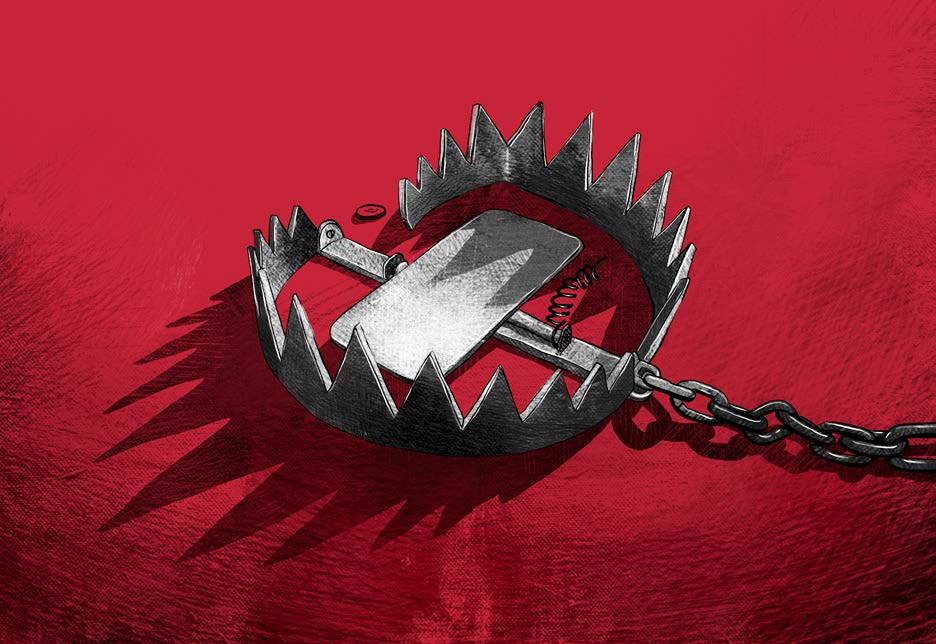
This article assesses the extent to which the smart bomb trap is, in fact, a recurring feature of limited war in the precision age. It finds that while the smart bomb trap narrative may be compelling and plays well in the media, it is not substantiated by the historical record of US military interventions. Historically, American leaders have been far more restrained with the strategic aims of precision air strikes, and more effective in controlling any resultant military escalation, than the smart bomb trap narrative suggests. There is certainly need for serious debate within policy and strategy circles about the use and utility of precision airpower. Given its weak foundation in the historical record, the smart bomb trap narrative is ill-suited to inform this debate.
The Smart Bomb Trap Narrative May Be Compelling but Lacks Foundation in the Historical Record
The smart bomb trap narrative has three core elements. First, political leaders are seduced by smart bomb technology and deluded in believing that they can achieve ambitious strategic goals—particularly foreign regime change—relatively cheaply via air strikes alone; they are accordingly prone to employ precision airpower in pursuit of these goals.11 Second, once employed, precision airpower yields tactical gains—sometimes spectacularly—but this does not translate to strategic success. In cases of attempted regime change, air strikes may eliminate individual leaders but not the deep political apparatus; instead of inducing change, air strikes serve to harden the threatened regime.12 Third, with strategic aims unmet and the adversary demonstrating ways to impose increasing costs, the initiating state is pressured to intensify and expand the conflict. In particular, the initiating state is driven to commit ground troops despite its original intent to limit intervention to airpower alone. This, in turn, triggers a spiral the initiating state no longer fully controls.13 The outcome is not merely escalation, but “catastrophic” escalation.14
If the smart bomb trap narrative played out with any regularity, one would expect to observe two patterns in the historical record of US military interventions, with these patterns becoming increasingly prominent following the advent of smart bomb technology. First, one should observe a pattern of the United States attempting without success to achieve foreign regime change via airpower alone. Second, and more generally, one should observe a pattern of US military interventions that were intended as limited air campaigns but turned into broader conflicts. Specifically, one should observe cases of limited air campaigns escalating to wars that involve US ground forces.15
Neither of these patterns exist.
The United States Has Rarely Sought to Affect Foreign Regime Change via Military Force, Particularly via Air Strikes
Assessing more than a thousand cases of military intervention by any state going back to the nineteenth century, Alexander Downes and Jonathan Monten observe that efforts to impose foreign regime change with any type of military force are “exceedingly rare.”16 For its part, the United States has a long and somewhat sordid history of foreign regime change, or at least attempted foreign regime change. Lindsey O’Rourke identifies seventy such attempts by the United States over the course of the Cold War (1947–89); however, sixty-four of these were prosecuted by clandestine organizations employing covert means (such as election interference or organizing dissidents) and not through the overt use of military force.17
While efforts to impose foreign regime change with military force may be exceedingly rare, efforts to do so via airpower alone are even more so. Of O’Rourke’s six Cold War cases in which the United States ostensibly sought foreign regime change via military force, the United States relied exclusively, or even primarily, on airpower in only one: Operation El Dorado Canyon (1986). And with this lone case, O’Rourke acknowledges that there remains ambiguity as to whether the United States intentionally sought to target Libya’s leader Muammar Qaddafi and induce the overthrow of his regime.
Operation El Dorado Canyon is an important case in that it represents the first airpower-only operation in which the United States employed precision-guided munitions (otherwise known as smart bombs), specifically the Paveway II laser-guided bomb developed and initially used during the Vietnam War. Again, O’Rourke categorizes the case as a US attempt to affect regime change, but evidence suggests that this was not the United States’ primary aim. With his guidance to the Joint Chiefs of Staff prior to the operation, President Ronald Reagan asked for a plan that would merely “send the right signal to Qaddafi.”18 Oliver North, deputy director for political-military affairs on Reagan’s National Security Council, recollected, “Killing him [Qaddafi] was never part of our plan.” Even if not a primary aim, though, the Reagan administration likely would have welcomed regime change as an outcome; along these lines, North noted, “If Qaddafi happened to be in the vicinity . . . when the bombs started to fall, no one would have shed any tears.”19 Other administration officials went as far as to consider political alternatives to Qaddafi “should we get lucky.”20
The paucity of cases in which the United States has tried to achieve foreign regime change via airpower alone extends beyond the Cold War, to include into the modern era in which smart bombs have become more prevalent. From the United States’ first use of military aircraft in 1916 through 2025—a period that includes more than 250 crises and conflicts involving US military forces—there have only been two cases other than Operation El Dorado Canyon in which the United States potentially sought foreign regime change via airpower alone; and neither of these cases is clear-cut.21
The first is Operation Desert Storm (1991). During this conflict, the United States conducted a thirty-eight-day bombing campaign in Iraq distinct from and prior to its ground operations in Kuwait.22 Desert Storm is an important case in that it is generally considered the “coming out party” for precision-guided munitions, ushering in a “new American way of war.”23 And some scholars categorize it as a case in which regime change was a main objective. It is true that the United States targeted presidential residences and command bunkers where Iraqi leader Saddam Hussein may reasonably have been located. However, in a since-declassified Top Secret directive issued two days before the start of the air campaign, the George H. W. Bush administration excluded regime change as one of its objectives, reserving the option if Iraq resorted to the use of chemical or biological weapons, supported terrorist attacks against the United States, or destroyed Kuwaiti oil fields.24 Although retreating Iraqi forces did, in fact, sabotage Kuwaiti oil infrastructure toward the end of the conflict, the United States does not appear to have altered its objectives in response. In 1993, CIA Director Robert Gates explained that while the administration discussed the possibility of overthrowing the Iraqi government at length, “we specifically decided not to make it a war aim so that we would not set ourselves objectives that we were not confident we could accomplish.”25
Colonel (ret.) John Warden, a leading architect of the Desert Storm air campaign, confirms this perspective, characterizing any suggestion that the United States was actively trying to overthrow Saddam Hussein as “categorically untrue.”26 Prior to the war, Warden developed a plan explicitly aimed at regime change, but this plan met with resistance and underwent multiple evolutions, with the focus on regime change eventually stripped out prior to the plan’s execution. The United States targeted Saddam Hussein from the first night of the campaign, but the main goal was to isolate the Iraqi leader from his military forces and facilitate the collapse of Iraqi resistance in Kuwait. According to Warden, if the United States had killed Saddam or weakened his regime enough to spark an internal coup, this would have been a “pretty good deal,” and US political leadership would likely have been “absolutely delighted.”27 But, again, this was not the primary aim. As with Operation El Dorado Canyon, it seems that at most the United States viewed regime change as a fortuitous turn of events should it happen.
The second case is Operation Odyssey Dawn (and the follow-up Operation Unified Protector under NATO leadership), during which the United States and its NATO partners conducted air strikes against Libyan regime targets from March to October 2011. While scholars have arguably oversold the extent to which the United States sought to affect regime change in the 1991 Iraq case, the reverse may be true with the 2011 Libya case. Particularly, others have claimed that in the 2011 Libya case, the United States viewed regime change as a potential consequence of its air campaign and never as an objective.28
“As with Operation El Dorado Canyon, it seems that at most the United States viewed regime change as a fortuitous turn of events should it happen.”
The stated aim of Operation Odyssey Dawn, in line with United Nations Resolution 1973, was the protection of Libyan civilians from regime forces amid civil war. At the outset, President Barack Obama called for Qaddafi to relinquish power but ruled out regime change as a military objective, expressing: “Broadening our military mission to include regime change would be a mistake. . . . If we tried to overthrow Gaddafi by force our coalition would splinter. We would likely have to put US troops on the ground to accomplish that mission or risk killing many civilians from the air.”29 Roughly a month into the air campaign, however, there was a subtle but observable shift in this stance. In mid-April, President Obama published an op-ed with British Prime Minister David Cameron and French President Nicolas Sarkozy that linked the UN mandate’s “all necessary measures to protect the people of Libya” clause to Qaddafi’s removal. Specifically, the op-ed stated: “So long as Qaddafi is in power, NATO must maintain its operations. . . . Qaddafi must go and go for good.”30 The Obama administration thus at least implicitly tied successful termination of the air campaign to an outcome of regime change. At a media engagement shortly thereafter, Senator Lindsey Graham (R-SC), who served on the Senate Armed Services Committee, more bluntly proposed that the goal of the air campaign was “to get rid of Gadhafi.”31 Over the following months, the United States and NATO increasingly targeted Qaddafi’s residences, offices, and command centers, killing several members of his family and inner circle.32
Evidence in this case suggests that while the United States maintained a policy goal of regime change from the start, this was not initially the aim of the air campaign. Only later, as the campaign progressed and the situation on the ground evolved, did American political leaders (and leaders in other countries) link the air campaign to regime change. To the extent that this characterization holds, the case is problematic for the smart bomb trap narrative. Per the smart bomb trap narrative, political leaders decide from the start to intervene militarily in pursuit of ambitious strategic goals, particularly foreign regime change, based on the belief that they can achieve these goals relatively cheaply via airpower alone. In Libya, however, President Obama specifically ruled out regime change as a military objective when he initially decided to intervene, at least in part because he doubted that the United States could achieve regime change with a limited air campaign, arguing, “We would likely have to put US troops on the ground to accomplish that mission.”33 Political leadership was not swayed to intervene militarily—or to pursue regime change—by an exaggerated sense of what could be achieved via airpower alone.
Overall, the empirical claim that states have been trying to topple regimes with airpower alone for more than a century is problematic, at least from the US perspective. Across more than a hundred years of US military interventions, there are only three cases that potentially align with the smart bomb trap narrative in this sense, and each of these cases offers relatively weak, contested support. It may be true, as Pape suggests, that attempts to topple regimes with airpower alone have never worked—but it is also true that such attempts are rarely made.
Limited Air Campaigns Rarely (If Ever) Escalate to Broader War Involving Ground Troops
The smart bomb trap narrative specifically highlights foreign regime change as an objective but applies to the employment of precision airpower more broadly. At the core of the narrative is the more general argument that limited air campaigns risk escalating into bigger and costlier wars. Particularly, Pape and others cite the risk of the initiating state being pressured to commit ground troops once air strikes have failed to secure strategic aims. The commitment of ground troops, in turn, serves to “change the structure of the conflict” and “make disengagement far more difficult.”34
There are cases of limited air campaigns that endured longer than anticipated, and in which the target set expanded over time. Operation Allied Force—the 1999 NATO bombing campaign versus Yugoslavia—is a prime example. In this case, some NATO leaders anticipated that two to three nights of bombing would be enough to compel Yugoslav President Slobodan Milošević to end regime-sponsored violence against Kosovo Albanians. Instead, the operation went on for seventy-eight days, with the target set expanding from air-defense systems and fielded military forces to economic infrastructure including factories, power plants, and railway hubs.35
It is difficult, however, to identify cases in which a limited air campaign escalated to a broader war involving ground troops of the initiating state. From 1916 through 2025—again, a period that saw more than 250 crises and conflicts involving US military forces—there are approximately thirty-seven cases of military intervention in which the United States conducted air strikes (including via drones).36 Of these thirty-seven cases, thirteen are characterized by the exclusive use of airpower, while the remaining twenty-four involved air strikes and US ground troops.37 Within this latter subset, there are no clear historical examples—before or after the advent of smart bomb technology—of the United States initiating what it intended to be an airpower-only operation and then later committing significant ground forces. In other words, the United States intended from the start to employ both air and ground forces.38
“It is difficult, however, to identify cases in which a limited air campaign escalated to a broader war involving ground troops of the initiating state.”
The case that aligns most closely with the smart bomb trap narrative in this sense is President Obama’s deployment of US ground forces to Syria in late 2015 after more than a year of precision bombing against ISIL targets had failed to yield desired results. Leading up to this deployment, Obama had publicly reiterated, more than a dozen times, a pledge not to put US troops on the ground in Syria; unsurprisingly, his reversal sparked critique from political opponents.39 Even in this case, however, the president exhibited significant concern about potential escalation and accordingly exercised caution.40 The initial deployment of ground forces consisted of approximately fifty special-operations forces personnel, primarily as military advisors. That number grew to three hundred by the end of the second Obama administration and fluctuated between approximately five hundred and two thousand over the subsequent first Trump and Biden administrations.41
There are at least two cases that proponents of the smart bomb trap narrative offer as evidence of limited air campaigns escalating to the commitment of ground forces that are highly problematic. One pundit, for example, recently described Operation Iraqi Freedom (2003) as a failed attempt by the United States to overthrow the Iraqi regime by airpower alone, a failure that led the United States to then launch a ground war.42 This is a faulty characterization, however, as the United States began its preplanned ground invasion within 24 hours of initiating air strikes. While the United States executed “target of opportunity” strikes against Iraqi leadership with the early bombing, the commitment of ground forces was intended from the start.43
Others have argued that the United States began its military intervention in Vietnam with an “airpower-only strategy” and shifted to ground operations only once it became clear that bombing alone was insufficient to prevent the collapse of South Vietnam.44 It is true that in early April 1965, a few weeks after the start of Operation Rolling Thunder—the United States’ bombing campaign against North Vietnam—President Lyndon Johnson authorized a significant increase in the number of US ground troops in South Vietnam, as well as the use of these troops in a more offensive role. This represented an important shift; however, Rolling Thunder was part of an overall spiral of escalation and not the origin of this spiral. By the start of Rolling Thunder, the United States already had tens of thousands of ground troops in Vietnam and had suffered hundreds of battlefield casualties. There is also evidence that the Johnson administration initiated Rolling Thunder specifically in response to an uptick in Viet Cong attacks against US Army bases and personnel.45 In effect, the United States launched the bombing campaign once a ground-centric strategy had proven inadequate—an inversion of the smart bomb trap narrative.
History Suggests a Pattern of Political Restraint Associated with Precision Air Strikes
US leaders have historically been more restrained with the aims of precision air strikes, and more effective in controlling any resultant military escalation, than the smart bomb trap narrative suggests. US leaders tend to seek relatively modest objectives with limited air campaigns; and when air strikes alone fail to fully achieve these objectives, US leaders face significant political and institutional barriers to shifting mid-conflict to a ground war. As a result, these leaders have proven relatively effective in resisting the impulse to escalate in response to a failing air campaign, and willing to walk away with an outcome less than a clear win.
At the core of the smart bomb trap narrative is the assertion that political leaders, seduced by smart bomb technology, are deluded in believing that they can achieve ambitious strategic goals—most notably foreign regime change—via precision air strikes alone. In actuality, the aims associated with limited air campaigns tend to be relatively modest. Instead of seeking to overthrow regimes or alter the territorial status quo, US leaders have historically used limited air campaigns to degrade adversary capabilities, disrupt adversary operations, enable local proxies, send a message, demonstrate resolve, or otherwise influence specific adversary behaviors. In the case of Operation El Dorado Canyon, for example, the stated US objective was to “stop Qaddafi’s direction of and support for international terrorism.”46
This is not to say that such aims are easily achieved, particularly via airpower alone, or that US leaders have always exercised good judgment in pursuing these aims with airpower. Still, such aims are categorically less ambitious than foreign regime change. Some of these aims can be achieved without concessions from the adversary. The primary objective of Operation Midnight Hammer in 2025, for example, was to degrade Iran’s nuclear weapons infrastructure, thus delaying Iran’s development of a nuclear weapon. In this sense, success did not hinge on any agreement by Iran to stop pursuing nuclear weapons. In cases where the aims do require adversary concessions, the modest nature of these aims provides bargaining space, a critical factor in conflict termination.47
In addition to being relatively modest, the objectives associated with limited air campaigns tend to be malleable. Measures of success are often imprecisely defined and are thus not only open to interpretation but can evolve as a conflict progresses.48 If the aim is to degrade adversary capability, how much degradation is enough to declare the operation a success? If the aim is to send a signal or demonstrate resolve, how much bombing is necessary to adequately communicate that message? Even in cases in which the United States seeks adversary concessions, what counts as compliance can be a gray area, both in terms of extent and duration. When an air campaign has proven less effective than anticipated, such malleability can present the United States with off-ramps that might not otherwise exist. This in turn, can serve to dampen—though not eliminate—pressure to escalate.
Political and institutional barriers also constrain the risk of a limited air campaign escalating to the commitment of US ground forces. The transition from air campaign to ground war is not a smooth, continuous escalation pathway. Instead, the commitment of ground forces represents a relatively abrupt threshold. Since the country’s founding, there has been tension between the president and Congress over the question of war powers.49 In the modern era, Congress has allowed the president more leeway to utilize military force absent congressional mandate, and has been more apt to give approval when asked, if the military action in question does not include US ground troops.
At the start of Operation Epic Fury in 2026, for example, the Republican-dominated Congress blocked a war-powers resolution backed mostly by Democrats that might have constrained the administration.50 But even key Republicans signaled that their continued support for the operation was contingent on the distinction between air strikes and ground operations. Senator Josh Hawley (R-MO), for example, commented, “I’ve always said that committed ground troops would be something I think that would require immediately a congressional authorization, but that doesn’t seem to be in the immediate horizon.”51
“In the modern era, Congress has allowed the president more leeway to utilize military force absent congressional mandate, and has been more apt to give approval when asked, if the military action in question does not include US ground troops.”
In 2013, President Obama requested congressional authorization to use military force against Syria after the Syrian regime employed chemical weapons. At a subsequent hearing, Representative Eliot Engel (D-NY), ranking member of the House Foreign Affairs Committee with a reputation for being hawkish toward Syria, stated, “I believe that Congress must authorize the Commander in Chief to use limited military force against the Assad regime, and I hope my colleagues will join me in supporting such an authorization.” Engel then hedged this endorsement, elaborating: “We should not give the President a blank check. The authorization measure we take up must clarify that any strike should be of a limited nature and that there should absolutely be no American boots on the ground in Syria.”52
Accordingly, US presidents have sought to garner congressional and public backing (or at least mitigate opposition) for military action via what has been termed the “no boots on the ground mantra.”53 To change direction on such a commitment mid-conflict can be institutionally challenging and politically costly, which at least partly explains why US presidents have resisted the urge to escalate to a ground war once an air campaign proves less than fully successful. For example, as Operation Allied Force dragged on longer than anticipated with no end in sight, President Bill Clinton held to his decision not to commit US ground troops despite assessments from think-tank analysts, NATO partners, and even his own advisors that the operation would likely fail without a ground campaign.54 Clinton’s national security advisor Sandy Berger noted that while the president might have been wavering on the issue of ground troops toward the end of the operation, he recognized that shifting to a ground war would require “some very heavy lifting with [Capitol Hill] and the American people.”55 In 2015, when deploying a mere fifty ground troops to Syria after an extended bombing campaign, the Obama administration made a concerted effort to mitigate political backlash; the president went on prime-time television to argue that because US military personnel would serve primarily in an advisory rather than frontline combat capacity, he had not technically broken his pledge of no boots on the ground.56
In its depiction of escalation dynamics, the smart bomb trap narrative emphasizes the element of control, or the lack thereof, with precision weapons offering the “illusion of control.”57 Specifically, the narrative expounds a pattern of limited air campaigns spiraling beyond the control of the initiating state. Even if political leaders want to exercise restraint, they lose the agency to do so and find themselves step-by-step embroiled in a costly ground war regardless of intent, hence the metaphor of an inescapable trap.58 Again, the outcome is not only escalation but “catastrophic” escalation. There is evidence of US political leaders overestimating the effectiveness of precision air strikes even in pursuit of modest aims, and of limited air campaigns lasting longer and costing more than anticipated. As discussed above, however, the transition from air campaign to ground war does not represent a smooth, continuous escalation pathway, and US political leaders have historically exhibited wariness of the threshold as well as the agency to exercise restraint and avoid crossing the threshold.
Despite Ominous Warnings, the Recent US Air Campaign in Yemen Exhibited Little Evidence of the Smart Bomb Trap
Prior to Operation Epic Fury, the most extensive use of precision air strikes by the United States across the last three administrations was the intensive fifty-two-day bombing campaign against the Houthis in Yemen under the name Operation Rough Rider. In the early stages of the campaign, critics evoked the smart bomb trap, warning that the United States was once again on the well-worn path of a limited air campaign escalating to full-scale war that would eventually necessitate US ground forces. Operation Rough Rider is thus a useful case for assessing the smart bomb trap narrative.
The Trump administration initiated Operation Rough Rider—which involved more than a thousand precision air strikes—on March 15, 2025, in response to Houthi attacks against shipping in the Red Sea that had occurred since 2023. With what the administration characterized as a “decisive and powerful” air campaign, the United States sought to degrade Houthi military capability and deter future attacks in the Red Sea. President Trump’s announcement of the operation on Truth Social warned the Houthis that if they continued the Red Sea attacks, “HELL WILL RAIN DOWN UPON YOU LIKE NOTHING YOU HAVE EVER SEEN BEFORE.”59
Despite the intensity of the campaign and associated rhetoric, there is no indication that the Trump administration expected to destroy the Houthi organization, topple its leadership, or drive the Houthis from their territorial holdings in Yemen. As Yemeni expert Mohammed al-Basha explained: “The US goal is not to overthrow the Houthi regime in Sana’a or directly intervene in Yemen’s internal affairs. . . . Rather, it seeks to protect US national security and restore free navigation in the Red Sea—vital to global trade.”60 Expressing his concurrence with the president’s decision, Vice President J. D. Vance noted that the strongest rationale for the air strikes was “to send a message.”61
After several weeks of US air strikes, the Houthis showed little sign of wavering in their defiance and proved relatively effective with their defenses, successfully downing seven US MQ-9 drones.62 While the air strikes degraded Houthi capabilities, the strategic effects were limited; US intelligence reportedly assessed that despite Houthi losses, the group remained in a position to easily reconstitute, regroup, and rebound.63 Further, US military leaders expressed concern about the depletion of precision munitions that might be needed for other conflicts.64
To decisively eliminate the threat posed by the Houthis would likely have required a substantial ground campaign; while the administration did not explicitly rule out the employment of ground forces, it also appeared to have no interest in such a commitment.65 On the domestic front, the president faced significant criticism from Democrats in Congress over the issue of war powers, which would likely have ballooned had the administration sought to put American boots on the ground.66 On May 6, the administration announced a relatively abrupt end to the air strikes, stating that the Houthis, not wanting to fight anymore, had “capitulated” and agreed to a ceasefire. Further, the administration proposed that the air strikes had yielded a “very, very positive” outcome for the United States.67 Houthi leadership acknowledged the ceasefire but rejected the administration’s framing, asserting that they had held firm while the United States had backed down.68 In reality, both sides compromised to stop the bombing.
Although American leaders might have miscalculated Houthi vulnerability to precision air strikes, they initiated the air campaign with relatively modest and malleable strategic aims. As the campaign continued and costs mounted without decisive result, they did not succumb to pressure to further escalate and commit ground troops. Instead, they looked for an off-ramp by which the United States could at least claim partial success. The case thus aligns well with the broader historical pattern of political restraint and, notably, provides little evidence of the smart bomb trap at work.
Don’t Be Ensnared by the Smart Bomb Trap Narrative
Over the first few months of the United States’ air campaign against Iran initiated in February 2026, proponents of the smart bomb trap narrative routinely warned that the United States was on the brink of escalating to a ground war. On July 12, 2026, Pape argued that the conflict was progressing exactly as he had predicted, and that the United States was closer to committing ground troops than at any previous point in the war.69 In a media engagement three days later, however, Vice President Vance clarified: “If the Iranian people want to rise up and change their government, that’s up to them. But we’re not going to send 150,000 ground troops in in order to accomplish a change in a regime. . . . We’re not in that business anymore. We’re just not.” Instead, per Vance, the United States would continue to use military airpower in a calculated way along with economic and diplomatic levers to keep the Strait of Hormuz open, protect the flow of oil, and prevent Iran from obtaining a nuclear weapon—far more modest, albeit still challenging, goals. And whatever the US objective, Vance said, “We’re not going to send the troops in regardless.”70
Considering its prevalence in policy circles, the lack of historical evidence for the smart bomb trap narrative is striking. Across hundreds of cases of US military intervention going back to the advent of military airpower and leading up to Operation Epic Fury, there is not a single clear-cut case in which the United States attempted foreign regime change via airpower alone and only a handful of cases in which the United States may have made such an attempt. Likewise, there is not a single clear-cut case of a limited air campaign—a military intervention intended at the start to be limited primarily to airpower—escalating to a broader war that involved US ground troops.
“Considering its prevalence in policy circles, the lack of historical evidence for the smart bomb trap narrative is striking.”
None of this dismisses the possibility that we will see the smart bomb trap narrative play out in the future, whether in relation to an ongoing or a yet-to-be initiated conflict.71 War is marked by uncertainty, military hubris seems ever-present in some form, and there is a long history of states launching ill-advised wars that get bigger, last longer, and become more costly than anticipated at the outset—a history that well pre-dates the advent of military airpower.72 Within this context, the smart bomb trap narrative is plausible.
That said, the lack of substantiation in the historical record is problematic. Again, the smart bomb trap narrative represents a theory linking precision airpower to the politics of war, a theory with significant implications for US military strategy and policy. As John Mearsheimer and Sebastian Rosato observe, theory and policy are inextricably connected; whether they recognize it or not, “virtually all policymakers rely on theories to formulate grand strategies and navigate crises.”73 And while no theory is perfect, not all theories are equal. Some are credible and others are not; although credible theories do not guarantee good policy decisions and successful outcomes, non-credible theories are more likely to contribute to bad policy decisions and failed outcomes.74 A primary criterion for a credible theory is that the theory’s claims find strong support in the historical record.75
As assessed above, there is little evidence of the smart bomb trap at play in the history of US military interventions. Instead, there are clear patterns of US leaders being far more restrained with the strategic aims of precision air strikes, and more effective in controlling any resultant military escalation, than the smart bomb trap narrative suggests. Given its weak foundation in the historical record, the smart bomb trap is a poor lens for assessing and debating future applications of precision airpower, with the potential to cause misconceptions about the use and utility of precision airpower and skew policy thinking. There are plenty of valid critiques associated with precision airpower. The smart bomb trap narrative is not one of them.
Shawn T. Cochran, PhD, is professor of military and security studies at the US Air Force Air Command and Staff College, and senior political scientist for the RAND Corporation. The former dean of the US Air Force School of Advanced Air and Space Studies, he holds a doctor of philosophy in political science from the University of Chicago and a master of public policy in international security and political economy from Harvard University. Dr. Cochran is author of the book, War Termination as a Civil-Military Bargain.
US Air Force Air Command and Staff College, Montgomery, AL, USA, email: shawn.cochran.6@au.af.edu
Acknowledgments: I would like to thank Miruna Barnoschi, Ann Mezzell, Kathryn Boehlefeld, and John Warden, as well as an anonymous reviewer, for their valuable insights and feedback.
Opening image credit: 127th Maintenance Group ensures mission readiness of A-10 Thunderbolt II aircraft [Image 9 of 9], by TSgt Joseph Pagan.76