
Podcast overview with the author
In 1976, Michael Howard, professor of history at Oxford University, published War in European History. The book describes war from the Middle Ages to the Cold War. Howard writes that the study of war has an applied purpose: to help generals, admirals, strategists, and politicians prepare for and ultimately wage war. But a larger purpose is to explain the relationship of war to peoples as a whole. “The historian who studies war, not to develop norms for action, but to enlarge . . . understanding of the past,” counsels Howard, “has to study war not only . . . in the framework of political history, but in the framework of economic, social and cultural history as well.”1
A rich literature exists on war in the framework of political, economic, social, and cultural history, often abbreviated to “war and society.”2 Most of this literature covers war before 1945. Few texts cover war since 1945, and fewer still diverge from the United States and Europe.3 A history of war and society during the Cold War in the Middle East and South Asia—two regions linked by geography, history, and culture—is badly needed. The peoples of few other regions have been so touched by war. Few other regions have so fixed the attention of world leaders. The scarcity of histories for this region is a disservice to students and time-pressed policymakers alike.
This article attempts such a history in a form that is quick for any student or decision-maker to read. Two themes run through it. The first is how politics, technology, society, and culture changed the conduct of war. The second is how the conduct of war changed politics, society, and culture. The overarching argument is that a combination of pressures spread forms of war—namely, guerrilla warfare and terrorism—that put the use of force in the hands of the people. This democratization of violence complicated the consolidation of state authority and was intertwined with the return of Islam as a political force.
It happened through a set of overlapping pressures. During the first decades of the Cold War, states fashioned their militaries along conventional lines and used them to consolidate power. The costs of modern conventional warfare and the limits of nationalism as a unifying force hampered states’ efforts. Identities and loyalties alternative to the state, above all Islam, empowered non-state groups. As the Cold War progressed, advances in technology multiplied these groups’ ability to resist state armies and conduct guerrilla warfare and terrorism. Catalyzing it all, military occupations—most notably the Soviet invasion of Afghanistan—inspired hundreds of thousands to be guerrillas and terrorists. If war after 1945 for the United States and Europe became, to quote Howard, “an affair of states and no longer peoples,” then in much of the Middle East and South Asia, it became an affair of peoples as much as states.4
The delegation of violence to the people and the breakdown in state authority have intensified since the end of the Cold War. New foreign interventions triggered resistance, and new technology—improvised explosive devices (IEDs), drones, and the internet and social media—further armed the people. Today, conventional armed forces persist, but guerrilla warfare and terrorism dominate the conduct of war. The conflicts that we see in Lebanon, Iraq, Syria, Gaza, Yemen, and many other parts of the region can be explained in part by changes in warfare that appeared during the Cold War.
This article looks at countries of the Middle East and South Asia. These countries largely share certain cultural beliefs and social dynamics. I could not, however, do justice to all the countries in the regions within an article. It might be more accurately said that the article is about the “greater Middle East”: the area from Egypt to Pakistan that imperfectly matches the territory of the Umayyad or Abbasid caliphates and, for those familiar with US defense policy, the area of Central Command (CENTCOM).
The experience of war and state-building in the greater Middle East during the Cold War contrasts with that of Europe. Otto Hintze, Michael Howard, and others concluded that from 1492 to 1945, war built states as we know them today.5 The military technology of the time—cannons, warships, fortifications, and muskets—were expensive, complex, or had to be employed at scale to be effective. The state was best suited to manufacture the technology, train and discipline soldiers and sailors, and administer logistics. As these developments occurred, rulers monopolized organized violence and consolidated authority. The process culminated in the era of total war, when European states as well as the United States and Japan mobilized their societies to win wars. Armies embodied the people. In the form of nationalism and militarism, war partly defined identity and values.6
“War made the state, and states made war.”
— Charles Tilly
The foremost scholar of war and European state-building is the sociologist Charles Tilly. “War made the state,” he wrote, “and states made war.”7 Warfare tended to force European states to strengthen capacity for infrastructure, taxation, supply, and administration.8 In Tilly’s words: “A ruler’s creation of armed forces generated durable state structures. It did so both because an army became a significant organization within a state and because its construction and maintenance brought complementary organizations—treasuries, supply services, mechanisms for conscription, tax bureaux, and much more—into life.”9 The process of war helped the state control its territory and centralize power.10 Tilly began what became known as the “bellicist” school of state formation.11 Historian William McNeill’s The Pursuit of Power, for example, supports Tilly’s case. McNeill argues that a “state unable to protect itself by force from foreign molestation loses its autonomy and may lose its corporate autonomy as well.” He demonstrates that over the course of centuries technology enabled “political management” to monopolize “the overt organization of armed force.”12 In a similar vein, political economist Faisal Ahmed looks at the greater Middle East and shows how the Arab conquests went along with political centralization that persisted over centuries.13
Others contend that it is not war that makes successful nation-states. Nobel laureates Daron Acemoglu and James Robinson conclude that inclusive economic and political institutions are what matter.14 Paul Kennedy’s The Rise and Fall of the Great Powers places weight on economic strength.15 When it comes to the greater Middle East, critics charge that militarization can preclude inclusive institutions and that the bellicist school’s association of war and state formation does not hold.16 Tilly himself admits that his theory is specific to Western Europe and that “the non-European experience will be different.”17 He even states that the impact of “the building of substantial armed forces” on state-making during the Cold War “appears to have diminished and changed.”18
This article does not adjudicate the debate. Both the bellicist school and its critics tell us something about the political evolution of the greater Middle East. Organized warfare was critical to the story, to be sure, but the overall changing conduct of war contributed to political disorganization. Fledgling postwar states were in a poor position to employ a conduct of war based on costly methods of conventional war to build themselves up. New technologies allowed militant groups to spread. Those groups fought unconventionally, and they often appealed to religious rather than national loyalties. These groups called upon ordinary people to join their causes and equipped them with small arms and tactics that allowed them to challenge larger security forces.
War in the Middle East Before 1945
The countries of the greater Middle East have their own history of war, from the Prophet Muhammad and the caliphates to the Mamluks to the Ottomans, Safavids, and Moghuls. This history, along with its changing social and cultural aspects, sets the stage for how warfare developed in the Cold War.
The idea of large standing armies arrived with European empires at the end of the eighteenth century. Muslim encounters with the French, British, and Russians showed that the old armies were obsolete. The Ottoman Empire, Egypt, Iran, and Afghanistan attempted to build disciplined armies with modern weapons, backed by administrative institutions. Conscription was introduced in certain armies, a new and hated practice among the lower classes. Results were imperfect. The new armies were expensive and often required European financial aid, which undermined state authority. New armies also produced cadres of young officers who could use their position and visions of nationalism to seize power.19
The Ottoman Empire made the largest effort. The reformers of the Tanzimat, then Sultan Abdul Hamid II, and then the Young Turks were all committed to a modern military. These leaders purchased the latest breech-loading rifles, machine guns, and artillery from abroad. For the first time, the sultan conscripted Turkish peasants and maintained an army of at least 300,000 troops. German advisors disciplined infantry units and instituted a mobilization plan. The state constructed railways, roads, and telegraphs. The Imperial School of Military Science and other new state schools educated a portion of officers.20 A new bureaucracy ran it all. Military modernization slowed the empire’s fragmentation, strengthened Turkish nationalism, and was a reason the state of Turkey could form in the aftermath of the First World War.21
Loyalties and sources of identity beyond the nation-state inhibited the consolidation of power. The Ottoman Empire and the states of the region lacked a monopoly on organized violence. Tribes, ethnic groups, and religious leaders were armed. Large areas outside the cities were outside control. In the Ottoman Empire, Arabs, Kurds, Christians, and those from provincial areas were generally exempt from conscription. These groups frequently viewed Turkish soldiers as occupiers.22 Across the region, people were as likely to fight for tribe, community, or religion as state, empire, or ruler.23
“Across the region, people were as likely to fight for tribe, community, or religion as state, empire, or ruler.”
Islam was important as a source of identity, in competition with the state. The religion was nearly universal and far older than modern notions of nation-state. In the form of jihad (a struggle or holy war), Islam was the classic way to bring tribes and communities together. The Quran instructs Muslims to take up arms against unjust aggression and in defense of Islam.24 Mujahideen holy warriors are praised.25 Fighting for Islam could therefore inspire high levels of cohesion. Fourteenth-century Arab historian Ibn Khaldun described soldiers on jihad as “like arrows or like rows of worshippers at prayers.”26
To call a jihad required a religious edict, or fatwa. Though political leaders—such as sultans, emirs, and kings—often tried, only the religious leaders (ulema)—such as a caliph, scholar (mufti, alim, or maulawi), or judge (qazi)—as interpreters of Islamic law could legitimately issue one. The sultan or emir or king may have claimed to represent religion, but could never strip the religious leaders of their authority.27
Fortunately for the state, the technology of the time constrained what tribal, ethnic, or Islamic warriors could achieve on their own. Breech-loading rifles that appeared toward the end of the nineteenth century were a vast improvement over muzzle-loading muskets, but these weapons were low in explosive power, not automatic, and hard to obtain. Dynamite was portable, cheap, and destructive, but fumbling together sticks and blasting caps was dangerous.28 Nor was technology one-sided. Roads and rail, and then cars and aircraft, endowed the state with its own advantages. Unless the government was already crumbling, irregular tribesmen or Islamic warriors could rarely defeat a disciplined regiment with field artillery (let alone a Maxim gun) or capture a city. The Ottoman Empire itself eroded at the hands of provincial generals leading modern armies and wars with great powers, rather than at the hands of the people.
Interstate Wars and Their Effect on Society During the Cold War
Turkey, Pakistan, Egypt, Iraq, Jordan, Syria, and other states emerged out of nationalism, the end of the Ottoman Empire after the First World War, and the end of the British and French Empires after the Second. These states were largely monarchic or autocratic regimes. All constructed armies, bureaucracy, and institutions and tried to consolidate power. Nationalism, modernization, and secular laws were driving forces, especially for autocrats in Western uniforms in Pakistan, Egypt, Syria, and Iraq. A deep desire for independence from European empires also contributed. Regional competitors and superpower or imperialist threats compelled states to arm and fight. War was among the highest purposes of the state, and defense spending was among the highest percentages of national income in the world. Rulers exploited outside threats to try to create a sense of identity, loyalty, and patriotism, and to legitimize their own rule.29
The frequent wars between states include six Arab-Israeli wars, three India-Pakistan wars, the brutal Iran-Iraq War, and smaller fires in between. States fashioned their militaries along conventional lines for state-on-state wars. India, Pakistan, Egypt, Israel, Iraq, Iran, Syria, Saudi Arabia, and Jordan built modern armies with tanks and air forces with jet aircraft. Tactics and organization resembled those of the Second World War, though states could rarely afford the training and logistics of the Allied or Axis powers. Superpower patrons provided weapons, equipment, funding, and advisors. New technology was incorporated, including helicopters, anti-tank missiles, surface-to-air missiles, and short-range ballistic missiles.
Proficiency in these weapons and associated tactics involved substantial training. Pakistani officers, for example, received three months of basic training and five months of collective unit training.30 Iraqi recruits received six months of basic training and seven to nine months of unit training. Still another year of experience was required before a soldier could join the elite Republican Guard.31 Israeli infantry recruits received five to six months of basic training, largely in the field and with advanced tactics like night fighting, before moving on to even more advanced unit training.32 Beyond individual and unit training, annual exercises taught units to work together as a division and coordinate with artillery, armor, and aircraft. Specialized training—such as for pilots or in electronic warfare—could often only be completed in the United States or Soviet Union.33
Wartime political aims were usually limited. The objective was rarely annihilation of the enemy’s armed forces. One constraint was the expense and expenditure of high-tech weapons. Ammunition, tanks, and aircraft could be exhausted in weeks, sometimes days. In both the 1967 and 1973 Arab-Israeli wars, Egypt lost the bulk of its aircraft and tanks and had to be resupplied by hundreds of Soviet airlifts during ongoing combat. Since resupply itself was a slow process, there was a natural limit to the length and goals of many wars. In fact, Pakistan, Iran, and Iraq launched offensive air strikes selectively and saved their jet fighters for the defense of their own airspace lest expensive airframes be burnt through in days.
Another constraint was the Cold War context. Oil and location made the greater Middle East a region of strategic interest for the superpowers.34 The superpowers generally restrained regional actors because they did not want to threaten each other’s interests or risk escalation—hence the intense crisis diplomacy that accompanied the India-Pakistan and Arab-Israeli wars.
Pakistan, the second most populous Islamic country, had a large and professional military, justified by tension with India. Originating as one-third of the British Indian Army, the military expanded from 140,000 men at the time of partition in 1947 to 250,000 in 1965 and 400,000 in 1971. Officers designed the military to wage a war of tanks, jets, and artillery. By 1971, the army had 850 tanks, and the air force had 278 combat aircraft.35
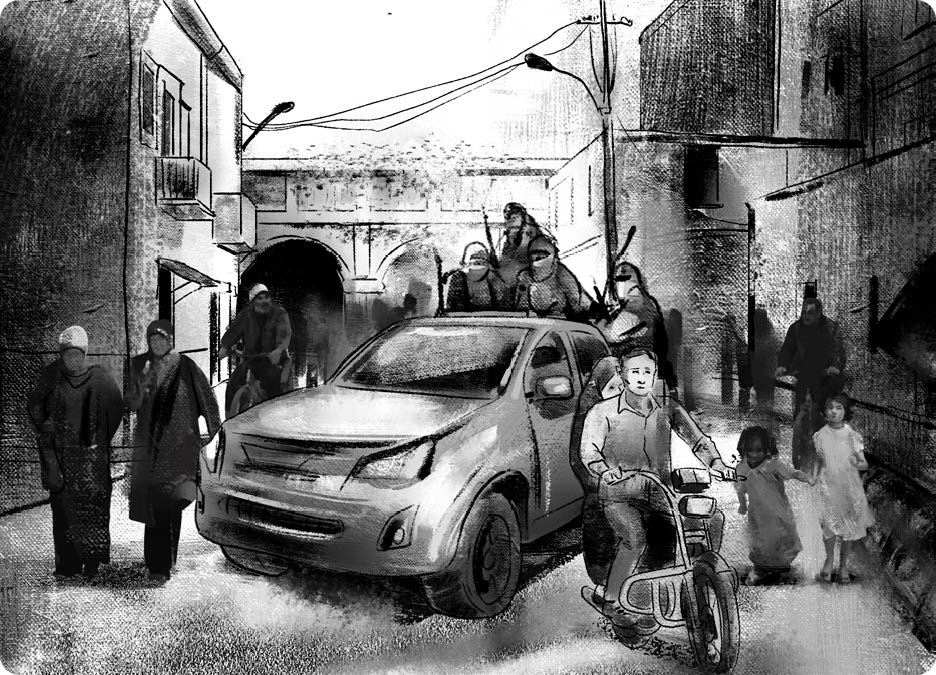
Pakistan’s society and culture framed its military. Pakistan was one of a few countries, along with Jordan, that eschewed conscription, partly because of British professional traditions, partly because the people would have resisted, and partly because the volunteer system safeguarded the dominance of the Punjabi political and military elite. Rather than all society, the army relied on certain tribes and rural communities (such as Pashtuns, Baluch, Sindhis, and Punjabi Muslims) for recruits. The handful of rural districts where recruitment occurred were a small percentage of Pakistan’s population.36 The historical links of these tribes and communities to the army ensured volunteers and discipline, as did the British method of granting land to officers in return for loyalty.37
War and the Pakistan army had a major role in strengthening the state. Pakistan’s leaders and generals viewed the army and the rivalry with India as a means of creating a sense of national identity. Urdu, the common language of the old Indian Army, became Pakistan’s official language. Generals saw themselves as the nation’s saviors. General Ayub Khan told the US consul general in 1951: “The Pakistan Army will not allow the politicians to get out of hand, and the same is true regarding the people of Pakistan.”38 Beginning with Ayub Khan in 1958, the generals staged coups whenever they objected to the civilian government.39
Pakistan was part of a larger trend. Generals or autocrats who used their militaries to control the key centers of state power often ruled Syria, Iraq, Turkey, and Egypt. In comparison, Indian politicians kept the 800,000-man Indian Army and 700 aircraft of the Indian Air Force under ruthless civilian democratic control.40
In the name of strengthening institutions, Pakistan’s army intervened in domestic affairs with martial law decrees and the appointment of generals to governorships and other posts.41 During the 1980s, army officers occupied a quarter of civilian senior bureaucratic billets.42 Officers also were involved in parts of the economy, including infrastructure, sugar, tobacco, and cargo.
Rivalry with India was the military’s guiding principle.43 The generals succeeded in spreading this idea to much of the people. An army colonel training recruits in the 1980s stated: “We don’t have to teach them anything, everybody in this country knows who is the enemy! The threat, the enemy, we don’t teach this in the syllabus because they already know!”44 Yet generals could hardly set the course of a place as populous, diverse, and traditional as Pakistan. The vast Indus River valley, mountainous tribal areas, and teeming cities had expansive, distant, and complex lives of their own. Tribe, community, trade, and Islam were ever present. After a visit to a frontier village in 1966, Ayub Khan noted in his diary: “In traditional old Pathan style the guest and the servants all sat at the same table and had the same food. One can’t help being moved by such demonstration of basic equality in Muslim society. But that is why ruling or leading Muslims is so much more different. . . . The leader is just a senior among equals.”45
No more than 1 percent of Pakistan’s population was ever mobilized.46 Military expenditures during the 1960s amounted to a small portion of national income—around 2.8 percent of gross domestic product (GDP) from 1960 to 1965, and 4 percent from 1966 to 1970.47 Egypt, Israel, the United States, and the Soviet Union spent far more. Pakistani generals, as well as politicians and the judiciary, were well aware that the average farmer and city worker were not interested in participating in the defense of the country. “The idea is to get more Sindhis in and the response is not there!” railed one of Ayub Khan’s generals.48 Ayub Khan himself commented to the central government secretariat in 1967 that the “idea of a citizen’s army is fallacious.”49
“For more than two decades, Egypt led the Arab conflicts against Israel and had the leading Arab military.”
More so than Pakistan, Egypt under President Gamal Abdel Nasser exemplified a state with a modern military for the greater Middle East. For more than two decades, Egypt led the Arab conflicts against Israel and had the leading Arab military. Nasser faced external dangers in the form of residual British military presence, US and Soviet superpower balancing, and Israel. Imperialism and Israel were concerns across Muslim peoples that animated Nasser, as well as other leaders.50 Nasser declared in a speech in 1958: “Independence is the foundation of real solidarity, for there is no solidarity if parts of the Arab nation are subject to varied administrations which resemble colonialism and resemble foreign control and resemble tyranny.”51 Accordingly, one of the six principles that Nasser and his colleagues instituted was to build “a powerful military.”52 The National Charter of 1962 read: “The new society . . . needs the armed forces as a shield to defend the reconstruction of society against external dangers.”53
Nasser created a modern military that could fight Israel’s modernizing military. The British had left a mere 36,000 men, 25 aircraft, 20 tanks, and 50 artillery pieces, with inadequate transport, logistics, and medical care.54 Nasser and his colleagues increased the numbers to 205,000 personnel by 1965 and then 800,000 by 1971, about 2 percent of the population.55 They also added 1,000 tanks, 400 jet aircraft, and better logistics. The professional officer corps and the number of technical specialists expanded over the same time.56
Conscription was introduced in order to mobilize enough manpower for industrial-scale war. This measure accompanied wider social reforms, such as the Agrarian Reform Laws that redistributed land to farmers and made Nasser a common hero. Less than universal, the burden of conscription fell on the lower classes in an attempt to maintain upper-class support for the regime. The obligation of university-educated males was shortened or exempted. Demand for technical skills to use and maintain jet aircraft and missiles widened conscription after 1967 (as there were fewer trained pilots than aircraft) without impinging too much on the upper class.57
Egypt’s developing economy could only resource its war machine through external assistance. Nasser was forced to turn to the Soviet Union for funding, arms, and technical expertise. Egypt’s base of educated people was too small to fill the needs of the technical branches and the air force, so the state had to rely on Soviet advisors. The large militaries of Syria and Iraq (where Nasser inspired the people and strongmen alike), as well as the volunteer militaries of the Jordanian and Saudi monarchies, likewise depended on superpower support.58
As in Pakistan, the military’s purpose was wider than fighting outside wars. The military was a source of authority and a symbol of nationalism. Nasser and the Egyptian people defined Egypt partly through martial experience. The 1948 defeat in Israel’s war of independence; the toppling of the British-backed monarch; the victory over the British, French, and Israelis in 1956; the tragedy of the 1967 Six-Day War; and the 1973 crossing of the Suez entered the national narrative, in the streets and villages as well as in textbooks and state propaganda.59 The threat of war rallied the people. Nasser warned: “The obliteration of Arab nationalism in Palestine is a sign of danger to us. Should we slacken or weaken, our turn will come. We shall suffer the same fate as Palestine.”60 Families distant from Cairo remembered wars as their own. “Our war is like this,” asserted one farmer in Fayoum. “We are fighting for our house and land only.”61 That said, nationalism was imperfect. In May 1967, only 80,000 of 120,000 reservists responded to being called up.62 The pinnacle was the run-up to 1973, when students and protestors demanded that Nasser and his successor, Anwar Sadat, respond to the 1967 defeat, and a few officers and sergeants plotted rebellion when action came too slowly.63
The military’s size forced the state to structure society in support. Defense spending rose from 5 percent of national income in 1952, to 13 percent in 1967, and then to 33 percent in 1973.64 Bureaucracy, infrastructure, and education developed concurrently, both as part of the military enterprise and under Nasser’s wider goals of industrialization, wealth redistribution, and reform. Raising funds for the military led to the nationalization of foreign enterprises and domestic industries and a failed attempt at an indigenous arms industry.
Just as in Pakistan, as well as in Iraq and Syria, Egyptian state functions were turned over to military officers as a way of centralizing power. Officers were seen as the leading element of the state: “high modernists, par excellence.”65 Civilian institutions were undeveloped. Officers were often ministers, senior bureaucrats, governors, police, and judges. Officers were appointed to run public corporations and to supervise revenue streams and economic resources, from public transport to housing to fisheries.66
Social and cultural context shaped how much the military could strengthen its authority. Kinship and network ties (shilla) segmented society. The military had networks based on relationships and graduating class. The very nature of these networks encased officers in the distribution of corruption above and below. Patrons expected officers to pay them off; friends and family members expected the generosity of the very same officers. Techniques of raising money abounded: collecting salaries for nonexistent soldiers, demanding payments for promotion, running businesses, and leasing of land.67 Officers were less a cohesive body united under a military ethos than groups of individuals with their own loyalties.68 Nasser favored his own supporters, as did Field Marshal Abdel Hakim Amer, the armed forces chief. Amer used promotions for the benefit of his own network of loyalists and kin. “The first drum were those who heard the cheapness of tribal privilege and in this way arrived the domination and the rule of the private,” reads an Arab military history of the 1967 Arab-Israeli War.69
The rivalries and corruption were counterproductive. By pitting military leaders against each other as well as the president and civilian officials, the rivalries fractured unity of effort. Amer repeatedly disregarded orders from Nasser himself. Corruption and self-interest undermined administrative efficiency and execution of state functions.70 In his memoirs, Samir Fazal, a high-ranking military judge, damns the top generals and civilians who amassed personal wealth as “not caring about the command of the force other than their own self-interest, and thirst for power and domination. . . . They fought with each other. . . . The result was the inevitable military defeat and fatal humiliation of the great people of Egypt.”71
“Israel’s conduct of war was part of the cycle of action and reaction between adversaries that spurred military modernization throughout the region.”
Egypt, Jordan, and Syria confronted Israel, a nation at arms. Israel’s conduct of war was part of the cycle of action and reaction between adversaries that spurred military modernization throughout the region. In part, Israel built up its armed forces to defend against its neighbors’ conventional forces. Those neighbors then reacted with their own buildups and adaptations, mimicking Israel’s preemptive air strikes and testing out Soviet surface-to-air missiles and anti-tank missiles. Israel is central to the story of war in the greater Middle East.72
For a tiny new democracy of 608,000 people beset by external threats, defense was imperative to Israel.73 Defense spending was roughly 10 percent of GDP in the mid-1960s and 26 percent by 1970. The defense forces were 16–18 percent of the population, with the number of soldiers growing from 100,000 in 1949 to 491,000 by 1967 (by which time Israel had grown to 2,700,000 people).74 The high costs of a military required support from outside powers, most importantly the United States, which became Israel’s primary weapons provider.
Israel’s mobilization of 100,000 soldiers against 23,500 Arab soldiers in its war of independence set the model for future recruitment.75 The Knesset, Israel’s legislature, prescribed service of the nation, Sherut Ha’am, to men and women. At roughly one-third of conscripts, more women served than in any other military in the world.76 Yigael Yadin, the second chief of staff of the Israel Defense Forces (IDF), coined the phrase that the Israeli “civilian is a soldier on eleven months annual leave.”77
Offensive armored and air operations characterized Israel’s conduct of war. To avoid being overwhelmed by larger enemies, operations were premised on preemption, concentration, fighting on enemy soil, the indirect approach, and surprise.78 The irregular battles of Israel’s founding bred an improvisational mindset conducive to the offensive.79 Human capital influenced warfighting as well. Greater than 15 percent of the population in 1972 held an undergraduate degree or higher. (By contrast, Egypt’s figure was 4.6 percent in 1986.80) Education supported staff planning to manage large armored forces with an adequate logistics base.81 Technical know-how favored air forces and the specialized skills of pilots, air controllers, and mechanics to fly and maintain aircraft, run defensive and offensive missions, and integrate radar operations and jamming.
David Ben-Gurion, the country’s first prime minister, used the army to unify the hundreds of thousands of immigrants into a nation. He asserted in a speech to the Knesset in 1952: “We do not have hundreds of years and without this instrument—the army—we will not become a nation.” The IDF would be “not only the fortress for our security . . . but also an educational force for national unity.”82 Ben-Gurion’s protégé (first his chief of staff and later the defense minister), Moshe Dayan, captured the feeling of the nation at arms in a eulogy for a fallen soldier in 1956: “A generation of settlement are we, and without the steel helmet and the maw of cannon we shall not plant a tree, nor build a house. Our children shall not have lives to live if we do not build shelters; and without the barbed wire fence and the machine gun, we shall not pave a path nor drill for water.”83 Israel’s offensive-minded strategy was a way of prioritizing the national interest toward war. According to Dayan, this strategy allowed “the Israeli government to maintain a high degree of tension in the country and in the army.”84 That Israel could so mobilize had something to do with its small size, small population, democracy, and dire outside threats, bringing us back again to the political and social as well as international context.
War and the Strength of Islam
Israel, Pakistan, Egypt, Syria, Jordan, and Iraq all adopted conventional militaries, intensive in labor, resources, and human capital. But the cost slowly reined in conventional warfare, a process that would outlast the Cold War. Egypt and Jordan ceased fighting other states after Sadat engineered the 1973 October War to reach peace with Israel and then halved the Egyptian Army.85 Iraq and Syria pressed on in the Iran-Iraq War and in Lebanon, but went little further once the Cold War and superpower support ended. Only Pakistan and Israel engaged in conventional war past 1992. All of these states also used war to rally their peoples and consolidate authority. War indeed did mobilize, albeit in most cases with friction—whether from competing sources of identity, the military’s skewing of economic and political institutions, or war’s very cost.
During these years, however, another, deeper source of identity was reviving.86 Since the nineteenth century, religious leaders, scholars, judges, intelligentsia, and political parties had looked to Islam to counter imperialism and Islamic law (shari‘a) to govern states. Islamic law was widely respected, was accessible to the people through their imams and mullahs, and envisioned an ideal society.87 The diverse groups favoring Islam included the Wahabi, Deobandi, and Salafi schools of thought, which sought to imitate the rule of Muhammad and the first caliphs, and the Muslim Brotherhood political party (the Ikhwan), which viewed the West as the antithesis of Islam and sought to implement Islamic law via modern state institutions.
Military defeats in the late 1960s and early 1970s opened the way for accommodation of Islam.88 In the 1967 Six-Day War, Israel’s preemptive air strikes and armored offensives rapidly defeated the combined forces of Egypt, Syria, and Jordan and captured the Sinai Peninsula, Golan Heights, West Bank, and Gaza Strip. It was a humiliation for Nasser and the Arab world.89 Although the Egyptian military recovered its dignity in the 1973 October War, the public decried the failure of its leaders to protect the umma—all Muslim believers.90 Pakistan had a similar experience in the 1971 India-Pakistan War. The loss of East Pakistan (Bangladesh) and the surrender of 90,000 soldiers to India was as traumatic as the losses of the Six-Day War.91
After the wars of 1967–1973, Islam was an answer to the military, political, economic, ethical, and spiritual shortcomings of the autocratic states. Nasser had to cede space to the Muslim Brotherhood and recognize Islamic law as the basis of all law.92 Pakistan’s Zulfikar Ali Bhutto had to accept a constitution that mandated that laws must conform with Islam; the army invoked Islam and allied with Islamist parties. As chief of staff of the army and Bhutto’s executioner, General Zia-ul-Haq associated being Pakistani with being a practicing Muslim and increased the numbers of madrasas and Islamic courts. He changed the army’s motto from “Unity, Faith, and Discipline” to “Faith, Obedience to God, and Struggle in the Path of Allah.” In 1977, he proclaimed: “Pakistan, which was created in the name of Islam, will continue to survive only if it sticks to Islam. . . . That is why I consider the introduction of [an] Islamic system as an essential prerequisite for this country.”93
The rising influence of Islam is most apparent in the Iranian revolution and the Iran-Iraq War. The Islamic Republic of Iran was the first regime ruled by religious leaders under Islamic law in the twentieth century.94 Ayatollah Ruhollah Khomeini rejected secular governments and American influence in the Middle East, endorsed violence to spread Islam, and introduced the doctrine of vilayat-e-faqih (rule by a single religious leader of Shi‘a worldwide).
“Iraq and Iran had to wage conventional war for years on end, as neither possessed the firepower and combined arms skills to blitzkrieg through the other’s defenses.”
Iran’s revolutionary regime frightened the surrounding states, and was immediately invaded by Saddam Hussein, another autocrat with a large army.95 Unlike the Arab-Israeli and India-Pakistan wars, the bloody Iran-Iraq War killed tens of thousands on either side.96 Iraq and Iran had to wage conventional war for years on end, as neither possessed the firepower and combined arms skills to blitzkrieg through the other’s defenses. Logistics were too undeveloped to reliably support multidivisional operations. Education was too rudimentary to use advanced equipment at scale. “The education level of the Arab soldier was at a very basic level,” explained General Ra’ad Hamdani, then an Iraqi battalion commander. “Even if we had the equipment, we did not have the scientific expertise and training to actually make good use of it.”97
These problems were magnified for Iran. Its army had shed a third of its troops in revolutionary purges, and equipment had broken down from disrepair.98 Iran had no dedicated foreign backer, while the United States, the Soviet Union, France, and the Gulf States supplied Iraq with weapons, loans, and funds. Iran had to find a way to sustain modern war on its own—something few states in the region had done.
Khomeini used Islam to mobilize people for war. The religious establishment proclaimed that they were fighting to protect Islam against the corrupt Saddam Hussein, backed by the infidel America.99 Khomeini announced: “What counts in war is not numbers, but experience, morale and resilience—attributes which [the believers] in the dawn of Islam possessed and used in routing big armies. . . . Therefore, what must be available is the strength which individuals derive from [faith].”100 Over the next few years, three million volunteered to fight in the Basij, the popular militia force composed of recruits with little training. These recruits fought for a variety of reasons, as do most people. Defense of their country was a strong motivator. Islam inspired as well. Khomeini celebrated the idea of martyrdom—traditionally strong in Shi‘a faith—to inspire poor young men to fight.101 Murals were painted in Iranian cities of martyrs with their names dripping in blood. “Volunteers wrote letters and last testaments to their families, asserting their longing for death in the crudest, most detailed vocabulary of Shiite martyrology,” writes Gilles Kepel, the great French scholar of the Middle East.102
Within Iran, the war strengthened the authority of the Islamic regime. Through the success of his “approach of the imam” in mobilizing the people to counterattack, Khomeini pushed aside the circle of post-revolution moderate leaders as “false heroes”—whose philosophy lacked the knowledge of “even a student who read in a single religious seminary of the ulema”—and entrenched his vision.103 In the streets, the people rallied around religion and the revolutionary Islamic regime.104 In “A Poem About War,” the poet Qaysar Aminpur wrote an example of a form of Iranian poetry known as “Sacred Defense”:
Although
their knees and backs are broken,
they are standing victorious and resolute
—without any house or shelter—
the Imam’s words are in their ears,
a fatwa of resolution and sacrifice.
On their shoulders, they bear the banners of
defiance.105
To sustain the war, the regime also intervened in the economy. Heavy industry, insurance companies, and the banking system were nationalized to ensure war production. When oil revenues proved insufficient to pay for the costs of war, Khomeini pushed through direct taxation, a classic way that war has strengthened the state.106
Khomeini’s main military instrument was not the regular conscript army, but the Islamic Revolutionary Guard Corps (IRGC), initially a group of militias numbering around 25,000 members. These fighters answered directly to Khomeini with the mission of defending the Islamic revolution.107 A 1982 IRGC history of the first two years of the war reads: “After the complete unavailability of necessary capabilities was evident for the conventional way of war, a new solution emerged that from the point of view of the Islamic Revolutionary Guards represented the approach of the imam in battle.”108 This approach was about “popular war,” “the eager masses of volunteers in the proper organization for war,” and “preparing order for forms of martyrdom, faith, and higher motives.”109 The Guards’ leadership derided conventional militaries as ignorant, morally corrupt, overly disciplined, and demeaning to the rank and file.110
By 1986, the IRGC numbered 350,000 members. Its leaders were sitting on strategy councils. It oversaw the Basij, which was at times 75 percent of the forces at the front. The militia conducted lightly armed assaults en masse, a tactic that depended on volunteers and faith instead of technology and firepower. Volunteers received just a month of training before being sent to the front. Though the senior commanders were obeyed, there was no rank structure and no official uniform. The thought was that rank allowed commanders to treat soldiers like slaves—instead, commanders and fighters needed to be Muslim brothers.111
Iraq adapted to long-term war against Iran by improving its army, but also by employing chemical weapons as well as a crude form of strategic bombardment. Lacking the skills to orchestrate air operations against military targets, Saddam Hussein went for the people, launching air strikes and ballistic missiles at Iranian cities. Iran responded and expanded its own rocket force. In what became known as the “war of cities,” each side bombarded the other with ballistic missiles. Iraq fired roughly 400–500 ballistic missiles at Iran.112 Less well-equipped, Iran fired roughly 120 at Iraq.113
Islamic fervor, the IRGC, and ballistic missiles became pillars of Iranian strategy—a development in the conduct of war free of the expense, resources, and human capital of traditional conventional warfare, and one that was formed by and then reinforced the Islamic republic. Changes in warfare and the revival of Islamic rule strengthened each other and opened a separate path for state formation.
Power to the People: Guerrilla Warfare and Terrorism
Meanwhile, other forms of conducting war were gaining momentum. During the latter half of the Cold War, religious identity, technology, and foreign invasion delegated violence to the people. The people could better assert, defend, and lead themselves. Movements and groups, villages and communities, could easily wage war regardless of the wishes of the king, president, or dictator. Many states could not gain a monopoly on force and had to deal with insurgencies. The spread of guerrilla warfare and terrorism armed the people, armed the Muslim community, and contested the arms of the state.
Guerrilla warfare and terrorism had a long history in the greater Middle East and the surrounding countries: the three Afghan wars against the British, decades of fighting along the Pakistani frontier, the Arab Revolt, the Palestinian and Zionist guerrilla and terrorist attacks, the fedayeen raids into Israel, Algeria’s war of resistance against the French, and myriad other acts of violence.
Technological developments allowed small groups in the Middle East and South Asia to fight on their own, whether against the state or outside powers. Since the turn of the century, weapons technology had been better arming the people. By the 1960s, advances were delegating violence to new levels. The assault rifle (usually in the form of the Kalashnikov) and rocket-propelled grenade (RPG) magnified the firepower of the machine gun, submachine gun, breech-loading rifles, and bazookas of the Second World War and early wars of decolonization. The assault rifle combined the best attributes of a machine gun and rifle—it was lighter than a machine gun, could switch between fully and semiautomatic, and had a range of 400 meters and a magazine of 30 rounds (well beyond the 5–10 rounds of the standard Second World War rifle). The RPG was also light and mobile, and it had a range of almost a kilometer, a 2–5-kilogram explosive round (so any fighter could carry several), and the punch to knock out a tank. Not to be forgotten, the handheld radio enabled different guerrilla sub-units to communicate and coordinate with each other. These systems could be purchased on the black market or, more likely, supplied by one of the superpowers in their quest to undermine the other. They were also simple to use. In contrast to the months of training for a regular soldier, a poor farmer could pick up a Kalashnikov and be ready to fight after a few days of training. Five to ten fighters on their own could deploy the firepower of what had required dozens of soldiers and an artillery piece as recently as 1940.114
“The teachings of Vladimir Lenin and Mao Zedong and the example of Vietnam influenced Middle Eastern and South Asian thinking on war, but did so less than these regions’ own intellectuals, religious scholars, and traditions.”
To these existing technological developments, we must add the car bomb: the B-52 raid of the terrorist, the guerrilla, and the mujahed holy warrior. Explosives packed into a car could crater a paved road and level a multistory building. Middle East terrorist groups combined the device with the suicide martyr for strategic effect. An early example was the October 1983 dual suicide-truck-bomb attack in which the nascent Hezbollah used 12,000 pounds of explosives in one of the bombs. The attack killed 241 US Marines and sailors and 58 French paratroopers, and compelled the United States and France to end their deployments to Lebanon.
The teachings of Vladimir Lenin and Mao Zedong and the example of Vietnam influenced Middle Eastern and South Asian thinking on war, but did so less than these regions’ own intellectuals, religious scholars, and traditions. The Algerian war against the French was an immediate and nearby experience, revered in one official Iraqi analysis as “our Arab people’s model” of how “patience and sacrifice” held off a million-man army.115 Islam supported guerrilla warfare by granting authority to religious leaders to call for war and resistance, separate from state authority. Jihad was a centerpiece of thinking. Abul A‘la Mawdudi, journalist and founder of one of Pakistan’s main Islamic parties, interpreted the Quran to call for jihad to destroy both imperialism and the existing states of the region in order to establish a single Muslim state under Islamic rule. Sayid Qutb of the Muslim Brotherhood, hanged by Nasser for organizing terrorist attacks, went further and insisted that jihad accepted killing other Muslims if they failed to accept Islamic law.116 Most important of all, the people had their own local traditions of fighting, often based on guerrilla resistance to occupation and irregular tribal warfare, along with their own local imams, mullahs, judges, and religious scholars to interpret jihad.
A guide for the Palestinians was Shaykh ‘Izz al-Din Abd al-Qadir al-Qassam, who as a religious scholar in his fifties led Palestinian guerrillas from 1928 to 1935. Arab histories remember him as leading the way in armed revolt. Qassam’s teachings on the Islamic obligation to resist, clandestine organization, and meticulous planning influenced Palestinian movements after his death in 1935.117
When the Arab states could not defeat Israel, the burden of resistance fell upon Qassam’s successors. The Palestinian Liberation Organization (PLO) and other Palestinian groups intensified their raids and ambushes.118 PLO leadership decided to organize “a force of fedayeen [guerrillas] and that the role of the force should be in the good activity of fedayeen war and its development.”119 These actions occurred amid enthusiasm among Arab thinkers and military officers for fedayeen or guerrilla war as the best method for the destruction and attrition of enemy forces.120 Middle East scholar Malcolm Kerr wrote in the 1971 edition of his respected book The Arab Cold War: “If anyone held the promise of miracles in his hand—and the Arab public lived as always in the hope, if not the expectation, of miracles—it was the Palestinian guerrilla.”121
The Palestinians combined guerrilla warfare with kidnappings, assassinations, and hijackings, including the 1970 destruction of four international airliners, the killing of nine Israeli athletes at the 1972 Munich Olympics, and the 1985 seizure of the Achille Lauro cruise ship. The purpose for the Palestinians was less to harm the Israel Defense Forces than to weaken Israeli political will and to attract popular Muslim support for the Palestinian cause. Publicity of the deed was as important as the deed itself. The Palestinian movement, with Yasser Arafat as chair of the Palestinian Liberation Organization after 1969, attracted foreign funding and 17,500–38,500 volunteers.122
The Palestinian movement crossed borders. Funding came from the Palestinian diaspora, Muslim private donors, the Arab League, Syria, Iraq, Kuwait, Libya, Egypt, and Saudi Arabia. Attacks and training were conducted out of Syria, Egypt, Lebanon, and Jordan, with or without host permission. Other guerrilla and terrorist groups came to the Palestinian camps for training. States within a state formed in Jordan and Lebanon. In Jordan, King Hussein’s Bedouin army fought for eleven months to stop Palestinian militants from overthrowing his kingdom. In Lebanon, the Palestinians defeated the government’s efforts to enforce its will, thereby inviting the dissolution of social harmony, the 1982 Israeli invasion, and a slogging guerrilla war between Israel and Hezbollah.123
From 1987 to 1993, the first intifada—uprising in the occupied territories—showed that even Israel’s state authority was vulnerable. The uprising was a spontaneous reaction to Israeli measures. Most Palestinian activities—protests, tire burning, rock throwing, and the like—were meant to cause disorder, not deaths, though they were interspersed with Molotov cocktails, stabbings, and a few acts of terrorism. “We were passionate; our morale was in the sky, above the wind,” said a Palestinian widow to poet Mourid Barghouti.124 It was a form of war that the Palestinians could sustain, building pressure on the Israeli public, but it was difficult for the Israel Defense Forces to suppress. Yasser Arafat explained the logic to East German President Erich Honecker: “For the use of police, army, and security forces in the Occupied Territories to repress the Palestinian uprising, additional funds outside the [Israeli] budget had to be provided. Currently half of the Israeli Army is deployed in the Occupied Palestinian Territories. As a result of these high economic burdens, there also have been psychological impacts in the Israeli population.”125
Israel was not alone in fighting an armed people.126 Iraq fought two wars to control the Kurds in its northeast. Egypt conducted low-level counterinsurgency against the Muslim Brotherhood in the 1990s. Around the same time, Algeria descended into a bloody civil war, while insurgency in Kashmir escalated and became a permanent headache for India. Even Turkey, a strong state, faced a difficult campaign from 1984 to 1999 against the Kurdistan Workers’ Party (known as the PKK), which pioneered suicide tactics. No state was able to uniformly enforce security. Letting armed groups exist and ceding state authority was often cheaper than stamping them out.
Superpower intervention brought the confluence of guerrilla war, terrorism, technology, and Islam to its apogee. The Soviet invasion of Afghanistan resulted in 1 million Afghans dead, 4 million refugees, 15,000–30,000 Soviets killed, 470,000 Soviets sick and wounded, and 40 years of civil war. Regionwide, war as the role of the state gave way to war as a role of the people, who proved as able to defend themselves as the state had been.
The Soviet invasion triggered a national resistance framed under jihad. The presence of non-Muslim invaders who also happened to be godless Communists was a lightning rod. As their predecessors had done against the British, Afghan tribal leaders revolted and religious leaders issued fatwas blessing jihad.127 The scholars and mullahs did so on their own accord, on their own authority, gathering people in mosques and madrasas throughout the country and in Pakistan and calling them to arms. Pashto biographies of religious scholars, with exquisite detail of each figure’s ancestry, teachers, and students, which made up the network of influence that crossed border and tribe, recount the widespread declarations: from Shahid Maulawi Shafiullah, Maulawi Abdul Hamid, and Maulawi Sardar Mohammed, who upon the Communist coup d’état summoned their students and announced a fatwa at their village madrasa outside Kabul; to Kashmir Khan and his fifty-two Shinwari tribesmen who revolted with the tribal leaders of the mountains of Kunar; to the revered Maulawi Mohammed Nabi Mohammedi, with his scores of disciples, who issued a fatwa before a gathering of Islamic and tribal leaders in Quetta.128
Jihad was inspirational. Mullah Mohammed Omar’s biographer wrote: “In this jihad, the people were original and foundational leaders and the ulema made the rightful revolt’s beginning. From Afghanistan’s distant and rural regions, the people began attacks,” including the poor Omar who suspended his religious studies to mount the first attacks in Uruzgan.129 A saying of a leading commander, Maulawi Nasrullah Mansour from Paktiya, was well known among the mujahideen: “I believe my own whole struggle to be divine and legitimate and a responsibility and on that path I am one hundred times in martyrdom content.”130
“In later years, veterans could be found in every village who spoke of the jihad as uniting them over tribal and other divisions.”
In later years, veterans could be found in every village who spoke of the jihad as uniting them over tribal and other divisions. How many Afghans fought in total is unknown. The US estimate was 150,000 to 200,000 at any time, nearly equivalent to the total number of Soviet personnel and Communist conscripts for most of the war, with more people mobilized per capita than Egypt’s supreme effort for the 1973 Arab-Israeli War.131
Jihad transcended the state framework. The obligation fell most heavily on Afghans but—depending on interpretation of the Quran—also to some degree on all Muslims.132 After the first years of the war, 35,000–40,000 Saudis, Egyptians, Algerians, and many others—roughly the size of the armed part of the Palestinian movement of the time—traveled to Afghanistan to fight. Mustafa Hamid, an early Arab fighter, explained: “The Arab world was, quite simply, on the boil. In addition to wanting to liberate Afghanistan, Arabs went to join the jihad because they felt stifled and frustrated at events in the Arab world and in their own countries. . . . It was in this environment the Afghan jihad took people back to Islam.”133
The tools of the mujahideen were Kalashnikov assault rifles, RPGs, PK or DShK machine guns, and ICOM handheld radios. Training never needed to be robust. For half the war, only 2,000 men per year were given rudimentary training of a few weeks. At its height, throughput increased to 20,000 per year, which still meant that many mujahideen never received formal weapons training.134 Regardless, Ghazi Noor Mohammed, a young fighter from Kandahar, boasted to Mohammed Taher Aziz, the local chronicler: “We started uneducated in guerrilla operations and a great many went forward in that work until now we can teach the world.”135 Mujahideen cadres on craggy heights could rain down machine-gun fire and armor-piercing, high-explosive RPG-7s on road-bound Soviet convoys, and then scramble out of sight before Soviet heavy weapons could be brought to bear—something beyond the dreams of their grandfathers armed with muzzle-loading jezail rifles.136 “Of all the weapons, Omar’s favorite,” wrote Mullah Omar’s biographer, “was the most effective RPG-7, that mujahideen called the ‘rocket’ and he had individual skill in shooting.”137 Starting in 1985, thousands of shoulder-fired surface-to-air missiles—SA-7s from China and then the famous Stingers from the United States—added another tool, an easy way to shoot down Soviet and government helicopters and disrupt air movements.138
The United States, Saudi Arabia, and Pakistan gave arms and approximately $1 billion per year to the mujahideen.139 The Saudi monarchy disliked the Soviets and felt their legitimacy as Islamic rulers obligated them to support the jihad.140 Other funding bypassed the state system. Charities, Gulf shaykhs, and wealthy and not-so-wealthy individuals sent funds. Islamic tithe, zakat, was one of the five pillars of Islam and could be collected at mosques and sent to one of the mujahideen parties or charities positioned in Pakistan. Funds could be transmitted through the centuries-old hawala system, a lending network that allowed money to be deposited in one country and then given to a recipient in another. The mujahideen, a movement of the people, could draw on Muslim peoples worldwide.
Pakistan under Zia al-Haq became the base. Pakistan’s military intelligence branch, the Inter-Services Intelligence (ISI), coordinated the effort, trained mujahideen, and multiplied their skills at proxy war. Pakistan pursued the same approach with Lashkar-e-Taiba to sustain the guerrilla war in Kashmir. The army had experimented with proxy war via guerrillas in Kashmir since partition, but the Afghan war took it to new levels. With access to international funding and free rein, the ISI became an intelligence and paramilitary force with a permanent role in defense and foreign policy, akin in many ways to the Islamic Revolutionary Guard Corps.
The war changed society in Afghanistan and the wider region. Social harmony between the state, the tribe, and Islam fell apart and did not reconstitute itself. The state, unable to control much more than two or three cities, broke down. Mujahideen commanders, tribal leaders, and religious leaders replaced it. Commanders and tribal leaders, often at odds with each other because of tribal rivalries, controlled territory. Religious leaders assumed a larger role as teachers, activists, recruiters, mediators, judges, party leaders, and military commanders. The network of mullahs throughout the villages spread ideas, guidance, and comfort to the people.141 Islam acted as an essential touchstone. Compared to the state or the individualistic tribal system and mujahideen commanders, Islam was a common source of belief, morality, and law that naturally fit traditional village life, and as such, was a strong source of identity through the maelstrom of the Soviet invasion and the ensuing civil war.142
Something else was even more troubling. Guerrilla war legitimized killing one’s fellow citizens and brethren. The mujahideen targeted the Afghan government’s soldiers, police, and supporters as much as Russians. The killings were praised in story after story. Kandahar commander Abdul Ghafar, sitting among a group of mujahideen, lamented to chronicler Aziz: “The people’s own traits became those of their enemies. The killing of a brother became a source of laughter. . . . The people’s genius became soiled in obscene, shameful death, and their party and uncle and their spirit and body became knotted with murder.”143 Guerrilla war could deepen rivalries and glorify those killed, acid upon the sinews of society.
Society also changed in Pakistan. “The ready availability of weapons of all manner of lethal intensity,” writes historian Ayesha Jalal, “seriously compromised the state’s monopoly over the instruments of coercion.”144 The role of Islam in Pakistani politics and society increased, as did that of armed groups, especially in the hard-to-control tribal areas. The war drew volunteers and resources to the Pakistani religious leaders and parties involved in supporting the effort. Zia encouraged the funding of madrasas along the border, where young Afghans could train to become mujahideen. Young Pakistanis also attended madrasas and were taught Islamic law and jihad. Tribal and teacher-student relationships connected madrasas to religious leaders and commanders inside Afghanistan. By the end of the 1980s, there were 33,000 madrasas, compared to 900 in 1971.145
The army tilted to Islam. The traditional secular orientation was in tension with a growing Islamic ethos. The war exposed officers to jihad, created a sympathy within the ranks for struggle against infidel occupation, and nurtured leanings toward Islamic rule.146 The lead article of the 1990 Pakistan Army Green Book, an official collection of articles by senior officers designed to guide officer thinking, was on the “Islamic Concept of Leadership.” The author, the serving adjutant general, Lieutenant General Mohammad Malik, wrote that “some positive developments have occurred during the last few years and if we try to cultivate Islamic values honestly and sincerely much can be accomplished.” He told officers to “strive to remove the dichotomy between thought and action and help our subordinates become true Muslims.”147 The army’s editors instructed readers that the article “not only warrants deep reading, but invokes introspection and self-analysis.”148
The wider implication of the Soviet-Afghan War for culture and society was the expansion of terrorism. Tens of thousands of Arab and foreign fighters grouping in camps in Pakistan and Afghanistan learned its ideas. The leading figure was Abdullah ‘Azzam, a Palestinian with a doctorate in Islamic Studies, who went to Peshawar and beckoned Arabs to join the jihad in Afghanistan. His widely printed books spoke of a religiously toned caravan of martyrs. Martyrdom and sacrifice had always been honored in Islamic war-making in terms of falling in battle. Khomeini had conceived of martyrdom in this tradition. Instead of through the fortune of combat, ‘Azzam called for ending one’s life purposefully—suicide—in the act of killing infidels or their puppets, regardless of Muslim civilian casualties. The idea emanated outward.149 Hezbollah was running its first suicide bombings at the same time, and ‘Azzam’s writings encouraged the suicide operations being adopted by the Palestinian groups Hamas (Harakat al-Muqamwa al-Islami) and Islamic Jihad in the intifada.150
Osama bin Laden added money, organizational talent, and personal presence on the battlefield to ‘Azzam’s cause. Al-Qa‘eda was founded out of a few hundred foreign fighters, and bin Laden and his colleagues conspired against the regimes of the Middle East.151 Training expanded into hijackings, kidnappings, and bomb-making. Following the Soviet withdrawal, bin Laden and many of the fighters returned to their homes in the Middle East and elsewhere, disseminating their terrorist ideas, organizations, skills, and plans.
Out of the Soviet withdrawal in 1989 and dissolution two years later came a story that lit up the Islamic world. The spirit of jihad was spread by terrorists who had joined the war. They, along with the Afghans and Pakistanis, had learned guerrilla war and terrorism and how to use jihad to meet political ends, setting the stage for the wider wars of the coming decades.
War, State-Building, and Implications for Today
From 1945 to 1992, the people of the greater Middle East were immersed in war. This period began with autocratic and monarchic regimes organizing themselves for modern conventional warfare. The context of colonialism, superpower intervention, and security dilemmas drove regimes across the region to build large armed forces and fight one another. These forces were expensive to sustain. As the Cold War went on, simpler ways of conducting war—guerrilla warfare and terrorism—became dominant. Islam’s authority over jihad, technology that eased the use of violence for the average person, and military occupations that inspired resistance collectively allowed these forms of war to thrive. Violence was increasingly in the hands of the people as much as the state.
The changes in war affected societies. States tried to harness state-on-state war to consolidate power. They partially succeeded. People rallied to the government, especially in Israel and Iran, and new bureaucracy, infrastructure, taxation, and industry built up state authority, bounded by cost and persistence of loyalties other than to the state and nationalism. But trends shifted during the second half of the Cold War. By widening the scope of violence in the hands of the people, guerrilla warfare and terrorism complicated the consolidation of state power—the people could wage war on their own without the support of a state. Unlike conventional warfare, guerrilla warfare and terrorism armed any group of people, who then obstructed state authority or even broke down the state itself. Beyond the state, guerrilla warfare and terrorism eroded borders, eroded state systems, and contributed to the fragmentation and inconclusive violence that marked the greater Middle East by the end of the Cold War.
Islamic movements, armed groups, and leaders, with their preexisting networks, legitimacy, and tie to identity, benefited from this delegation of violence to the people. Religious leaders had always enjoyed a measure of independence and held a role in judging the legitimacy of people’s participation in war. By the middle of the Cold War, military and autocratic shortcomings raised the popular appeal of Islamic rule and forced regimes to open politics to Islamic law and movements. Iran, particularly, adjusted conventional warfare to Islamic influence, which in turn helped the regime institute Islamic rule. New technology raised the effectiveness of guerrilla warfare and terrorism for Islamic groups. Old and new movements gained supporters, challenged the state, and in some cases took it over. Islam became the foremost ideology of order. War in the hands of the people cannot be said to have caused the successes of Islam, but their paths were certainly intertwined.
After the Cold War, these trends continued. Regimes with strong militaries, such as Egypt and Pakistan, retained political power but suffered a greater degree of insurgency and terrorism. Israel endured near-perpetual Palestinian revolt. Over the long term, the state lost ground. Most states faced guerrilla war and terrorism for long spans, often losing control of territory, sometimes the entire country. The US interventions in Iraq and Afghanistan witnessed the breakdown of those states and decades of civil war. Syria, Yemen, and Libya followed the same path. New technology kept delegating military power to the people. IEDs and drones, not to mention more and more suicide bombs, were easy for people to use, while the internet and social media transmitted words and ideas and set up networks faster and wider than ever before.152 The surviving regimes expanded their police and devoted portions of their militaries to internal security. They also doubled down on using armed groups as offensive proxies. State-on-state war in the conventional mold was barely heard of amid the drumbeat of insurgencies and civil wars. Islamic movements prospered. Those with cohesion—such as the Islamic regime in Iran and Taliban in Afghanistan—became stable political organizations alongside the older regimes. Their stability has yet to equate to economic growth, let alone international acceptance. Their ultimate fate remains to be seen.
“Islamic movements, armed groups, and leaders, with their preexisting networks, legitimacy, and tie to identity, benefited from this delegation of violence to the people.”
The history of war and society in the greater Middle East during the Cold War suggests some unsettling conclusions. Among other things, it should dampen expectations for peace and political development. The seemingly unending conflicts are underwritten by the fact that the people have ample recourse to violence. It is too early to tell if drones, widescale technical surveillance, and artificial intelligence will return the advantage to the state. Some of this technology arms the people as well. In the meantime, state authority is likely to be as difficult to exercise and foreign interventions as unrewarding as ever. Favorable turns of events—the Arab Spring, the fall of the Syrian regime, and defeats of Hezbollah and Iran—should be taken with a grain of salt. They may herald the advent of stability. Just as likely, the factors that drove the conduct of war for the past half century will continue to complicate state authority and fuel instability.
This article is a first step toward bridging the gap in the history of war in the Middle East and South Asia. A next step would be to synthesize the existing works on specific wars into books on the region or regions as a whole. The view should be broad. Saudi Arabia, Turkey, and Algeria deserve greater attention than I have given them. The best history of the Middle East and South Asia would tackle India as well. Additionally, a research agenda must bring in political science, anthropology, and sociology, and especially economics. Capital growth, labor productivity, financial institutions, and oil have often been deeply interrelated with war. Finally, the research agenda should widen the time horizon. The greatest shortcoming of this history is that it ends in 1992, excluding the past thirty years, which are of the greatest interest to students and policymakers. The story of war and its effects should go from at least the beginning of Islam, through the Islamic empires, to imperialism, up to the Cold War, and on to today. That’s the only way to truly consider the centuries-long interaction between war and state formation. Such a research agenda would build upon the wisdom of studying war in a broader framework in order to enlarge our understanding of the past.
Carter Malkasian is the author of The American War in Afghanistan: A History and Illusions of Victory: The Anbar Awakening and the Rise of the Islamic State. He teaches at the National War College. The views expressed here are his own.
National War College, Washington, DC, USA, email: carter.malkasian@gmail.com.
Acknowledgments: The author thanks Fredrik Logevall, Afshon Ostovar, the archivists at the Library of Congress African and Middle Eastern Reading Room, the two reviewers, and the editors of the Texas National Security Review for their generous assistance.
Image: Afghan heroes, CC BY-SA 4.0, via Wikimedia Commons.153
© 2026 Carter Malkasian