Podcast overview with the author
In September 2025, following a joint appearance—alongside Russian President Vladimir Putin—at a military parade at Tiananmen Square commemorating the end of World War II, Chinese President Xi Jinping and North Korean leader Kim Jong Un held their first summit in six years in a high-profile display of renewed solidarity. While the summit concluded with pledges of “mutual support,”1 the most consequential signal lies less in what was proclaimed than in what was conspicuously omitted. For the first time in the history of Xi-Kim summits, the official Chinese readout made no reference to the “denuclearization of the Korean Peninsula” (bandao wuhehua)—a cornerstone of Beijing’s Korea policy in the post–Cold War era.2 This omission was not an isolated anomaly. Although the phrase appeared in China’s May 2025 National Security White Paper, it was absent from China’s November 2025 White Paper on Nonproliferation,3 and notably missing from the readout of Xi’s January 2026 summit with South Korean President Lee Jae Myung, despite Lee’s explicit plea for Beijing to act.4 In June, the official Chinese readout on Xi’s state visit to North Korea likewise made no reference to denuclearization.5 The pattern across these more recent documents is telling. While the National Security White Paper preserved the standard denuclearization language, the omissions from subsequent documents and summit readouts suggest a quiet but seismic shift: Beijing appears increasingly reluctant to press that goal, and probably more reconciled to a nuclear-armed Democratic People’s Republic of Korea (DPRK).6
Across the Pacific, a parallel shift seems underway. The Trump administration’s 2025 National Security Strategy and 2026 National Defense Strategy have dropped all explicit references to North Korean denuclearization—marking a departure from the standard policy language maintained by previous administrations.7 Even as it acknowledges that the DPRK’s expanding nuclear arsenal poses a direct threat to both US allies in Asia and the American homeland and invokes denuclearization in its readout on the May 2026 Xi-Trump summit,8 in practice Washington appears to be pivoting from rollback to threat management and deterrence. Reflecting this shift, and in line with its broader emphasis on allied burden-sharing, the 2026 National Defense Strategy (NDS) assigns South Korea—a non-nuclear ally within range of Pyongyang’s missiles that has accordingly pursued a conventional deterrence strategy of its own—primary responsibility for deterring the North, with “more limited US support.”9
The simultaneous retreat from denuclearization by these two great powers, combined with North Korea’s tightening security ties with Russia—a partner with far less interest than China in maintaining stability on the peninsula—risks dangerously emboldening Pyongyang.10 This emerging geopolitical reality around the Korean Peninsula places a strategic dilemma before the United States: How can Washington achieve the “decent peace” in the Indo-Pacific articulated in the latest NDS when the great powers have effectively ceded the nuclear issue? What leverage does Washington retain to incentivize Beijing back toward cooperation on North Korea, and what concrete form should that cooperation now take?
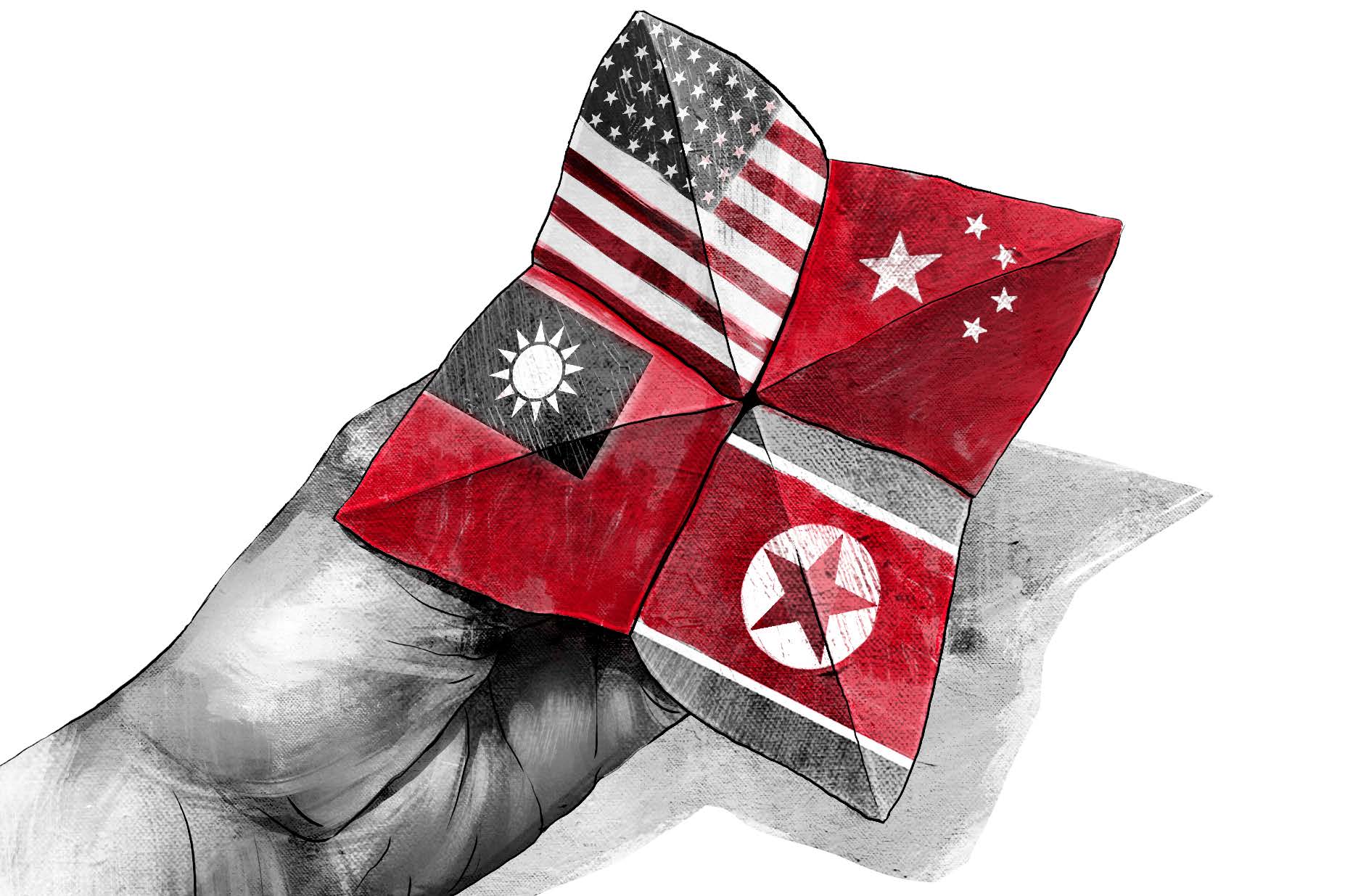
The United States possesses a critical, underutilized lever: China’s willingness to constrain North Korea is inextricably linked to the perceived level of US assurance regarding Taiwan. The history of negotiations over Pyongyang’s nuclear program demonstrates that Beijing views North Korea neither consistently as a “strategic liability” to be abandoned,11 nor purely as a “strategic asset” to be protected.12 Rather, China oscillates between constraining and condoning North Korea, with its calculus consistently shaped by the perceived level of US assurance on Taiwan.
I define “assurance” as US policy statements and actions that collectively (1) convey unequivocal opposition to any unilateral change to the status quo by either Beijing or Taipei; (2) reaffirm the commitment to maintaining strictly unofficial ties with Taiwan; and (3) support a peaceful, mutually acceptable cross-strait resolution, clearly signaling that Washington does not seek Taiwan’s permanent separation from the mainland. In this study, assurance is treated as the combination of all three elements, although the specific wording or emphasis may vary across occasions.
This linkage logic based on assurance operates in two directions. When Beijing perceives a high level of US assurance on Taiwan, it tends to view North Korea’s nuclear program and provocations as a major source of regional instability rather than a strategic asset. Secure in its core interest on Taiwan, China has proven willing to cooperate with the United States and impose tangible political and economic costs on North Korea, ranging from public condemnation and support for UN sanctions to suspending oil exports, restricting financial transactions, and driving multilateral diplomacy such as the Six-Party Talks. These instances demonstrate that when Beijing feels reassured regarding Taiwan, it is willing to constrain and punish Pyongyang’s nuclear pursuit, even at the expense of bilateral ties.
Conversely, when Beijing perceives a heightened US threat to its interests regarding Taiwan, it tends to leverage North Korea as a strategic counterweight to American pressure. In these circumstances, China shifts from constraining to condoning and even shielding the regime. “Condoning” manifests as diplomatic cover: remaining silent on North Korea’s provocations, blaming Washington for neglecting the regime’s “legitimate security concerns,” or expanding high-level exchanges. “Shielding” goes beyond acquiescence or rhetorical backing; it involves substantive, active protection where Beijing mitigates the economic and political costs of North Korea’s violations by blocking UN sanctions and obstructing international condemnation.
This article traces this North Korea–Taiwan linkage in Chinese foreign policy across four phases from 1993 to 2024. The first phase (1993–96) serves as a “non-barking dog” case, in which the temporal misalignment between the first North Korean nuclear crisis (1993–94) and the third Taiwan Strait crisis (1995–96) precluded the formation of a linkage strategy. The second phase (2002–08) illustrates explicit affirmative linkage, where Beijing actively traded pressure on Pyongyang for US opposition to then–Taiwanese leader Chen Shui-bian’s independence maneuvers. The third phase (2009–17) represents implicit affirmative linkage. During this period, China’s pressure on the North peaked, coinciding with a period of stable cross-strait relations and a high level of US assurance. The fourth phase (2018–24) marks a shift to negative retaliatory linkage. Viewing Washington’s support for Taiwan as part of a broader containment strategy, Beijing shifted from constraining to condoning and shielding Pyongyang’s aggression.
By exploring these four strategies—explicit affirmative linkage, implicit affirmative linkage, condoning, and shielding—this study moves beyond generalized claims that linkage exists to offer a concrete analytical framework. This article explains when and how Beijing utilizes the DPRK as a unique instrument to counter perceived US encroachment on its Taiwan interests. Empirically, this study challenges existing literature that suggests that China has historically compartmentalized the North Korean nuclear issue from US Taiwan policy.13
Understanding what drives the variation in China’s policy on North Korea and understanding how the United States might tilt Beijing toward cooperation are both tasks that carry renewed urgency. Even as the great powers grow skeptical of denuclearization,14 profound shifts on the Korean Peninsula and in the region have raised the stakes. These include North Korea’s September 2022 nuclear law declaring its nuclear state “irreversible” and authorizing preemptive nuclear strikes (including against non-nuclear states),15 its January 2024 abandonment of peaceful unification and designation of South Korea as its “principal enemy,”16 and its deepening alignment with Moscow following the conclusion of the December 2024 defense pact.17 Meanwhile, tensions over Taiwan show no sign of abating: Beijing has maintained steady political and military pressure on the island, and such pressure campaigns remain a focal point of contention in US-China relations. In this context, it is imperative to assess whether Beijing retains any meaningful willingness to constrain Pyongyang and any ways to do so, and under what conditions it might act as a collaborator rather than a spoiler.
Below, I provide an analytical lens to identify those conditions and recalibrate US strategy accordingly. I draw on a wide range of primary sources, categorizing Chinese-language materials into three tiers of authoritativeness. The first tier includes formal government documents and leadership speeches. These carry the highest authority and serve as the most reliable proxies for the perceptions of Chinese decision-makers. The second category consists of quasi-authoritative sources, including the Chinese Communist Party (CCP)’s official mouthpiece, the People’s Daily, and analyses from government-affiliated think tanks.18 While not definitive policy statements, these materials function as valuable barometers for prevailing strategic frames and signaling. The third category includes publications by scholars at elite universities. While technically less authoritative, these works often reflect the views of scholar-practitioners deeply embedded in the policy process and supplying the intellectual foundations for Beijing’s strategic choices.
To mitigate potential bias and verify inferences, I triangulate these Chinese materials with credible non-Chinese primary sources, including memoirs by US diplomats, declassified US government documents, contemporaneous media reports, and interviews with former US and South Korean officials who possess direct insight into China’s negotiating behavior. This multi-layered approach minimizes reliance on any single channel and grounds the findings in cross-checked evidence.
Issue Linkage Frameworks
Existing scholarship on why great powers seek nonproliferation generally falls into five categories: preserving military power-projection advantages, maintaining control over weaker allies, sustaining the global nuclear oligopoly, preventing nuclear domino effects, and mitigating nuclear safety risks. While each offers valuable insights, none fully explains the variation in China’s approach toward North Korea’s nuclear program.
The first perspective, emphasizing conventional military power-projection considerations, posits that great powers oppose nuclear pursuit—whether by adversaries or allies—to preserve their freedom of action and minimize the risk of being entangled in unwanted military conflict.19 Yet, despite possessing the capability to project power onto the Korean Peninsula and harboring obvious concerns about the destabilizing effects of North Korea’s nuclear arsenal, Beijing has not consistently constrained Pyongyang over the past three decades. This uneven track record defies the expectations of a pure power-projection model.
A second school of thought focuses on alliance politics. It argues that great powers champion nonproliferation primarily to ensure allies’ continued dependence on the patron’s security guarantees and thereby maintain or maximize the great power’s influence and control.20 This literature explores how alliance tools—such as security guarantees,21 threats of abandonment,22 forward deployments,23 and economic sanctions24—can be leveraged to bolster the nonproliferation regime.
The logic of alliance control, however, travels poorly to the Sino-DPRK case because this relationship lacks the potent control mechanisms central to the US alliance architecture. First and most important, although the 1961 Treaty of Friendship, Cooperation, and Mutual Assistance nominally obligates China to provide immediate military assistance in the event of an armed attack,25 this commitment does not constitute a credible security guarantee underwritten by extended nuclear deterrence. As Nuno Monteiro and Alexander Debs observe, a credible commitment of protection is the patron’s most powerful nonproliferation tool for dissuading a protégé from acquiring the bomb; such a commitment mitigates the protégé’s security fears while simultaneously amplifying the coercive effect of a threat of abandonment, which would leave the ally exposed to an adversary’s preventive strike.26 If Beijing’s opposition to North Korea’s nuclear program were primarily driven by a desire for alliance control, the logical move would be to provide such a guarantee—thereby eliminating Pyongyang’s rationale for an independent deterrent and deepening its security dependence on China. But Beijing has persistently refused to do so, arguably reflecting a calculated judgment that the risk of entanglement—being dragged into an unwanted conflict by its reckless ally—makes extended deterrence more a burden than a lever.27 Therefore, the alliance-control thesis fails to explain the primary driver of China’s opposition to Pyongyang’s nuclear pursuit.
Furthermore, the utility of economic sanctions—another key instrument in the alliance-control thesis—is similarly constrained by China’s own strategic paradox vis-à-vis North Korea. The alliance-control thesis posits that a great-power patron should exploit a protégé’s economic dependence to enforce nonproliferation and tighten its grip,28 but Beijing has proven unable to translate high North Korean dependence on China into sustained coercive leverage to compel nonproliferation. Instead, North Korea’s deepening dependence and geographic proximity only aggravate Beijing’s fear that withdrawing assistance could trigger instability that can spill across the border. This mentality has effectively rendered China a “hostage to . . . North Korean provocations.”29 In this particular context, economic dependence has confined the patron, rather than facilitating nonproliferation of the client.
The third explanation attributes great powers’ nonproliferation efforts to the fear of nuclear domino effects, where proliferation in one state significantly increases the likelihood of proliferation in others.30 While China worries that North Korea’s nuclear program could prompt South Korea, Japan, and other regional players to reconsider their non-nuclear commitment,31 this fear has not translated into consistent Chinese pressure on Pyongyang. The variation in China’s response suggests that preventing the fall of the nuclear dominoes is not its sole or overriding motivation.
Fourth, the “nuclear oligopoly” thesis suggests that great powers oppose proliferation to maximize their relative strategic advantages by keeping the nuclear club exclusive.32 At times, however, geostrategic priorities override this interest. During the Cold War, France provided Israel with sensitive nuclear assistance in the hope of constraining Egypt, and the United States’ rivalry with the Soviet Union led Washington to tolerate—and at times shelter—the nuclear programs of Israel and Pakistan.33 Similarly, China has facilitated or tolerated the nuclear pursuits of Pakistan and Iran.34 This reveals a key explanatory gap: If preserving nuclear oligopoly were Beijing’s primary driver, it would have maintained persistent pressure on Pyongyang. Conversely, if North Korea were a geostrategic exception, Beijing would have consistently condoned and shielded the regime’s nuclear program. The oscillation in China’s North Korea policy, however, suggests that Beijing refuses to commit to either path, and indicates that other, more dynamic variables are at work.
“States rarely address international issues in isolation; instead, they engage across multiple issue areas simultaneously, creating both incentives and opportunities for strategic bargaining through issue linkage.”
Lastly, the nuclear safety explanation highlights great powers’ fears that nuclear materials in weak or fragile states could be acquired by non-state actors, potentially leading to nuclear terrorism.35 While China shares these concerns regarding North Korea’s nuclear facilities,36 its fluctuating policy indicates that safety considerations alone do not drive its strategic calculus.
The Logic of Issue Linkage
If existing explanations cannot fully account for China’s fluctuating approach toward North Korea’s nuclear program over the past three decades, what does? I argue here that China’s North Korea policy can be understood through the logic of issue linkage: Beijing’s willingness to constrain Pyongyang is shaped by its perception of US responsiveness to China’s core interest regarding Taiwan.
States rarely address international issues in isolation; instead, they engage across multiple issue areas simultaneously, creating both incentives and opportunities for strategic bargaining through issue linkage. Issue linkage occurs when one party conditions its actions on a particular issue upon the other party’s behavior on a separate issue. This practice is long recognized as an “ancient and accepted aspect of diplomacy”37 and a “prominent and venerable practice” in international politics.38
Linkage can involve mutual accommodation, where parties agree to make reciprocal concessions to induce desired changes in each other’s policies, or unilateral concessions, in which one side unilaterally imposes linkage to compel the other to yield.39 In great-power relations, linkage is more likely to involve mutual accommodation, as unilateral concessions are often politically costly and unacceptable due to concerns about status and credibility. Moreover, the relatively narrow power gap between great powers limits the ability of one to simply impose its will on the other. For example, during the 1962 Cuban Missile Crisis, the Soviet Union removed missiles from Cuba in exchange for US missile withdrawals from Turkey and a pledge not to invade Cuba. Similarly, in the 1911 Agadir crisis, Germany recognized a French protectorate in Morocco in exchange for France’s territorial concessions in Congo.40 By contrast, the Clinton administration’s attempt in 1993–94 to condition the extension of China’s “most favored nation” (MFN) trading status on human-rights improvements failed, illustrating the limitations of unilateral linkage in great-power interactions.
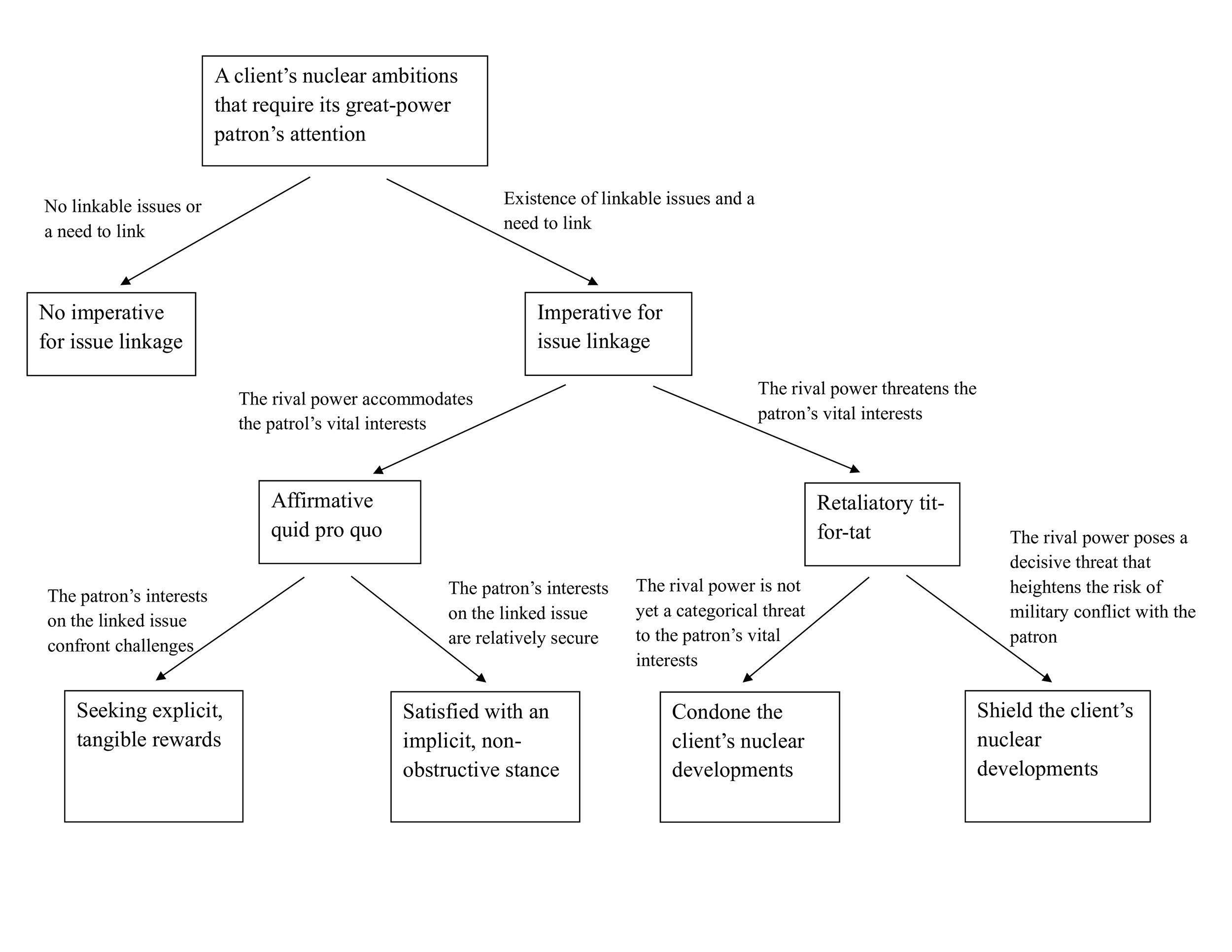
For a great-power patron managing a nuclear-aspiring client state, issue linkage is an attractive strategy. Although a client’s nuclear ambitions can jeopardize the patron’s own security interests—by increasing risks of a preventive strike, provoking an arms race, prompting rival powers to strengthen missile defense capabilities that in effect undermine the patron’s deterrent,41 or emboldening the client to provoke crises that entrap the patron42—the client’s behavior can also serve as leverage in the patron’s strategic bargaining with a rival power.
Patron states can pursue two types of linkage. The first is affirmative quid pro quo linkage, where the patron restrains the client’s nuclear program in exchange for the rival power’s accommodation on a separate issue vital to the patron’s strategic interests. For this to be viable, both issues need to be perceived as comparable in importance, ensuring that each side views the accommodation it offers on one issue as commensurate with the gains it receives on the other.43 Moreover, the parties need to have divergent but complementary priorities across the issues, allowing each side to compromise on the issue it considers relatively less pressing to secure accommodation on the one it deems more urgent.44 This functions as a mechanism for side payments, allowing the parties to achieve satisfactory mutual gains to sustain cooperation.45
The extent of accommodation sought by the patron varies based on its threat perception. When the patron perceives its interests on the linked issue as seriously challenged—whether by the rival power’s actions or developments internal to the issue—it may seek tangible and explicit rewards, such as public statements or concrete policy adjustments. Conversely, if the patron feels relatively secure, an implicit, non-obstructive stance by the rival may suffice. Therefore, linkage can be explicit or implicit, formal or informal—but it exists when issues are discussed jointly for coordinated management at high-level venues such as summits, rather than being addressed separately through lower-level bureaucratic channels.46
However, quid pro quo arrangements achieved through issue linkage are inherently susceptible to disruption. Setbacks in one issue can spill into the other, weakening or dissolving the entire arrangement.47 For example, if one party’s gains diminish and no replacement issue of comparable significance can be identified to sustain the equilibrium, that party’s incentive to uphold accommodation on the linked issue may decline accordingly. Additionally, shifting strategic priorities may prompt a reassessment of the original bargain. For instance, an adversarial shift in the parties’ broader relations may lead them to subordinate nonproliferation goals to their new strategic imperatives.48
If affirmative linkage proves elusive and the patron perceives heightened threats from the rival power, the patron may opt for retaliatory linkage. This approach can manifest in two ways. If the threat from the rival power is seen as concerning but not yet fundamental, the patron may tacitly condone the client’s nuclear development without directly confronting the rival power, using the client’s activities as leverage to push the rival back toward affirmative linkage. If, however, the patron believes that the rival power has adopted a decisively adversarial posture that threatens its vital interests, it may overtly shield the client, viewing it as a strategic asset to counterbalance the rival or pin down adversary forces in a potential military conflict.
Table 1 summarizes the four distinct linkage strategies outlined in this section, and figure 1 maps the whole decision-making process.
Table 1. A matrix of linkage strategies
| Rival power is accommodating | Rival power is threatening | |
|---|---|---|
| Patron’s vital interests being seriously challenged | Affirmative linkage (explicit affirmative linkage) | Retaliatory linkage (overt shielding) |
| Patron’s vital interests remaining relatively secure | Affirmative linkage (implicit affirmative linkage) | Retaliatory linkage (tacit condoning) |
Figure 1. A stylized decision tree of issue-linkage strategy. Figure by author.
North Korea–Taiwan Linkage
Beijing has long viewed its relationship with Pyongyang through the prism of its broader strategic interactions with Washington, making the North Korean nuclear issue inseparable from other contentious issues in US-China relations.49 Among these other issues, Taiwan constitutes China’s paramount “red line,” and one on which Beijing persistently seeks US assurances. This structural configuration creates a strong incentive for China to link its cooperation on North Korea to Washington’s willingness to reassure Beijing regarding Taiwan.
This North Korea–Taiwan linkage operates under three scope conditions. The first is a divergence in immediate strategic priorities. While both Beijing and Washington regard Taiwan and the Korean Peninsula as geopolitically vital, their hierarchies of immediate concerns in each place differ. China places paramount importance on preventing Taiwan’s de jure independence and ensuring stability on the Korean Peninsula, whereas the United States prioritizes peaceful resolution of the Taiwan issue and curbing North Korea’s nuclear program. This divergence allows each side to make some accommodation on the issue it views as having lower urgency (represented by the blue shading in table 2) to secure cooperation on the issue it deems more pressing (the red shading in table 2).
Table 2. Differing priorities of China and the United States on North Korea and Taiwan
| China | United States | |
|---|---|---|
| Taiwan | 1. Taiwan’s status 2. Peace and stability | 1. Peace and stability 2. Taiwan’s status |
| North Korea | 1. Peace and stability 2. Curbing nuclear program | 1. Curbing nuclear program 2. Peace and stability |
The second scope condition is the capacity for the symmetrical exchange of benefits. This symmetry arises because both North Korea and Taiwan can create high-stakes contingencies that directly implicate the core security interests of both great powers, but that neither great power can manage unilaterally. North Korea did not initially emerge as China’s default lever; Beijing earlier made attempts to link Taiwan to its counterterrorism cooperation after 9/11 but abandoned such intention.50 This lack of success likely stemmed from an asymmetry in value: Although China provided diplomatic support, it could not offer benefits commensurate with the accommodation it sought on Taiwan. Beijing’s refusal to permit US military logistical transits through Xinjiang via the Wakhan Corridor into Afghanistan arguably further limited the value of its cooperation and bargaining leverage.51 By contrast, the North Korean nuclear issue offered a more symmetrical bargaining space. China’s status as the DPRK’s primary patron rendered its cooperation indispensable to US nonproliferation objectives, while the nuclear risks to the US were severe enough that Beijing could demand reciprocal US assurances on Taiwan.
The third scope condition is that US-China interactions over both issues constitute a repeated game. Unlike episodic policy issues such as the Cuban Missile crisis or discrete trade frictions that are amenable to “one-off” settlements, North Korea and Taiwan are protracted geopolitical issues that defy clean, “one-off” resolutions. Thus, the management of the two issues unfolds as repeated strategic interactions spanning decades. Once Beijing operationalized the linkage during the second North Korean nuclear crisis (2002–08), the strategy’s utility became internalized. For China, the structurally weaker party vis-à-vis the United States, that initial success fostered a path of dependence that entrenched the linkage approach across subsequent leadership changes in Beijing.
To assess Beijing’s cooperation on the North Korea issue, I examine four qualitative indicators: (1) China’s declaratory position attributing responsibility for negative developments; (2) China’s support for and enforcement of international sanctions; (3) high-level contact signaling Beijing’s political backing for or dissatisfaction with Pyongyang; and (4) China’s attitude toward multilateral efforts to curb North Korea’s nuclear program.
To evaluate the perceived level of US assurance on Taiwan, I examine three qualitative dimensions: (1) the US declaratory position reflecting attribution of responsibility for cross-strait tensions; (2) US arms sales to Taiwan; and (3) high-level contact between the US and Taiwan, which Beijing views as an indicator of erosion in the unofficial nature of US-Taiwan relations.
Table 3 summarizes the measurements of China’s cooperation and US assurance.
Table 3. Measurements of Chinese cooperation and US assurance
| China’s cooperation on North Korea | Level | US assurance on Taiwan | |||||
|---|---|---|---|---|---|---|---|
| Declaratory position | International sanctions | China–North Korea high-level contact | Attitude toward multilateral efforts | Declaratory position | Arms sale | US-Taiwan high-level contact | |
| Explicitly condemn DPRK | Support and enforce | Senior-level visits* | Active/open support | High | Oppose Taiwan independence; welcome cross-strait engagement | Twice a year or less; no major weapons platforms included | Restricted Taiwan leader transits; no high-level visits |
| Neutral language; push for denuclearization while acknowledging the legitimacy of DPRK’s security concerns | Support but water down | Leadership-level visits** | Non-obstructive participation | Medium | Non-support for Taiwan independence; reaffirm the “One China” policy | More than twice a year; no major weapons platforms included | Relaxed restrictions on Taiwan leader transits with low visibility; limited high-level visits |
| Blame the US; defend DPRK | Block or veto sanctions | Top leader visits*** | Resist/obstruct | Low | Claim that the US has a defense obligation to Taiwan | More than twice a year; major weapons platforms included | Relaxed restrictions on Taiwan leader transits with high visibility; frequent high-level visits |
* Chinese senior-level visits are defined as visits by CCP Politburo members minus all Politburo Standing Committee (PBSC) members.
** Chinese leadership-level visits are defined as visits by PBSC members minus the general secretary.
*** Chinese top leader visits are defined as visits by the general secretary of the CCP.
China’s Policy Toward North Korea’s Nuclear Program as an Issue Linkage
Beijing’s cooperation (or lack thereof) in curbing North Korea’s nuclear program has varied between 1993 and 2024 in response to perceived US willingness to reassure China on its interests regarding Taiwan.
The Dog That Didn’t Bark: The DPRK Nuclear Crisis and Taiwan Strait Crisis in the 1990s
During the 1993–94 North Korean nuclear crisis, China played an active, behind-the-scenes role in restraining Pyongyang. Although Beijing avoided formal participation in nuclear negotiations, due largely to lingering tensions with Washington following the 1989 Tiananmen crackdown, it did operate as an informal intermediary between the United States and North Korea. This episode represents a “non-barking dog” case: China did not link its cooperation on North Korea to US assurance regarding Taiwan. This absence of linkage was primarily a result of temporal misalignment: The nuclear crisis ended before the 1995–96 Taiwan Strait crisis, a watershed event that severely undermined Beijing’s confidence in Washington’s commitment to maintaining (only) unofficial relations with Taipei.
China initially responded to the 1993 North Korean nuclear crisis with relative passivity. When Pyongyang threatened to withdraw from the Non-Proliferation Treaty (NPT) in March of that year, Beijing opposed a UN Security Council condemnation. At the same time, it served as a communication conduit between Washington and Pyongyang and signaled its general opposition to North Korea’s nuclear program.52 China then abstained from the mildly worded Security Council Resolution 825 in May 1993 that urged North Korea to reconsider its NPT withdrawal.
Two interrelated factors drove this passive posture. First, China Institutes of Contemporary International Relations (CICIR) researcher Sun Ru notes that strained US-China relations after the Tiananmen crackdown—and consequent US sanctions—dampened Beijing’s willingness to cooperate.53 Then, under the early Clinton administration, bilateral frictions over human rights intensified: After campaigning against George H. W. Bush for coddling the “butchers of Beijing,” President Bill Clinton in May 1993 formally tied renewal of China’s MFN trade status to human rights improvements.54 As Fudan University arms-control expert Shen Dingli noted ahead of Clinton’s meeting with Chinese President Jiang Zemin in Seattle in November 1993, such a political climate was “not very conducive” to eliciting active Chinese cooperation on the nuclear issue.55 Second, Beijing was aware of the limits of its leverage over Pyongyang, which had been worsened by China’s diplomatic recognition of South Korea the previous year and North Korea’s subsequent distancing.56
“Following the Jiang-Clinton summit in Seattle, where Clinton’s pledge to pursue a more constructive relationship initiated a thaw in bilateral ties, Beijing began actively pressuring North Korea.”
Following the Jiang-Clinton summit in Seattle, where Clinton’s pledge to pursue a more constructive relationship initiated a thaw in bilateral ties,57 Beijing began actively pressuring North Korea.58 By December, China had leveraged its newly established ties with Seoul to push Pyongyang into allowing International Atomic Energy Agency (IAEA) inspections; by cultivating ties with Seoul, Beijing demonstrated to Pyongyang that it now had diplomatic options that its isolated ally lacked—a pointed reminder that China, as North Korea’s sole remaining friend, was essential to the regime’s survival and that Chinese support could not be assumed.59 This pressure increased in the spring of 1994 after Pyongyang obstructed IAEA access to its reprocessing facilities and threatened to turn Seoul into a “sea of fire.” In a move that a US negotiator described as a “sharp departure” from its previous obstructionism, Beijing abstained from an IAEA resolution referring North Korea’s noncompliance to the United Nations (UN) Security Council.60
The crisis deepened after North Korea discharged spent fuel in a manner that prevented the verification of plutonium separation, and Beijing signaled—both publicly and privately—that it might not shield Pyongyang from international sanctions. In June 1994, the Hong Kong–based Da Gong Bao, a widely recognized quasi-official outlet for Beijing, published an article suggesting that China could suspend oil and food supplies if UN sanctions were imposed. Meanwhile, Chinese think-tank experts informed the US Embassy officials that Beijing might abstain from a Security Council resolution imposing “limited” sanctions.61 These signals gained further credibility when China abstained from an IAEA decision to suspend all technical assistance to the DPRK, and China’s Vice Foreign Minister Tang Jiaxuan explicitly warned the North Korean ambassador that there were “limits” to China’s ability to block UN sanctions.62
Crucially, Beijing’s pressure on North Korea during this period proceeded without attempts to extract reciprocal assurances from Washington on Taiwan. When Clinton came into office, Taiwan was neither central to US-China bilateral tensions nor high on the administration’s agenda.63 Despite protesting the 1992 sale of F-16 fighter jets to Taiwan, Chinese leaders largely accepted the Bush administration’s explanation that the sale was motivated by electoral considerations and involved less advanced fighter models.64 This confidence was sustained during the nuclear crisis by the Clinton administration’s cautious handling of Taiwan. Notably, when Taiwan’s leader, Lee Teng-hui, transited through Hawaii in April 1994, Washington deliberately restricted him to a brief refueling stop without allowing an overnight stay. As Richard Bush observed, this episode occurred at a time when the administration was actively working with Beijing on the North Korean nuclear issue and seeking to delink China’s MFN status from human rights; these foreign-policy priorities—especially the nuclear crisis—shaped the administration’s cautious handling of Lee’s transit, because “it was in Washington’s fundamental interest that Beijing’s position be close to that of the United States, and that nothing be done to sow unnecessary division.”65 Former senior State Department officials involved in the crisis, including chief negotiator Robert Gallucci, confirmed that Taiwan did not feature prominently in US-China interactions, and Beijing made no attempts to link the two issues.66
This compartmentalization between Beijing’s North Korea policy and Washington’s Taiwan policy collapsed after May 1995, when Washington granted Lee Teng-hui a visa to visit Cornell University. This decision triggered the 1995–96 Taiwan Strait crisis and severely eroded Chinese confidence in US assurances. Beijing rejected the Clinton administration’s explanation that congressional pressure compelled it to reverse an earlier denial of Lee’s visa; instead, Chinese leaders viewed the visa as a deliberate attempt by Washington to play the “Taiwan card” to obstruct China’s unification and revive containment.67 Subsequent US reassurances68—including Clinton’s 1998 “Three Nos” policy, which marked the first open presidential pledge not to support Taiwan independence69—failed to fully restore Beijing’s confidence. One former State Department senior official identified this episode as laying the foundation for issue linkage.70
By the late 1990s, the rationale for linking China’s cooperation on North Korea to US assurance on Taiwan began to take shape. This evolution was catalyzed by the election of George W. Bush, who signaled a preference for a tougher China policy and robust support for Taiwan’s security,71 as well as by Lee Teng-hui’s 1999 characterization of cross-strait relations as “special state-to-state.”72 Beijing also feared that Lee was backing pro-independence candidate Chen Shui-bian in Taiwan’s 2000 general election.73 Against this backdrop, Chinese foreign policy experts began articulating a specific logic for linkage. In 2000, for example, Peking University professor Zhang Xizhen warned that China’s continued willingness to mediate on the North Korea issue would be contingent on the US stance toward China—especially regarding Taiwan and missile defense. If US hardliners prevailed, he argued, China could cease its mediation and realign more closely with North Korea and Russia.74
Explicit Affirmative Linkage: Leading the Six-Party Talks and Reining In Chen Shui-bian (2002–08)
The second North Korean nuclear crisis (2002–08) coincided with Beijing’s growing anxiety over what it perceived as independence-leaning moves by Taiwan during Chen Shui-bian’s tenure (2000–08). In contrast to the passive approach of the early 1990s, China assumed an assertive leadership role in multilateral efforts like the Six-Party Talks (6PT) to curb Pyongyang’s nuclear program,75 explicitly linking its cooperation to Washington’s willingness to restrain Chen’s pro-independence agenda. This US-China dynamic, described by scholars with close ties to Chinese officialdom as “co-management,” established a transactional equilibrium: Beijing depended on Washington to restrain Taipei, while Washington looked to Beijing to help curb North Korea.76
When revelation of Pyongyang’s secret highly enriched uranium (HEU) program precipitated the crisis in October 2002, Beijing was already alarmed by the Bush administration’s signals on Taiwan. President Bush had relaxed restrictions on official contacts between the US and Taiwan, approved the largest arms sale to the island since the 1992 F-16 deal, and publicly declared the US would do “whatever it took” to defend Taiwan.77 China’s anxiety deepened in August 2002 when Chen asserted that “one country exists on each side of the Taiwan Strait” and called for a referendum on Taiwan’s formal independence.78
The nuclear crisis provided Beijing the leverage it needed to counter these trends. After Beijing’s abandoned attempts to link its post-9/11 counterterrorism cooperation to the Taiwan issue,79 President Jiang Zemin pledged cooperation toward a nuclear-free Korean Peninsula at an October 2002 summit with President Bush in Crawford, Texas.80 According to Christopher Hill, the US chief negotiator to the 6PT from 2005, it was during this summit that the two leaders first worked through the idea of the 6PT.81 Meanwhile, Jiang urged Bush to explicitly “oppose”—rather than merely “not support”—Taiwan independence. While US policy remained publicly unchanged, Bush privately agreed to the stronger language.82
Beginning in 2003, Beijing’s actions operationalized its linkage strategy. After Pyongyang withdrew from the NPT, China supported an IAEA resolution referring the issue to the UN Security Council—a notable departure from its 1994 abstention on a similar measure.83 When Secretary of State Colin Powell visited Beijing in February to urge China to host multilateral talks on the nuclear crisis,84 Chinese officials indicated that Washington’s willingness to consider “trade-offs”—meaning greater US flexibility on Taiwan—would be key to Beijing’s cooperation on North Korea. One Chinese official bluntly stated: “The United States cannot expect us to continually give unless it gives us something, too. That’s how the real-world works.”85 Chinese officials also expressed frustration with Washington’s refusal to discuss US military support for Taiwan, particularly in light of China’s tacit acceptance of US policies on North Korea and Iraq; they warned that continued US unresponsiveness would ultimately make China’s cooperation less active than it could be.86
To compel Pyongyang to the negotiating table, Beijing briefly halted oil supplies in March 2003, and signaled that its defense commitments under the 1961 treaty were conditional on North Korean behavior.87 These measures facilitated the launch of 6PT that August. By the fall, acting on a US intelligence tip, China blocked a rail shipment of chemicals bound for North Korea that could be used for plutonium extraction, further demonstrating its operational cooperation.88 Senior Chinese officials explicitly confirmed that China’s actions were motivated in part by expectations of reciprocal US assurances on Taiwan. In 2005, Chinese Vice Foreign Minister Zhou Wenzhong noted that while North Korea and Taiwan were separate issues, Beijing viewed them as inherently linked. Such connections were rarely openly discussed by the Chinese government, but Zhou noted that one motivation behind China’s increasingly active cooperation on North Korea was to signal good faith to Washington and secure US support on Taiwan.89 Another senior MFA official similarly stressed to American interlocutors: “China is ready to work with the US for a peaceful, non-nuclear [Korean] peninsula. We want you to care as much about Taiwan as you want us to care about Korea.”90
Chen Shui-bian’s provocations throughout 2003—including proposals for referendums that touched on the sensitive issue of Taiwan’s sovereignty91—strengthened Beijing’s case for linkage, largely by heightening Washington’s fears of cross-strait military conflict. During Chinese Premier Wen Jiabao’s visit to Washington in December 2003, President Bush publicly rebuked Chen for attempting to unilaterally change the status quo, while praising China as a “partner in diplomacy” on the North Korean nuclear issue.92 Subsequent statements from senior US officials reinforced Washington’s dual message of restraining Taipei and reassuring Beijing. In April 2004, Assistant Secretary of State James Kelly warned that Taiwan’s leaders “misunderstood” US policy if they expected unconditional support.93 In October of that year, Secretary of State Colin Powell told Chinese media that independence movements would find “no support” from the United States.94 In December, Deputy Secretary of State Richard Armitage clarified that the US was not strictly required to defend Taiwan.95
Despite these American assurances, Beijing remained skeptical of the extent to which Washington would accommodate its concerns over Taiwan. A friction point surfaced in February 2005 when the US-Japan Security Consultative Committee (a.k.a. the “2+2” Ministerial Meeting) issued a joint statement that explicitly identified the peaceful resolution of the Taiwan issue as a shared strategic objective of the alliance. This marked a significant departure from the more ambiguous 1997 Defense Cooperation Guideline, which referred only to “situations in areas surrounding Japan.”96 Beijing feared that this shift would embolden pro-independence groups on Taiwan,97 and in a signal of great displeasure, Foreign Minister Li Zhaoxing downplayed China’s role in the 6PT at a press conference on March 6, describing China as just “facilitating.”98
In this context, Chinese strategic thinkers began to consider the limits of the affirmative linkage strategy. Fudan University professor Wang Yiwei—who later served as a diplomat to Europe—cautioned that US accommodation through linkage had clear limits, and urged Beijing to maintain realistic expectations.99 Furthermore, the 2007 annual report of the China Arms Control and Disarmament Association (CACDA)—a nominal NGO affiliated with the Foreign Ministry and maintaining close ties to the People’s Liberation Army (PLA)100—floated a negative variant of the linkage logic. The report suggested that a nuclear-armed North Korea could serve a strategic purpose by pinning down US forces in the event of a Taiwan contingency.101
The linkage further solidified following North Korea’s first nuclear test in October 2006. Having failed to prevent the test despite a suspension of oil exports to the DPRK in September,102 and having received only twenty minutes’ notice of the test,103 Beijing responded with a stern condemnation calling the test a “blatant” (hanran) act—one of its strongest diplomatic rebukes of Pyongyang.104 China also supported a Security Council resolution imposing expanded economic sanctions and travel bans on individuals associated with North Korea’s nuclear program, although it blocked authorization of the use of force.105 By late October, major Chinese state-owned banks had reportedly cut off financial transactions with North Korea.106
These punitive measures coincided with continued US assurance regarding Taiwan. In early October 2006, news broke that President Bush had blocked the sale of sixty-six F-16 fighter jets to Taiwan despite the Pentagon’s endorsement.107 This decision was shaped by the administration’s broader strategic calculations, including especially the need for Chinese cooperation on North Korea and Iran, as well as US concerns about Taiwan’s internal politics.108 In August 2007, Chinese Foreign Minister Yang Jiechi reiterated Beijing’s opposition to the possible sale of F-16s and anti-submarine aircraft during a meeting with Deputy Secretary of State John G. Negroponte, who reassured Yang that Washington remained attentive to China’s concerns and committed to preserving the cross-strait status quo.109 By the end of his presidency, Bush had drawn strong criticism from Taiwan’s supporters for effectively freezing arms sales to the island to secure Beijing’s cooperation on North Korea.110 When the F-16 sale eventually proceeded in 2019, Rupert Hammond-Chambers, president of the US-Taiwan Business Council, noted that Beijing had played an “over-weighted role” in Washington’s arms-sale deliberations—including Bush’s 2006 decision.111
In the final year of the Bush administration, Beijing continued to use linkage to press the United States. Washington provided further reassurance by publicly opposing Chen Shui-bian’s 2008 referendum on joining the UN as “Taiwan.”112 During a January 2008 meeting with US Deputy Assistant Secretary of State Thomas Christensen, Yang Jiemian (head of the influential think tank SIIS and brother of Foreign Minister Yang Jiechi) reiterated the notion that the way the United States dealt with Taiwan was linked with Chinese cooperation on other international issues such as North Korea.113
The year 2008 marked a turning point in Beijing’s linkage strategy, as Beijing shifted away from explicit to implicit affirmative linkage. On the Korean side, the 6PT collapsed after Pyongyang withdrew from the talks and embarked on full-scale nuclear development, sharply raising the security risks for China. Meanwhile, across the Taiwan Strait, the 2008 electoral victory of Kuomintang (KMT) candidate Ma Ying-jeou, whom Beijing viewed as firmly anti-independence and receptive to cross-strait engagement, considerably eased its anxieties over Taiwan and reduced the urgency of using the North Korea issue as a lever to secure explicit US assurance. With cross-strait relations stabilized, Beijing grew content with an implicit, non-obstructive US stance on Taiwan and came to treat North Korea’s nuclear program primarily as a national security concern rather than bargaining leverage on the Taiwan question.
The levels of China’s cooperation and US assurance during the second North Korean nuclear crisis are summarized in appendices 1 and 2.
Implicit Affirmative Linkage: Curbing North Korea and Enhanced Reassurance About Taiwan (2009–17)
During Ma Ying-jeou’s presidency (2008–16), which largely overlapped the Obama administration, Beijing enjoyed a relatively high level of security regarding Taiwan and US assurance. This considerably reduced China’s incentive to actively leverage the North Korea issue to extract explicit US assurances, allowing Beijing to settle for an implicit, non-obstructive US stance. In this context, China recalibrated its approach toward North Korea’s nuclear program, treating it primarily as a direct national security concern rather than a bargaining lever vis-à-vis Washington.
Between 2009 and 2012, China adopted a softer approach toward North Korea, driven by peninsula-specific concerns unrelated to Taiwan. Beijing prioritized ensuring a stable leadership succession from Kim Jong Il to Kim Jong Un, hoping the new leadership would embrace economic reform and eventual denuclearization in exchange for international aid and security assurances.114 As such, China tempered its response to North Korea’s 2009 nuclear test, blocked international condemnation of the 2010 Cheonan sinking and the shelling of Yeonpyeong Island, and expanded its own engagement with the DPRK.115
Despite being buoyed by improved cross-strait relations and a welcoming US posture,116 however, Beijing remained uncertain about the long-term durability of these conditions, and continued to implicitly probe the viability of linkage. Following US arms sales to Taiwan in 2010 and 2011, Chinese President Hu Jintao urged President Barack Obama in March 2012 to respect China’s “core interests and major concerns,” notably without naming Taiwan or demanding explicit, public US assurances; meanwhile, Hu signaled Beijing’s readiness to expand coordination with Washington on North Korea.117 This episode coincided with Washington’s efforts to secure and implement the 2012 Leap Day Agreement, a deal that Christopher Hill noted Beijing “worked fairly hard” to help cement.118 The Obama administration subsequently froze further arms sales to Taiwan until late 2015. Some US experts attributed the freeze to “changing conditions and new priorities.”119 While unspecified in open sources, such factors might range from reduced cross-strait tensions to Washington’s desire to secure Beijing’s cooperation on Iran, to halting North Korea’s weapons of mass destruction (WMD) programs—an objective Obama framed as Washington’s “core interest” in exchanges with his Chinese counterpart, who invoked Beijing’s core interests in Tibet and Taiwan.120
“Beijing continued to push the linkage strategy under President Xi Jinping, even though Taiwan was not the most contentious issue in US-China ties during the early Xi era.”
Beijing continued to push the linkage strategy under President Xi Jinping, even though Taiwan was not the most contentious issue in US-China ties during the early Xi era. Recalling a government-to-government meeting after the 2013 Xi-Obama Sunnylands summit, a former senior Department of Defense (DOD) official noted that his Chinese counterpart implicitly suggested “there could be some maneuvering room” for North Korea–Taiwan linkage.121
Seeing its Taiwan interests as relatively secure, China responded to North Korea’s third nuclear test in February 2013 with an unusually harsh public rebuke. Pyongyang’s move dashed Beijing’s hope for North Korea’s reform and denuclearization,122 and Foreign Minister Yang Jiechi summoned the DPRK ambassador to express “strong dissatisfaction” and “firm opposition.” This protest prominently featured in the People’s Daily, signaling a sharp break from Beijing’s customary reluctance to openly criticize its ally.123 In April, Xi Jinping warned at the Boao forum that “[no] one should be allowed to throw a region and even the whole world into chaos for selfish gains”—remarks widely interpreted as directed at Pyongyang.124
Beijing followed this strong rhetoric with material pressure. It supported expanded UN sanctions, and closed the North Korean Foreign Trade Bank’s account at Bank of China—a move that came after the Security Council strengthened financial sanctions against the North and the US Treasury Department sanctioned the bank for its connections to Pyongyang’s nuclear weapons and missile activities.125 In a sharp departure from its past opacity on export controls, China issued a detailed list of dual-use items banned from export to the DPRK.126 Xi’s 2014 visit to South Korea further underscored Beijing’s displeasure by reversing the long-standing protocol that Chinese leaders visit Pyongyang before Seoul. Meanwhile, China repeatedly rebuffed North Korea’s requests for Xi to meet Kim Jong Un, wary that such a meeting might be followed by another nuclear test that could imply (wrongly) Chinese endorsement.127 A growing number of Chinese analysts—including CCP officials affiliated with the Central Party School and retired senior PLA officials—also began openly questioning the value of the Sino-DPRK alliance and calling for its termination.128
The electoral victory of Tsai Ing-wen from Taiwan’s Democratic Progressive Party (DPP) in January 2016 reactivated Beijing’s impetus to consider linkage strategies, but did not trigger an immediate reversal in China’s approach. Circumstantial evidence suggests that the Obama administration’s rapid diplomatic intervention to preserve cross-strait stability reassured Beijing,129 thereby sustaining the basic conditions for affirmative linkage. On January 19, former Deputy Secretary of State William Burns traveled to Taipei, and Deputy Secretary of State Anthony Blinken visited Beijing on January 21. These back-to-back visits underscored Washington’s commitment to continued stability in the Taiwan Strait.130 As Tsai pledged to maintain regional stability,131 Blinken reaffirmed in Beijing the US’s “abiding interest in continued cross-strait peace and stability” to China’s Taiwan Affairs Office Minister Zhang Zhijun. Notably, Blinken also co-chaired the US-China Interim Strategic Security Dialogue (ISSD), where both sides discussed their responses to North Korea’s January 6 nuclear test.132
Against this backdrop of continued US assurance, Beijing doubled down on pressuring North Korea after the nuclear tests in January and September 2016. China supported a Security Council resolution mandating inspections of cargo entering or leaving North Korea—a measure it had long resisted.133 Although China faced criticism for continuing coal imports from North Korea in violation of international sanctions,134 it eventually supported a November 2016 resolution to close that loophole by imposing an annual coal import cap and establishing a UN monitoring mechanism.135 Trade data from the subsequent year confirmed a significant drop in China’s coal imports from North Korea, aligning Chinese policy with international sanctions.136
China’s stringent stance persisted into the first year of the first Trump administration (2017), motivated by a desire for continued US assurance. President Trump’s intense focus on North Korea and his transactional diplomatic approach reinforced the logic of affirmative linkage and shifted it toward a more explicit modality. Beijing’s anxiety initially spiked after Trump’s December 2016 call with Tsai and his remarks questioning the US commitment to the “One China” policy,137 but eased after Trump reaffirmed standard US policy during a call with Xi in February 2017.138 At the April 2017 Mar-a-Lago summit, President Xi agreed on the urgency of the North Korea issue, while urging Trump to handle Taiwan “properly” to avoid straining bilateral ties.139 Chinese think-tank analysts underscored the linkage explicitly. China Institute of International Studies (CIIS) researcher Liu Qing warned that challenging the One China policy would jeopardize US-China ties precisely when Washington urgently needed Beijing’s help on North Korea, warning that “the benefits would not warrant the costs.”140
A major boost to Beijing’s confidence in US assurance came in late April, when Trump openly rejected Tsai’s request for a second call and explicitly stated that he did not want to create problems for Xi while China was helping on North Korea.141 With this renewed assurance, China continued applying pressure on Pyongyang, consistent with the logic of issue linkage. Following North Korea’s July 2017 intercontinental ballistic missile (ICBM) test, China backed a Security Council resolution imposing sweeping bans on key North Korean exports.142 Chinese state media publicly warned that China might withhold assistance if North Korea’s provocations triggered US retaliation—a stern message given the approaching 2021 expiration of the 1961 Sino-DPRK treaty.143 Reinforcing this warning, prominent Chinese experts—including retired PLA strategist Major General Yao Yunzhu and Peking University professor Jia Qingguo—openly urged Beijing to initiate contingency planning discussions with Washington and Seoul regarding the Korean Peninsula. This broke a longtime taboo on the subject, and reflected Beijing’s willingness to risk antagonizing Pyongyang.144
China’s response to North Korea’s September 2017 nuclear test was its most robust since Pyongyang’s first test in 2006. Beijing issued a statement of “strong condemnation,” explicitly criticizing North Korea’s “incorrect actions” for aggravating regional tensions—unusually harsh language.145 China then supported a new Security Council resolution imposing crushing economic sanctions, including a 30 percent cut to oil supplies and a ban on joint ventures and overseas labors.146 Shortly after, China ordered the closure of joint ventures within 120 days.147 Ahead of President Trump’s state visit to China in November, Beijing also suspended tourism to North Korea, thereby cutting off one of Pyongyang’s few remaining foreign sources of hard currency.148
By early 2018, US analysts noted “unprecedented” Chinese cooperation on North Korea,149 and some even suggested that Beijing was no longer committed to preserving the regime.150 Yet the Chinese posture soon shifted from actively constraining North Korea to tacitly condoning and overtly shielding its behavior, driven in part by Beijing’s renewed anxiety over what it perceived as weakening US assurance on Taiwan amid deteriorating US-China relations.
Appendices 3 and 4 summarize the levels of China’s cooperation and US assurance during the 2009–17 period.
Retaliatory Linkage: Condoning and Shielding North Korea as US Assurance “Hollowed Out” (2018–24)
The first Trump administration’s designation of China as a “strategic competitor” in its national security documents marked a fundamental shift toward a more adversarial bilateral relationship beginning in 2018.151 As US-China tensions over Taiwan grew, Beijing increasingly came to view North Korea as a strategic counterweight to the United States. Consequently, China shifted its policy from constraining Pyongyang to condoning and shielding the regime.
Throughout 2018, Washington significantly bolstered US support for Taiwan, eroding Beijing’s confidence in US assurances. The FY2018 National Defense Authorization Act (NDAA) mandated a stronger US-Taiwan defense partnership,152 and the Taiwan Travel Act relaxed restrictions on high-level exchanges between the two sides’ officials. In March, Deputy Assistant Secretary of State Alex Wong visited Taipei to reaffirm US support,153 a move followed by US approval of technology transfers in April for Taiwan’s indigenous submarine program.154 These moves drew strong protests from Beijing, which viewed them as threats to the political foundation of US-China relations.
Amid these developments—and also fearing marginalization ahead of the impending Trump-Kim Singapore summit155—Beijing moved swiftly to preserve its leverage vis-à-vis Washington by revitalizing ties with Pyongyang. During Kim Jong Un’s first visit to China in late March 2018, Xi Jinping reassured him that the Sino-DPRK bond “would not change due to a single period of time or a single issue.”156 A People’s Daily commentary framed their meeting as a strategic elevation of the relationship, necessitated by a shifting international landscape.157 Kim’s two subsequent visits to China over the next three months further consolidated this rapprochement.
This rapprochement was likely designed to sustain and reinforce an affirmative quid pro quo linkage. Fudan University professor Wu Xinbo—a policy advisor to the foreign ministry—suggested that, given Trump’s transactional approach, Beijing should utilize “interest exchanges” to shape strategic competition in its favor.158 Fudan scholar Qi Huaigao similarly argued that China should actively pursue interest exchanges in its peripheral diplomacy, identifying the United States as the most critical counterpart and the Korean Peninsula as the primary theater for such practices.159
By the summer of 2018, however, the linkage assumed a distinctly negative character. As US–North Korea talks stalled, Trump publicly blamed Beijing for Pyongyang’s intransigence (although Western commentary widely attributed the impasse to the vagueness in the Singapore Declaration and the Trump administration’s insistence on the “Libya model” of denuclearization).160 Concurrently, changes in the way that Washington handled Taiwan aggravated Beijing’s sense of insecurity. In July, the US Navy began publicly announcing Taiwan Strait transits—a departure from prior administrations’ practice of keeping many such operations unpublicized161—converting what used to be routine freedom of navigation activity into a visible, open posturing to Beijing. Senior DOD officials also began to explicitly refer to Taiwan as a partner in the US Indo-Pacific strategy—a reference later formalized in the DOD’s 2019 Indo-Pacific Strategy Report.162 Tensions intensified further in August following Washington’s sharp reaction to El Salvador’s diplomatic switch to Beijing.163
Chinese experts interpreted these developments through the lens of negative linkage. China Academy of Social Sciences (CASS) Taiwan expert Wang Shushen argued that Trump was deliberately using Taiwan policy to pressure China on North Korea and trade. Wang warned that the administration would double down on this approach by further loosening restrictions on contacts between US and Taiwan officials, expanding arms sales, and adopting new legislation to achieve its goal.164 In this context, China dispatched its third-ranking PBSC member, Li Zhanshu, to North Korea as Xi’s envoy in September 2018, signaling renewed support for Kim.165
As US-China tensions over Taiwan escalated during 2019 and 2020, Beijing leaned further toward Pyongyang, substantiating the idea of retaliatory linkage. Beginning in 2019, Washington demonstrated its commitment to a “free and open Indo-Pacific” through near-monthly Taiwan Strait transits,166 and in June the Pentagon’s Indo-Pacific Strategy Report formally designated Taiwan as a “vital partner.”167 These moves were reinforced by two major arms sales to Taiwan (including sixty-six new F-16 fighter jets),168 and the Taiwan Allies International Protection and Enhancement Initiative (TAIPEI) Act, which mandated that the United States advocate for Taiwan’s membership in international organizations where statehood is not a prerequisite and help Taiwan strengthen its diplomatic partnerships with other countries.169 High-level visits by Secretary of Health and Human Services Alex Azar (August 2020) and Under Secretary of State Keith Krach (September 2020)—the most senior US officials to travel to Taiwan since 1979—underscored Washington’s resolve to elevate political support for Taipei to new levels.
These developments diminished Beijing’s incentive—or hope—to sustain affirmative linkage, and produced a shift in its behavior toward tacitly condoning Pyongyang. Following the failed Trump-Kim Hanoi summit in February 2019, Pyongyang resumed missile tests in May and refused further talks.170 In contrast to previous condemnations, in June 2019 Xi Jinping made his first visit to North Korea in a show of solidarity, where he emphasized the need to address Pyongyang’s “legitimate security concerns” in negotiations.171 Chinese State Councilor Wang Yi echoed this message in March 2020, explicitly praising Pyongyang’s “positive steps” toward denuclearization while faulting the US for the deadlock.172
Chinese analysts justified this hardened position by arguing that US hostility toward China over Taiwan had rendered cooperation on North Korea untenable.173 Wang Junsheng, a Korea expert at CASS, contended that the Trump administration’s “trampling on China’s bottom-line on Taiwan,” alongside the trade war, had hindered substantive progress on the North Korea issue—an area where “the two countries should have every reason to cooperate.”174 While formally denying that Beijing was leveraging North Korea as a bargaining chip, Shanghai Academy of Social Sciences (SASS) North Korea expert Liu Ming argued that because Washington still needed China’s help to bring Pyongyang back to the negotiating table, Beijing’s future role in mediating US-DPRK negotiations would depend on whether Washington would change its hostile approach toward China. Moreover, Liu warned that any arrangements retaining US forces on a nuclear-free Korean Peninsula must guarantee that those assets would never be deployed in a Taiwan Strait contingency.175
During the first half of the Joe Biden presidency, Beijing escalated from tacit condoning to overt shielding of North Korea, viewing US actions on Taiwan as efforts to further “hollow out” the One China policy and “contain” China’s strategic ascendence.176 In spring 2021, Washington referenced the importance of stability in the Taiwan Strait in summit-level joint statements with both Japan and South Korea—the first such mentions in decades.177 Even more provocative in Beijing’s eyes were President Biden’s four public statements between August 2021 and September 2022 that the United States would defend Taiwan if attacked.178
As these events unfolded, Beijing moved to reinforce ties with Pyongyang. In July 2021, China renewed its mutual assistance treaty with North Korea, which Wang Yi hailed as unveiling a “new historical era” of closer strategic communications and mutual support.179 In October, after President Biden for a second time suggested a US defense commitment to Taiwan, Pyongyang issued a rare warning that US interference over Taiwan could spark tensions on the Korean Peninsula.180
“In October, after President Biden for a second time suggested a US defense commitment to Taiwan, Pyongyang issued a rare warning that US interference over Taiwan could spark tensions on the Korean Peninsula.”
In what appears to be a return of favor, China—alongside Russia—vetoed a US-sponsored Security Council resolution to tighten sanctions on North Korea in May 2022, following a surge in Pyongyang’s missile tests.181 This marked Beijing’s first veto on the North Korean proliferation issue since the UN began sanctioning Pyongyang in 2006.182 Notably, the veto came just three days after another Biden statement on US military commitments to defending Taiwan.183 In August, Pyongyang vocally condemned House Speaker Nancy Pelosi’s visit to Taiwan, echoing Beijing’s position.184 Beijing also made this retaliatory linkage explicit in private communications with Seoul. According to a former senior South Korean diplomat, when Seoul pressed Beijing to rein in Pyongyang, a “very senior Chinese official” responded that South Korea must “stop talking about Taiwan.”185
Consistent with linkage logic, Beijing’s support for North Korea receded after Washington took steps to restabilize the Taiwan Strait in the aftermath of Pelosi’s visit. While Beijing responded to the visit with large-scale military exercises around the island that became a new normal in the region, the Biden administration’s damage-control diplomacy arguably restored a measure of assurance. At the November 2022 summit with Xi in Bali, Biden reaffirmed the One China policy and opposition to unilateral changes to the status quo, while raising concerns about North Korea.186 Xi emphasized a shared interest in managing regional challenges through coordination, but omitted direct mention of the DPRK.187 The Biden administration further signaled assurance by avoiding additional remarks on US defense commitment to Taiwan.
This moderation continued into 2023. The United States, Japan, and South Korea reaffirmed continuity in their Taiwan policies at Camp David,188 while Beijing quietly downgraded its representation at North Korea’s founding-day military parade to a vice premier rather than a top-ranking PBSC member.189 Immediately following Taiwan’s election of Lai Ching-te as president in January 2024, Biden reiterated US non-support for Taiwan independence.190 This was consistent with Washington’s long-standing policy, but the timing and direct statement from a sitting American president carried added weight as an assurance.191 Soon after, China abstained from—rather than blocking—a Security Council vote in March to renew the North Korea sanctions-monitoring panel, leaving Russia to cast the sole veto.192 In May, Beijing further distanced itself from Pyongyang by joining Japan and South Korea as they reaffirmed their commitment to the denuclearization of the Korean Peninsula—a development Pyongyang denounced as a “grave political provocation.”193 Throughout 2024, China-DPRK ties remained—as the DOD’s 2025 China military power report noted—“notably cool, with minimal high-level exchanges.”194
Appendices 5 and 6 summarize the levels of Chinese cooperation and US assurance between 2018 and 2024.
Alternative Explanations
There are competing explanations for the variation in China’s policy toward North Korea’s nuclear program. Each of these lacks explanatory power relative to the argument that China’s stance has been shaped by its perception of US assurances regarding Taiwan.
One alternative explanation posits that China ratchets up pressure on North Korea primarily when it fears looming US preemptive strikes, in an effort to avert armed conflict and preserve stability on its northern border.195 While consistent with the conventional wisdom that Beijing prioritizes “no war, no instability” on the peninsula,196 this explanation is contradicted by empirical evidence. China played a far more active role during the second North Korean nuclear crisis (2000s) than during the first (1993–94), despite the risk of a US military strike being significantly higher in the first crisis. The Clinton administration had developed a detailed war plan, and by the account of its own defense leadership, the United States “came to the brink of initiating war” with North Korea.197 By contrast, despite its hawkish “axis of evil” rhetoric, the Bush administration assessed that an invasion would be “extremely difficult” given North Korea’s conventional military capabilities.198 As noted by Charles L. Pritchard, who served as a US envoy for North Korea under both administrations: “The Bush administration was significantly softer on North Korea than the Clinton administration had been.”199
Chinese assessments at the time mirrored this view, undercutting the claim that fear of an imminent US attack compelled Beijing to cooperate. Zhang Liangui, a North Korea expert at the CCP’s Central Party School, noted that the Bush administration, preoccupied with the wars in Iraq and Afghanistan, lacked both the military capacity and political will to attack North Korea, and that a preemptive strike would almost certainly trigger retaliation against Japan, South Korea, and US military bases.200 In other words, even as China’s own experts judged the probability of a US attack on North Korea to be low, Beijing still pursued proactive nonproliferation diplomacy during this period. This pattern contradicts the prediction of the strike-fear explanation but supports the affirmative linkage framework elaborated above—that is, Beijing’s willingness to cooperate on the North Korea issue was in part incentivized by its perception of a high level of US assurance regarding Taiwan. After 2009, as Pyongyang’s nuclear and missile capabilities advanced, Beijing appeared more concerned with internal instability or a regime collapse caused by sanctions than a direct US attack.201 Although Trump’s 2017 “fire and fury” threat heightened the risk of a preemptive strike, China’s cooperation with the United States later that year arguably reflected a continuity of its tough approach toward North Korea during the Obama era, rather than a specific reaction to Trump’s rhetoric. As such, fear of a US strike was unlikely to have been the primary driver of Beijing’s pressure on Pyongyang between 2009 and 2017.
A second explanation attributes the variation in China’s approach to its gradual internalization of international nonproliferation norms. Proponents of this thesis argue that China’s passivity during the 1994 nuclear crisis—and its broader reluctance to assume a bigger role in upholding and strengthening the nonproliferation regime at the time—stemmed primarily from its recent accession to the NPT in 1992 and nascent commitment to nonproliferation norms.202 But as China gradually internalized these norms throughout the 1990s and developed relevant institutional capabilities to implement them—for example, export control laws and regulations, and bureaucratic resources and enforcement mechanisms—it adopted a more proactive posture during the second nuclear crisis in the 2000s. Scholars observe that Beijing “took ownership of the North Korea problem” and devoted “significant diplomatic resources” to its management during this period.203
If this “norms and socialization” explanation held, however, we would expect a relatively linear, or at least steady, trajectory of Chinese opposition to North Korea’s nuclear development. The empirical record contradicts this expectation. While China’s shift from passivity in the 1990s to activism in the 2000s fits the normative explanation, its regression to condoning and shielding Pyongyang since 2018 demonstrates that the normative commitment is neither irreversible nor deep. Even proponents of this theory acknowledge that China’s embrace of nonproliferation norms was, to a large extent, driven by US policy incentives and the material benefits of stable relations with Washington.204 By implication, this commitment remains instrumental (and therefore fragile to a certain extent), susceptible to being overridden by realpolitik and particularly by a deterioration in US-China relations.205 As Tong Zhao observes, Chinese experts increasingly view a nuclear-armed North Korea as a geostrategic asset against long-term threats from the United States; moreover, Beijing perceives Western hypocrisy within the global nonproliferation regime, citing US normalization of India’s nuclear status to counterbalance China’s rise as evidence that nonproliferation is not a sacrosanct principle.206 China also refused to support US efforts in 2010 to strengthen the NPT’s withdrawal clause following North Korea’s breakout—a clear instance where normative commitments were subordinated to strategic interests.207
Third, some may argue that China’s cooperation on North Korea and US assurance regarding Taiwan are both derivatives of the overall state of US-China relations—that is, good bilateral relations foster mutual accommodation, while adversarial relations lead to obstruction.208 While the broader diplomatic atmosphere undoubtedly matters, empirical evidence does not support a direct correlation. The trajectory of US-China ties is not closely correlated with ups and downs in cross-strait relations. Between 2008 and 2016, for instance, cross-strait relations improved markedly, even as US-China relations grew more tensely competitive due to China’s growing assertiveness and the US rebalance to Asia.209
Likewise, China’s North Korea policy often diverges from broader bilateral trends. Beijing quietly pressured North Korea during the first nuclear crisis despite the post-Tiananmen strain in US-China relations, and it maintained a proactive approach between 2009 and 2017 even as relations with Washington became competitive. In 2023–24, China distanced itself from North Korea even as Washington labeled China as its only “pacing threat” and strategic competition escalated across all domains.210 These anomalies suggest that both cross-strait relations and China’s North Korea policy operated according to their distinct logics, rather than being mere derivatives of overall US-China relations.
Another explanation suggests that China has condoned North Korea’s behavior to avoid marginalization in the event of US–North Korea rapprochement—for example, after the Trump-Kim Singapore summit,211 or to compete with Russia for influence over Pyongyang.212 While Beijing has historically been wary of being sidelined in the Korean Peninsula peace processes,213 this concern cannot explain China’s condoning and shielding of North Korea during the early Biden administration, when US diplomatic outreach to North Korea yielded little progress.214 The repeated collapse of US-DPRK deals may also have reduced China’s fear of a durable rapprochement.
Nor does competition with Russia provide a convincing explanation. Although Pyongyang has visibly deepened ties with Moscow since 2023, Beijing has not responded by immediately increasing its own support for Pyongyang to compete for influence. China’s 2024 abstention on the renewal of the UN sanction-monitoring panel—contrasting with Russia’s veto—underscores this restraint.
Lastly, some contend that Beijing uses North Korea as leverage to press for US accommodation on other contentious issues, such as the South and East China Seas,215 Xinjiang, Tibet, Hong Kong, or trade. Empirical evidence does not support this argument. Between 2009 and 2016, amid escalating tensions in both the South and East China Seas,216 China constrained North Korea’s nuclear ambitions and supported new UN sanctions. A similar pattern appears in 2023–24, when renewed tensions in the South China Sea coincided with Beijing’s visible distancing from Pyongyang. Linking North Korea to Xinjiang, Tibet, or Hong Kong is even less plausible, as these regions are under Beijing’s uncontested control and formally recognized by Washington, reducing the need for or the value of US “assurance.” As for trade, there is a clear disconnect between the trade frictions and China’s North Korea policy. While the onset of the trade war during the first Trump administration and China’s shift to condoning North Korea’s behavior roughly coincided in March 2018, the correlation breaks down thereafter. Even as trade war intensity stabilized under the Biden administration, China’s condoning and shielding of North Korea intensified, peaking in 2022 with its first-ever Security Council veto on this issue.
Conclusion: A Middle Path to Stability
US assurances regarding Taiwan have been a critical but underappreciated factor shaping Beijing’s policy toward North Korea. The historical record reveals a consistent pattern: China tends to condone and shield Pyongyang when it perceives US assurances vis-à-vis Taiwan as weakening; conversely, China is inclined to constrain North Korea when Washington demonstrates a strong willingness to reassure Beijing on the Taiwan issue. Thus, issue linkage operates as a two-way mechanism: It can foster affirmative quid pro quo or descend into retaliatory tit-for-tat, with only a thin line separating the two.
These dynamics hold profound implications for US strategy, as Washington seeks to manage two of Asia’s most volatile flashpoints. As North Korea has consolidated its status as a de facto nuclear state and tensions in the Taiwan Strait have been running high, the security landscape in East Asia has become brittle. Beijing’s prioritization of peninsular stability imposes a ceiling on the pressure it will apply to Pyongyang, but its desire to avert nuclear confrontation on its doorstep—and its opposition to nuclear coercion, evidenced by its stance against Moscow’s nuclear threats in Europe217—simultaneously establishes a bottom line in China’s tolerance for North Korea’s provocations. Within these bounds lies the space for calibrated, creative US diplomacy, navigating the middle ground between the binary extremes of a “grand bargain” and compartmentalized negotiations.
Proponents of a grand bargain argue that the United States should make major concessions on Taiwan—such as explicitly ruling out military intervention—in exchange for Chinese accommodation on North Korea, the South China Seas, and trade.218 However, political appetite in Washington for such an arrangement is virtually nonexistent at present, as even this proposal’s advocates acknowledge.219 More fundamentally, the idea of grand bargain rests on a flawed assumption: that great powers possess absolute control over their smaller partners. As both Beijing’s experience with Pyongyang and (to a lesser extent) Washington’s experience with Taipei demonstrate, client states have agency; they are not mere pawns to be traded away. They can, and often do, act unilaterally in ways that complicate their patrons’ strategic calculus.
At the opposite end of the spectrum lies the argument for strictly issue-by-issue negotiations.220 The limitation of this strategy is that single-issue bargaining may fail to produce enough mutual gains to generate agreement. Cross-issue bargaining, by contrast, can open up opportunities for side payments, allowing negotiating parties to generate sufficient mutual gains to unlock agreements that would remain unattainable if negotiations remained confined to a single issue area.221
“Instead of choosing between these extremes, the United States should consider pursuing a middle path: a concerted effort with China to jointly manage and reduce military risks on both the Korean Peninsula and in the Taiwan Strait.”
Instead of choosing between these extremes, the United States should consider pursuing a middle path: a concerted effort with China to jointly manage and reduce military risks both on the Korean Peninsula and in the Taiwan Strait. To this end, the United States should effectively leverage China’s demonstrated willingness to restrain North Korea when Beijing feels secure about its vital interests on Taiwan.
Regarding North Korea, Washington and Beijing need to accept that rolling back an existing nuclear weapons program is significantly more difficult than deterring a potential future one.222 The great powers should tacitly agree—without necessarily making an open declaration—to shift the short-term emphasis away from denuclearization, preserving it instead as a long-term aspiration. In the interim, Washington and Beijing should focus on pursuing four concrete objectives geared toward risk management and tension reduction: (1) suspension of nuclear and long-range missile testing; (2) renewed multilateral diplomacy; (3) nuclear restraint; and (4) nonproliferation enforcement.
First, the great powers should revive the “freeze-for-freeze” model. Washington must urge Beijing to press Pyongyang, even if only privately, to cease nuclear and ICBM tests and scale back other missile development, testing, and export activities. In exchange, the United States and South Korea could offer a reciprocal suspension or reduction of joint military exercises. While this trade may appear asymmetric given the remaining conventional threat from North Korea, the risk is manageable for three reasons. To begin with, a testing freeze would halt the advancement of North Korean capabilities that pose the gravest threat to the US homeland and regional stability. Violations of such a freeze can be easily detected. Moreover, suspended or scaled-down exercises are fully reversible, as the resumption of large-scale US-ROK drills in 2018 and 2022 demonstrated,223 and can be compensated for by computer-based simulation training, as was the case during the 2018–21 suspension, to ensure readiness.224 Lastly, the remaining North Korean conventional threat—most notably, its long-range artillery capabilities—is probably far weaker than commonly assumed, and South Korea’s existing conventional military advantages and robust civil-defense system can further offset the danger.225 With a verifiable freeze established and regional tensions reduced, Washington—in coordination with Beijing and Seoul—should move toward partial sanctions relief.
Second, Washington and Beijing should work to reopen multilateral talks aimed at reducing the risk of military conflict. Prospects for multilateral diplomacy have arguably improved following three developments: President Lee Jae Myung’s January 2026 visit to Beijing, which stabilized China-ROK relations; President Trump’s May 2026 state visit to China, where the Korean Peninsula was on the leaders’ summit agenda;226 and President Xi Jinping’s June 2026 state visit to North Korea, reportedly in an attempt to mediate between Kim Jong Un and Trump.227 Multilateral talks could begin as a quadrilateral effort (the United States, China, South Korea, and North Korea), with the possibility of expanding to include Japan and Russia. Crucially, Washington must clarify to both Beijing and Pyongyang that its central interest is protecting the US homeland and its allies from nuclear attack or coercion, not pursuing regime change.228
Third, Washington should encourage Beijing to push Pyongyang toward greater nuclear restraint. Specifically, Beijing should press the DPRK to revise its 2022 law authorizing preemptive nuclear strikes, including against non-nuclear states.229 To be sure, this would be a demanding objective, as Pyongyang has since moved in the opposite direction, amending its constitution in 2023 to “exponentially” boost its nuclear arsenal and diversify its strike means, and having reportedly adopted an “automatic nuclear launch” policy in 2026 should its supreme leader be assassinated.230 However, precisely because the trend is growing more dangerous, Chinese pressure against further developments in this direction carries practical value. China should also encourage North Korea to abandon its January 2024 designation of South Korea as the “principal enemy,” and to commit neither to use nor threaten to use nuclear weapons against non-nuclear states.231 Reciprocally, South Korea and the United States should consider credibly scaling back advanced capabilities geared toward preemptive disarming and decapitation strikes—capabilities that, although the extent of their influence is debated, have heightened Pyongyang’s decapitation fears and “use-it-or-lose-it” pressures and likely contributed to its nuclear doctrinal hardening.232 Viewed in this light, reducing the salience of decapitation and regime-ending threats would help lower crisis-escalation risks on the peninsula. Furthermore, Seoul should reaffirm its non-nuclear status to mitigate the risk of a nuclear domino effect in the region.
Fourth, China must assume an assertive leadership role in preventing proliferation. This entails addressing the risks of both vertical proliferation (further advancement or modernization of North Korea’s nuclear and missile capabilities) and horizontal proliferation (direct or indirect transfer of nuclear or missile technologies or materials from North Korea to third parties, including non-nuclear states and non-state actors).233 To curb vertical proliferation, Beijing must strictly enforce export bans on weapons-related technology and materials to North Korea, while pressuring Moscow to follow suit.234 Even if Russia does not comply, credibly tightening Chinese enforcement alone could still restrict North Korea’s access to key resources and materials, given China’s central position in the North’s external trade. Preventing horizontal proliferation will also require China to collaborate with regional stakeholders to build robust capabilities for detection, inspection, and seizure—measures authorized under existing Security Council resolutions that China voted for but has historically implemented inconsistently. Curbing both forms of proliferation directly serves US security interests. Unchecked vertical proliferation would allow North Korea to develop more reliable capabilities to strike the US homeland, while rampant horizontal proliferation can place radiological materials—or even nuclear weapons—within reach of terrorists and violent extremist organizations.
Proposals that marginalize or exclude China from a Korean Peninsula tension-reduction process are empirically groundless and strategically perilous. As Andrew Coe and Jane Vaynman argue, superpowers are uniquely positioned to jointly uphold the nonproliferation regime because they possess the influence to persuade or pressure other states to comply; conversely, that same power enables them to undermine one another’s nonproliferation efforts by weakening enforcement and mitigating punishment for proliferators through economic and diplomatic support, arms transfers, technological assistance, or security guarantees.235 While Beijing’s influence over Pyongyang is admittedly limited, the relevant counterfactual is stark: Had China been entirely uncooperative over the past three decades, North Korea’s nuclear trajectory would likely have been far steeper and more dangerous. Therefore, for the United States, it is strategically preferable to have China as a constrained cooperator than to drive it into the role of a determined spoiler—one capable, particularly in concert with Russia, of actively shielding Pyongyang and sabotaging US threat-management efforts.
Furthermore, framing tension reduction on the Korean Peninsula merely as an instrument of strategic competition would only reinforce zero-sum thinking in Beijing.236 Specifically, a US strategy that draws down defense commitments to South Korea, as outlined in the 2026 National Defense Strategy, to free up those forces for regional contingencies including a conflict over Taiwan, would almost certainly incentivize China to bolster North Korea specifically to constrain and fix US forces in place.237 Instead, Washington must recognize that even a rivalrous relationship need not preclude collaboration on shared nonproliferation interests. The Cold War offers a compelling precedent, wherein the United States and the Soviet Union cooperated to curb the nuclear ambitions of their respective client states.238
Regarding Taiwan, the threshold for reassuring Beijing has risen considerably since 2018. Restoring stability, however, does not require the United States to make new concessions or abandon its commitments. Rather, Washington can shore up assurance simply by strengthening three existing components of its policy: (1) reinforcing declaratory statements; (2) pacing arms sales based on threat levels; and (3) sharpening executive-legislative differentiation.
First, Washington should send consistent, high-level political signals reaffirming the One China policy’s central pillars: the unofficial nature of US-Taiwan relations, opposition to unilateral changes to the status quo by either side, and lack of support for Taiwan independence. President Trump’s May 2026 statement that he was “not looking to have somebody [Taiwan] go independent” brought the administration’s position in line with these pillars.239 Washington must also clarify that it seeks neither a permanent separation across the strait nor a specific outcome other than a peaceful resolution acceptable to both sides. This point has been dangerously blurred under both the Trump and Biden administrations, as senior officials and national security documents have increasingly framed Taiwan as a critical geostrategic node in the Indo-Pacific that must be denied to Beijing.240 Unambiguous reaffirmation that the US goal is process-oriented (peaceful resolution) rather than outcome-oriented (permanent separation) is essential to arrest the downward spiral in the Taiwan Strait.
In parallel, China should pledge to pursue unification strictly through peaceful, non-coercive means, and substantiate this commitment with concrete measures demonstrating restraint and patience. In the military dimension, Beijing should reduce its air and naval military activities across the strait’s median line and around Taiwan to pre-2022 levels,241 and halt large-scale military exercises around the island. In the diplomatic dimension, Beijing should suspend campaigns to strip Taipei of its remaining diplomatic partners and to squeeze its international space—including its access to international organizations where statehood is not required. Easing the diplomatic pressure would work to Beijing’s advantage, as such pressure has already backfired. Taipei’s willingness to host Pelosi in 2022—even at the risk of damaging its own security—stemmed partly from the island’s international isolation, showing that sustained diplomatic pressure could prompt precisely the reactions from Taipei and its supporters in Washington that Beijing seeks to deter.242 In the economic dimension, Beijing should lift politically motivated economic sanctions on Taiwan’s goods.243 Such restraint would not only stabilize the immediate security environment in the Taiwan Strait but also serve Beijing’s stated long-term goal of achieving peaceful unification by appealing to the “hearts and minds” of the general public in Taiwan. Both Beijing and Washington could use high-level engagements, including summits, to credibly signal a reinvigorated effort to stabilize the cross-strait situation.
Second, pacing arms sales would allow the US and China to address one of the most persistent and volatile friction points in their interactions regarding Taiwan. While the Six Assurances, which were articulated by the Ronald Reagan administration in 1982, preclude the United States from consulting Beijing prior to arms sales,244 the policy does not forbid prior notification. Washington could creatively utilize the mechanism established in the 2014 US-PRC “Memorandum of Understanding on Notification of Major Military Activities,” which encourages information exchanges on defense policy and strategy, to give notification of defense transfers.245 In exchange, China could provide reciprocal notification of planned military activities and exercises around the island. Such a modus vivendi would reduce surprise and enhance predictability without compromising US commitments. Skeptics may dismiss such an arrangement as unrealistic. However, it builds on a mechanism both governments have already established rather than requiring a new initiative, and even modest implementation would yield a meaningful level of predictability. Recent developments may point in this direction. During his May 2026 state visit to China, President Trump said he “discussed” Taiwan arms sales with Xi Jinping246 —a departure from Washington’s long-standing refusal to consult Beijing on this matter and a possible opening toward the notification arrangement proposed here. Nonetheless, Washington arguably overreached when it paused a $14 billion arms sale to Taiwan after the visit and characterized the sale as a negotiating chip for ad hoc dealmaking with China.247 It should instead keep the channel to notification, not consultation, and base any pause or reduction entirely on a decline in China’s military threat to Taiwan.
Should Beijing curtail the scale and frequency of its military activities targeting Taiwan to pre-2022 levels and demonstrate sustained restraint, then Washington should cap—and potentially scale down—the quantity and quality of arms sales accordingly. This conditional and proportionate approach represents not a concession but a restoration of the framework established by the 1982 Reagan Secret Memorandum, which predicates US arms sales entirely on the threat posed by the PRC.248 This approach carries low risk: Chinese military posturing is highly visible and easy to verify, making the US policy adjustments readily reversible in the event of Beijing’s reneging.
Third, the White House must sharpen the distinction between executive policy and legislative action. While the executive branch cannot dictate the speech or travel of congressional members due to the separation of powers, it can demonstrate its own strategic discretion and discipline. This includes reinstating clear guidelines and restrictions for contacts between US officials and their Taiwan counterparts to keep relations strictly unofficial. Such discipline would clearly differentiate executive policy from congressional symbolism. When necessary, the executive branch should publicly caution against symbolic actions by members of Congress—such as the 2022 Pelosi visit—that could be seen by Beijing as undermining the credibility of US assurances and therefore undermining Taiwan’s security. Washington should also ensure that transits by Taiwan leaders through the United States remain low-profile and free of political fanfare.
Critics may counter that the United States would be giving up too much in concrete terms—forgoing important military exercises with allies and offering assurances on Taiwan—for a very questionable gain. Three factors in the cost-benefit balance weaken this counterclaim and justify trading such assurances for China’s cooperation on North Korea. First, the assurance measures proposed here largely restate existing US policy—declaratory consistency, threat-based arms sales, and executive discretion over congressional symbolism—rather than extend new concessions. What Washington offers Beijing is consistency, not capitulation. Second, every step is calibrated and reversible. Chinese restraint and North Korean compliance are easily observable, and exercises and arms sale packages can all be restored rapidly upon violation. Third, the gain is not speculative. The record documented in this study shows that Beijing repeatedly constrained Pyongyang when it felt assured, while a reinvigorated China-DPRK alignment would pose far higher security risks to the United States and its allies. As such, these factors tip the balance toward the middle path proposed here.
Taken together, this middle-ground approach offers greater political viability in both Washington and Beijing than a “grand bargain,” as it requires neither a fundamental policy shift nor the abandonment of each great power’s smaller partners. Rather, it acknowledges a shared interest in preventing catastrophic war in East Asia, while recognizing the limits of both powers to control their respective partners. Precisely because Pyongyang and Taipei remain autonomous actors capable of forcing their patrons’ hands, the middle path proposed in this study is inherently brittle. Success requires Washington and Beijing to manage their expectations, accept imperfections, and maintain a long-term perspective.
The objective of this middle path is not to definitively resolve the core political disputes, but to manage military risks in the Taiwan Strait and on the Korean Peninsula. By leveraging affirmative linkage, this approach has the potential to create dual virtuous cycles: Credible US assurances regarding Taiwan help secure Chinese cooperation on North Korea, and simultaneously advance America’s vital interest in preserving cross-strait peace by mitigating Beijing’s impetus to use force and coercion. In parallel, China’s cooperation in constraining North Korea reduces the pressure for US allied defense buildups and harsh international sanctions, thereby serving China’s own interest in maintaining stability on the peninsula and preventing the fall of the nuclear dominoes in East Asia. Additionally, South Korea benefits in two ways: Beyond a stabilized peninsula, a stabilized Taiwan Strait helps alleviate Seoul’s fear that US forces on the peninsula would be deployed to a Taiwan conflict, which risks pulling South Korea into a US-China war.249
To sustain this linkage strategy, Washington and Beijing must maintain a strict focus on the issues of North Korea and Taiwan, and resist the temptation to bundle other contentious issues such as trade, technology, or critical minerals into this framework, as doing so would likely doom the entire arrangement. Indiscriminately expanding the agenda would increase the risk of “issue entanglement”—an inherent problem when multiple issues are linked because one party fears that concessions on one but not others may go unrewarded, or even be punished, by the other party.250 By contrast, a more focused use of linkage allows for clearer measurement of progress and bolsters the resilience of the joint effort by the United States and China to address risks to peace and security in the Indo-Pacific.
Shuxian Luo is an assistant professor in Asian studies at the University of Hawai‘i, Mānoa.
University of Hawai‘i, Mānoa, Honolulu, HI, USA, email: sluo7@hawaii.edu
Acknowledgments: The author is deeply grateful to Brian C. Chao, Sungmin Cho, Carla Freeman, Bonnie S. Glaser, Charles Glaser, David M. Lampton, James M. Lindsay, Jonathan Panter, Sheila A. Smith, Andrew Yeo, Chengzhi Yin, Tong Zhao, participants at the ISA 2025 conference, the 2024 Stanton Nuclear Security Seminar, the editorial team at Texas National Security Review, and the anonymous reviewers for their very helpful suggestions and feedback in various phases of the project. This study is generously supported by the Stanton Foundation.
Opening image credit: Louise Moillon, Public domain, via Wikimedia Commons.251