Podcast overview with the author
China’s engagement with regions such as Africa, Asia, and the Middle East has attracted significant attention from the international community and American foreign policymakers. While scholars and analysts increasingly highlight Beijing’s growing use of space diplomacy in the Middle East to advance its interests, this aspect of China’s regional strategy remains relatively understudied.1 Understanding China’s space diplomacy in the Middle East is critical for grasping how Beijing uses various foreign policy tools to build partnerships that could reshape geopolitical alignments and challenge US influence. Moreover, examining this understudied aspect of China’s foreign policy offers valuable insights into the evolving nature of great-power competition and the future of international cooperation in space.
In this article, we examine the drivers of space activities by the People’s Republic of China (PRC) in the Middle East and North Africa (MENA) and assess how states in the region have responded to Chinese outreach. We do so by focusing on three countries: Egypt, the United Arab Emirates (UAE), and Iran. China tailors its space diplomacy to prioritize influential regional actors, particularly those with advancing technological capabilities, while navigating pressure from the United States and the domestic conditions inside target states. At the same time, local states engage in a complex balancing act of managing their relationships with the United States while seeking to reap technological benefits from China. Even when the United States uses tools such as export controls to limit cooperation with the PRC, countries such as the UAE have found creative ways to continue cooperation. MENA states are influenced by both pressures from the international system and domestic political considerations, including regime priorities and national development goals. It is important to understand how China and MENA states engage together in a complex balancing act, managing great-power relations while pursuing localized interests in technological development, prestige, and economic diversification.
This tension has important implications for US space policy. Whereas China projects a consistent strategy by leveraging space diplomacy to extend its global influence, American space policy sometimes appears inconsistent. Restrictive US policies that constrain exports of technology raise barriers to international collaboration and risk diminishing American influence, while allowing the PRC to position itself as the more accessible and cooperative partner in the global space arena. Moreover, as the United States seeks additional members to join the Artemis Accords, China and Russia also vie to recruit partners for the International Lunar Research Station (ILRS). The comparative success of China’s space diplomacy could have significant consequences for competition over the future rules and norms governing outer space. It thus behooves both scholars and policymakers to make sense of China’s approach to space diplomacy.

Choosing Orbits: Agency and Great-Power Competition
Both rising and established great powers often seek to increase their influence abroad by investing resources and diplomatic capital in select regional powers. They may do so to promote their preferred regional order, as the United States did in Asia and Europe.2 In seeking greater influence, rising powers have some unique advantages over established powers. While established great powers may offer several benefits to target states, there are certain goods they might be unwilling to provide. For example, although there are incentives to collaborate with a target state, an established power may be hesitant to share sensitive technologies if doing so might weaken its technological edge—especially if the technology falls into the hands of a rising power that could one day be a peer competitor.3 In contrast, while rising powers may have incentives for sharing sensitive technologies, they can also face fewer costs for exporting these technologies, particularly in the cases where their technological prowess lags behind that of an established power. In those cases, were a rising power’s technologies to fall into the hands of the established power, the rising power may not have a technological edge to lose. An established great power, such as the United States, is therefore more likely to limit advanced technology sharing, while a rising power such as China faces fewer risks in sharing its technologies.
“Non–great powers often seek the 'best deal' from great powers by selectively aligning across domains.”
Great powers must also consider the interests of non–great powers. Although often overlooked, small and middle powers possess considerable agency and can exert meaningful influence on world politics.4 They are not merely passive actors responding to the pressures of stronger states, but also active co-constructors of international order.5 Understanding the strategic interactions that lead to different outcomes, either fostering cooperation or fueling competition, requires examining not only the considerations of great powers but also the roles of non–great powers.
Non–great powers often seek the “best deal” from great powers by selectively aligning across domains. Sheena Greitens and Isaac Kardon describe this behavior as “hybrid alignment,” whereby regimes rely on the United States for regional security and turn to China for regime security.6 Beyond security, non–great power states pursue a range of goals, including economic development, security, and prestige. As Austin Strange notes, China often provides governments in the Global South with high-visibility prestige projects that confer valuable “symbolic capital” and help legitimize their rule domestically.7
Small and medium powers try to maximize cooperation with both established and rising powers in pursuit of military or technological benefits, and to strike this balance without provoking the established power. Space technologies can serve as a useful means for addressing such goals, due to these technologies’ dual-use nature. For example, although it may seem provocative for a state to cooperate with a rising power on sensitive military technology, the state can more easily cooperate on development of remote sensing satellites, which can be used for environmental monitoring or for intelligence-gathering purposes. Thus, space technologies, because they are dual use, enable rising and non–great powers to acquire capabilities without appearing to challenge established powers. Through cooperation in civil space projects such as communications and remote sensing satellites, non–great powers can acquire sensitive technologies that may also be useful for military purposes.
Overall, rising powers may seek to target influential regional actors, and focus on either countries or domains where the established power has less influence. In these cases, technology represents a useful means for rising powers to provide assistance, as they have less to lose than established powers do by providing these dual-use space-related technologies to non–great powers.
Case Selection and Scope of Study
We focus on three key MENA states: Egypt, the UAE, and Iran. These countries vary in their space-related engagements with China, their relevance in regional politics, and their relations with the United States.8
Egypt, for example, has deepened its cooperation with China through its satellite launches, infrastructure development, and technology transfer (as a recipient), and by joining the ILRS, all while maintaining its relationship with the United States as a strategic partner. Egypt’s behavior reflects a model of alignment tied not only to economic development assistance that seeks ways to sustain its economy and bolster regime survival, but also to satisfy prestige demands, as technological cooperation allows leaders to project modernity and regional leadership.
The UAE illustrates the high end of potential Chinese partnerships in the region. A technologically and diplomatically ambitious country, the UAE seeks to cooperate with China, but to do so without jeopardizing its relationship with the United States. Thus, it may provide clues into what deeper space partnerships in the region could look like if countries such as Saudia Arabia pursue a deeper space partnership with China. (The UAE and Saudi Arabia are similar in many key respects: Both are wealthy Gulf Cooperation Council [GCC] countries with comparable strategic outlooks, ambitious space agendas, and close ties to the United States. However, Saudi Arabia has a significantly larger population and less than half the UAE’s investment in its space sector.)
Third, Iran’s cooperation with China, both in the civil and military realms, illustrates China’s sensitivities to the concerns of its Arab Gulf partners (primarily Saudi Arabia and the UAE), which may be wary of Iran developing dual-use capabilities that could threaten their security.
We focus on satellite development and launches, joint missions, ground infrastructure programs, BeiDou navigation integration, and diplomatic signaling through bilateral or multilateral agreements from 2010 to 2024. This period captures the launch of the Belt and Road Initiative (BRI)—China’s massive global infrastructure investment project—allowing us to examine how its implementation shaped space diplomacy.9 Collecting these data allows us to capture not only the scale of China’s engagement, but also the variation in depth across different activities. Comparing satellites, infrastructure, and training initiatives, for example, highlights core activities of sustained, resource-intensive partnerships and allows us to trace both the breadth and intensity of China’s space diplomacy in the region.
China and the United States seek to increase influence relative to one another in this region and, sometimes, to deny the other’s influence. While “influence” broadly describes the effects of one state’s actions on another, space diplomacy is more specific: It refers to the intentional use of space cooperation—through agreements, joint missions, and technology sharing—as a diplomatic tool and instrument of statecraft. Whereas Mai’a Cross and Saadia Pekkanen define space diplomacy as processes of dialogue that result in cooperation or conflict, this article emphasizes the use of space diplomacy as a foreign policy tool.10
Contextualizing Chinese Interests and Space Diplomacy in MENA
China has increased its footprint in the MENA region for over a decade.11 Its efforts have mainly focused on investments in infrastructure, through a series of agreements on energy, gas, and telecommunications.12 Diplomatically, Beijing has developed comprehensive strategic partnerships (全面战略伙伴关系) with Egypt, Saudi Arabia, the United Arab Emirates, Iran, Bahrain, and Algeria.13 Comprehensive strategic partnerships are among the highest forms of bilateral relations China may pursue, and may include political, economic, security, and technological cooperation.14 In addition to bilateral engagement, the PRC engages Gulf countries through regional organizations such as the GCC.15
“The MENA region occupies an important, though not central, place in China’s foreign policy.”
For countries in the region, China is a valuable trading partner, energy consumer, military supplier, and political ally. It is the largest trading partner for most countries in the region; in 2023, China’s trade with Iran and the GCC exceeded $300 billion.16 This trade includes energy products like crude oil and minerals, and a range of non-energy goods, such as minerals, electronics, technology, vehicles, and infrastructure materials, further strengthening these bilateral relationships.17
Some states in the region view China as a political and economic counterweight to perceived Western agendas, particularly those related to human rights and currency reform. Additionally, the PRC is often seen as a champion of the Global South and a leading member of BRICS (Brazil, Russia, India, China, and South Africa), which enhances its appeal among MENA countries. China’s domestic achievements, most notably lifting 800 million citizens out of poverty, are frequently cited as a developmental model worth emulating, admired for its centralized decision-making and efficient execution.18 However, China does not actively promote its political or economic system abroad; rather, it encourages others to draw lessons from its experience.19 Beijing has further cultivated goodwill in the region by supporting the Palestinian cause at the United Nations, often in contrast to US positions.20
China’s Interests in the Middle East and North Africa
The MENA region occupies an important, though not central, place in China’s foreign policy.21 As Andrew Nathan and Andrew Scobell have argued, Chinese interests can be thought of as emanating outward in concentric rings, ranging from China’s interior and immediate periphery to lower priorities that appear further outward, encompassing regions such as the Middle East.22 A variety of motives drive China’s interests in these farther-flung peripheral regions, and Beijing’s strategic approach toward the region tends to focus on preserving China’s energy security, avoiding entanglement in regional conflicts, and countering US influence.23 China’s regional relations also focus on trade, investment, and technology.24
China is the world’s largest oil importer and is also one of the largest exporters on the planet, with much of its trade traveling through the Suez Canal.25 China seeks to avoid having its access to trade or oil denied or used as a source of coercive leverage (for example, in a conflict in the Taiwan Strait).26 These geoeconomic motivations also extend to China’s need for export markets and investments, particularly as the pace of Chinese economic growth slows.27 To avoid falling into the so-called “Middle Income Trap,” China seeks overseas markets to absorb investment capital and an overproduction of commodities such as steel.28
China’s most ambitious international development project is the BRI. The PRC launched “One Belt One Road” in 2013, presenting it as a modern “Silk Road” intended to link China to Europe physically; it has since expanded to other regions, including Latin America, Africa, and Oceania. The BRI involves a range of infrastructure, investment, and other projects, including pipelines, railways, and roads. Part of the motivation for BRI is economic, as it provides an outlet for China’s excess capacity, but it serves as a broader tool that increases China’s political influence around the world.29
Although once President Xi Jinping’s signature foreign policy project, the BRI now operates alongside China’s newer initiatives, such as the Global Development Initiative (GDI, announced in 2021) and the Global Security Initiative (GSI, announced in 2022), as part of Xi’s vision of implementing a “community of common destiny for mankind (人类命运共同体).”30
The Middle East has assumed increasing relevance for China’s strategic calculus, particularly in the domains of energy security and commercial connectivity,31 and China’s engagement with the Arab world has expanded under Xi Jinping’s ambitious foreign policy. In 2014, Xi introduced the “1+2+3” cooperation framework as a blueprint for advancing ties with Arab states. This framework anchored cooperation in trade and infrastructure development in advanced sectors such as nuclear power, space activities, and renewable energy.32 It was institutionalized further in the PRC State Council’s first Arab Policy white paper in 2016, which signaled a more systematic approach to regional diplomacy and partnership-building.33
These initiatives reflect Beijing’s effort to balance its global geoeconomic objectives with a non-interventionist posture in formulating foreign policy toward a region long dominated by Western strategic interests. While China has sought closer ties with countries in MENA, it has, to date, largely avoided playing a prominent role in regional politics and security. Beijing did facilitate the détente between Saudi Arabia and Iran in 2023, which Chinese sources framed as a success for Xi’s GSI, but China’s role has remained limited.34 China also took a strong stance against Israel when the Gaza war began and its diplomatic efforts included hosting a meeting between Fatah and Hamas, in which the two rival Palestinian factions called for a unity government in Gaza.35 Beijing has also cooperated with countries in the region on military training and by convening meetings on counterterrorism.36 Despite its many advantages, particularly on the economic side of the ledger, some analysts contend that China remains disadvantaged relative to the United States in the region, due to its comparatively modest security presence in the region as well as the United States’ comparative advantages in technology quality.37
“China has emerged as the world’s second-most advanced spacefaring power behind the United States.”
China provides important trade and investment opportunities without concerns over a country’s regime type or human rights record. This transactional arrangement allows local partners to avoid dealing with democracy and human rights–related restrictions.38 Likewise, the PRC’s presence is embraced, in part, due to the United States’ unpopularity in the region, owing mainly to its war in Iraq and its support for Israel.39 Countries in the region also welcome China’s presence because Beijing has been willing to provide sensitive technologies and arms that the United States was unwilling to provide, and because they see China as having less stringent intellectual-property export controls than the United States does.40
The Role of Space in Chinese Diplomacy
Space diplomacy is a key part of China’s diplomatic outreach to the region. More than a narrow technical endeavor, space diplomacy is broadly described as the use of space cooperation, agreements, and technology as instruments of statecraft and international engagement.41 Kevin Pollpeter emphasizes that China’s rise as a space power is inseparable from its international security strategy, highlighting how its space program serves diplomatic purposes.42 PRC space diplomacy functions as a distinctive form of engagement.43 It enables China to cultivate relationships with states in geopolitically significant regions, such as MENA, by using its advancements in satellite technology, infrastructure, and cooperative agreements. This approach sets China’s space diplomacy apart from purely commercial or military partnerships. Moreover, PRC space diplomacy focuses on sensitive technologies that intersect with areas of global competition—including global governance, economics, military power, and political influence.
China has emerged as the world’s second-most advanced spacefaring power behind the United States. Its space program serves multiple purposes: military, economic, diplomatic, and symbolic. Recent milestones, such as landing on the far side of the moon (2019), soft-landing on Mars (2021), and completing the Tiangong space station (2022), showcase its growing capabilities. China has also built the BeiDou Navigation System, a global GPS alternative, and is developing its own satellite mega-constellations to rival Starlink. These efforts reflect China’s ambition to shape international norms in space and assert technological leadership.44
China’s growing technological prowess in the space domain provides it with several tools by which to advance its diplomatic interests in MENA and globally. China hosts and leads the Asia-Pacific Space Cooperation Organization (APSCO), a regional organization located in Beijing. In addition, through its Tiangong space station, China offers a public good that enables it to invite other countries to host experiments or even to launch their astronauts.45 In his speech at the China-GCC Summit in December 2022, General Secretary Xi stated that China and the GCC could train astronauts together, and invited GCC astronauts to China’s space station for “joint missions and space science experiments.”46 In the same speech, Xi invited GCC states to contribute payloads to China’s Chang’e and Tianwen missions (its lunar and Martian programs, respectively).47 China agreed to welcome its first foreign astronaut (from Pakistan) in February 2025.48 Moreover, China and Russia are planning to build their own base on the moon—the ILRS—and are recruiting several countries to join their initiative.
Beyond these diplomatic initiatives, China’s advanced space technologies provide it with several tangible forms of assistance that it can offer to gain greater diplomatic and political influence with the target countries. Because it possesses advanced indigenous launch capabilities, China can provide launch services to other countries that seek to launch satellites, and can offer training in launch capabilities and satellite design, as well as access to satellites and the data they transmit. Moreover, China provides countries in the region with aerospace technologies such as the BeiDou Navigation System—which is overseen by the China Satellite Navigation Office and its satellites, rockets, and related hardware are developed through CASC.49 Taken together, these activities are concrete forms of assistance that China can offer countries in the region.
Space also plays an important role in China’s BRI through the Space Information Corridor and the Space Silk Road, first introduced by China’s National Development and Reform Commission in 2016 and implemented through CNSA.50 Through the Space Information Corridor, China aims to connect countries participating in BRI to a network of space-based services, including its BeiDou Navigation System and several remote sensing satellites. By contrast, the Space Silk Road focuses more broadly on promoting cooperation in space sciences and deep space exploration.51 Several MENA states’ development plans tie their nascent space programs to Chinese cooperation frameworks. Egypt was the first country to engage in satellite cooperation with China explicitly within the BRI, with the MisrSat-2 project linked directly to Egypt’s Vision 2030; Saudi Arabia has similarly pursued BRI-Vision 2030 synergy that includes aerospace as a priority sector. Notably, China has begun extending space cooperation into its newer initiatives as well; in September 2025, Premier Li Qiang announced an International Alliance of Sustainable Development Satellites under GDI, signaling that Beijing intends to institutionalize space cooperation beyond the BRI framework.52
China uses space diplomacy to compete more broadly for influence in the region. At the time of writing in spring 2026, three MENA countries—Egypt, Turkey, and Iran—had joined the ILRS. It is important, however, to note the broader context: Beyond the US and China, other actors are engaging in space diplomacy in the region, including Russia, the European Space Agency, and India.53 Moreover, the United States’ space ties in the region are older and longer-lasting. Several countries in the region also signed the Artemis Accords—US-led nonbinding principles intended for peaceful and transparent civil space exploration—including the UAE (original signatory), Israel, Bahrain, Oman, and Saudi Arabia.
Assessing Patterns in Chinese-MENA Space Cooperation
We compiled data documenting over a decade of China-MENA space initiatives from 2010 to 2025, identifying at least fifty episodes. We drew this information from official government press releases, international media coverage, academic reporting, and project-specific documentation, such as launch announcements or memoranda of understanding (MoU). Chinese space cooperation activities in the region include satellite launch assistance, BeiDou integration, ground-station construction, training programs, joint research, data-sharing agreements, and financial support. In order to distinguish between fundamentally different modes of cooperation, we categorized episodes of space engagement by their primary functional domain—such as satellite hardware provision, launch and mission support, navigation services, data sharing, research collaboration, governance frameworks, and financial or technical assistance.
Figure 1. Timeline of China-MENA space cooperation projects (2009–25). Figure by authors.
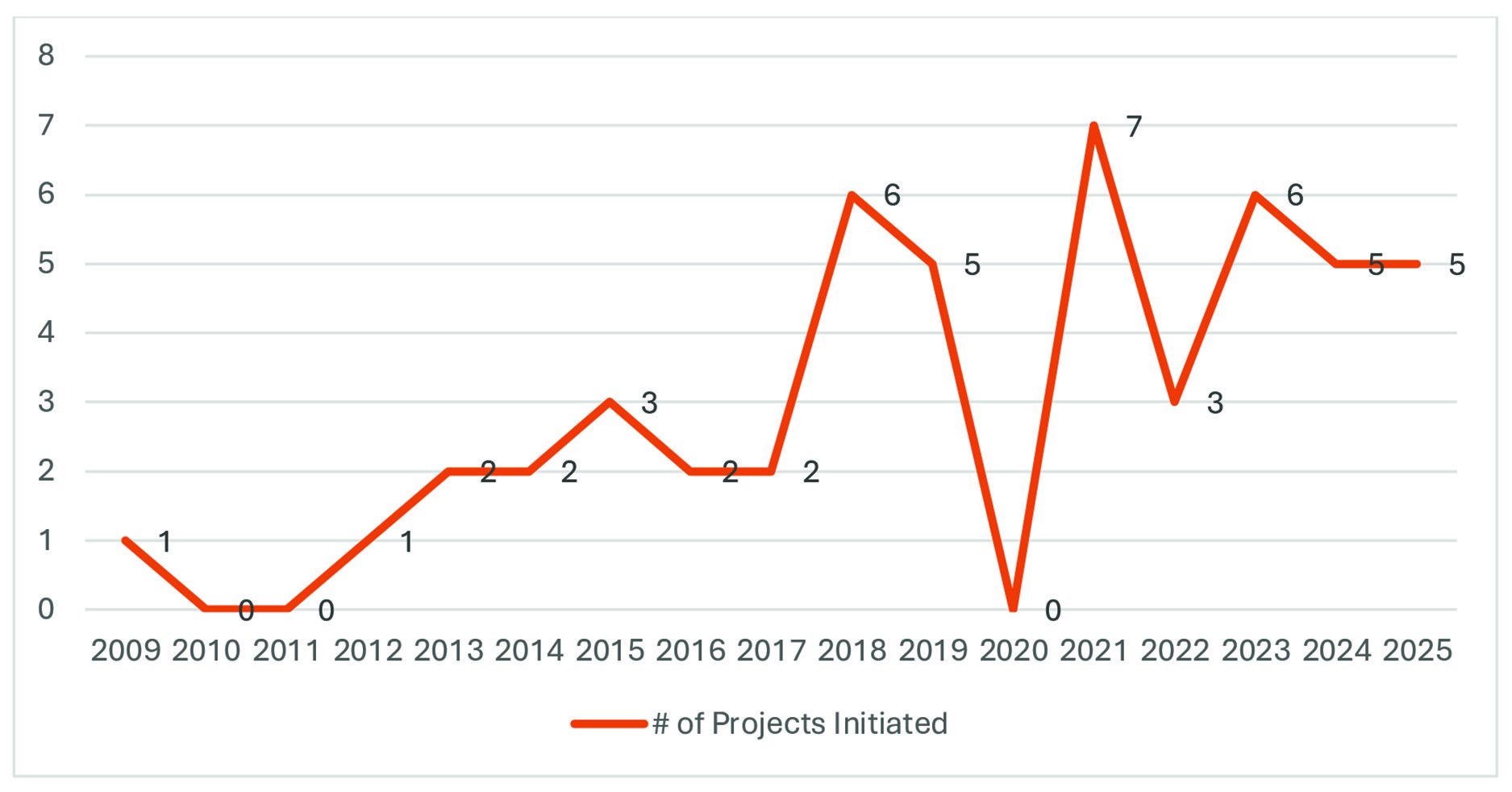
Figure 1 shows the increase in China’s engagement in space cooperation across the MENA region over the past decade.54 Many of these projects focus on providing satellite infrastructure: constructing ground stations, as well as developing and launching satellites. While satellite manufacturing and launch facilities are often more capital-intensive than adopting navigation services alone, BeiDou-related cooperation is strategically consequential because it embeds Chinese technical standards, software, and operating protocols into partner states’ civilian and security sectors.
Once countries adopt BeiDou-compatible receivers, establish ground augmentation stations, or integrate BeiDou into transportation, agriculture, or security systems, they become reliant on Chinese updates, maintenance, signal access, and future system upgrades. This creates a form of long-term technical and institutional lock-in that extends beyond a single project and shapes future procurement and cooperation choices.
Projects that do not come into fruition are also important because they are further evidence of China’s engagement strategy and priorities. Memoranda of understanding, feasibility studies, and pilot programs reveal which domains the Chinese government and its partners prioritize; they also provide evidence on where, geographically and domain-wise, China seeks to establish influence, even if projects do not ultimately reach full operational implementation.
The majority of ventures in which China has actively invested, and to which China has transferred technology, include three groups of collaboration projects—Satellite Systems and Hardware; Launch and Mission Support; and Navigation and GNSS (Global Navigation Satellite System).
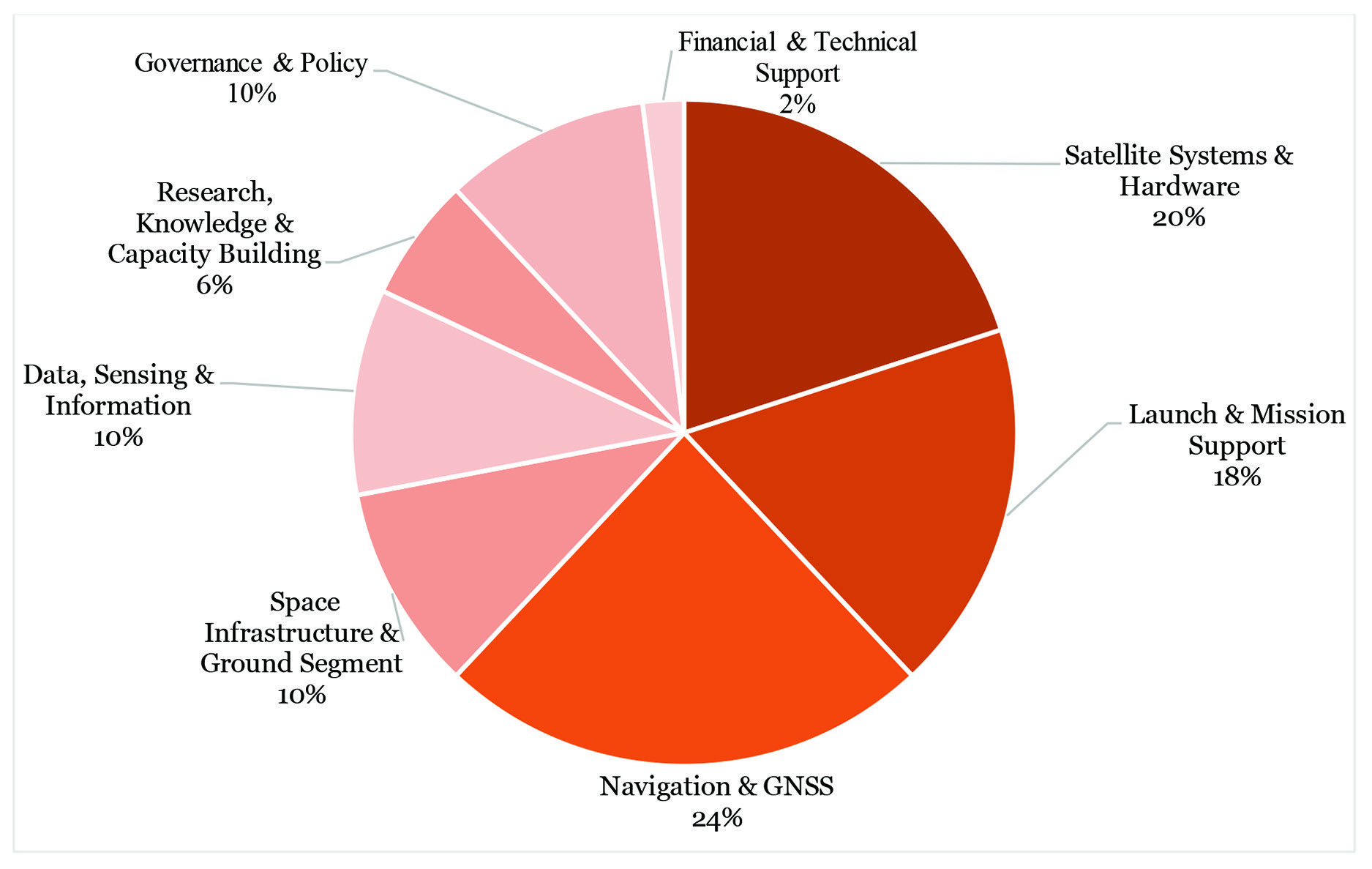
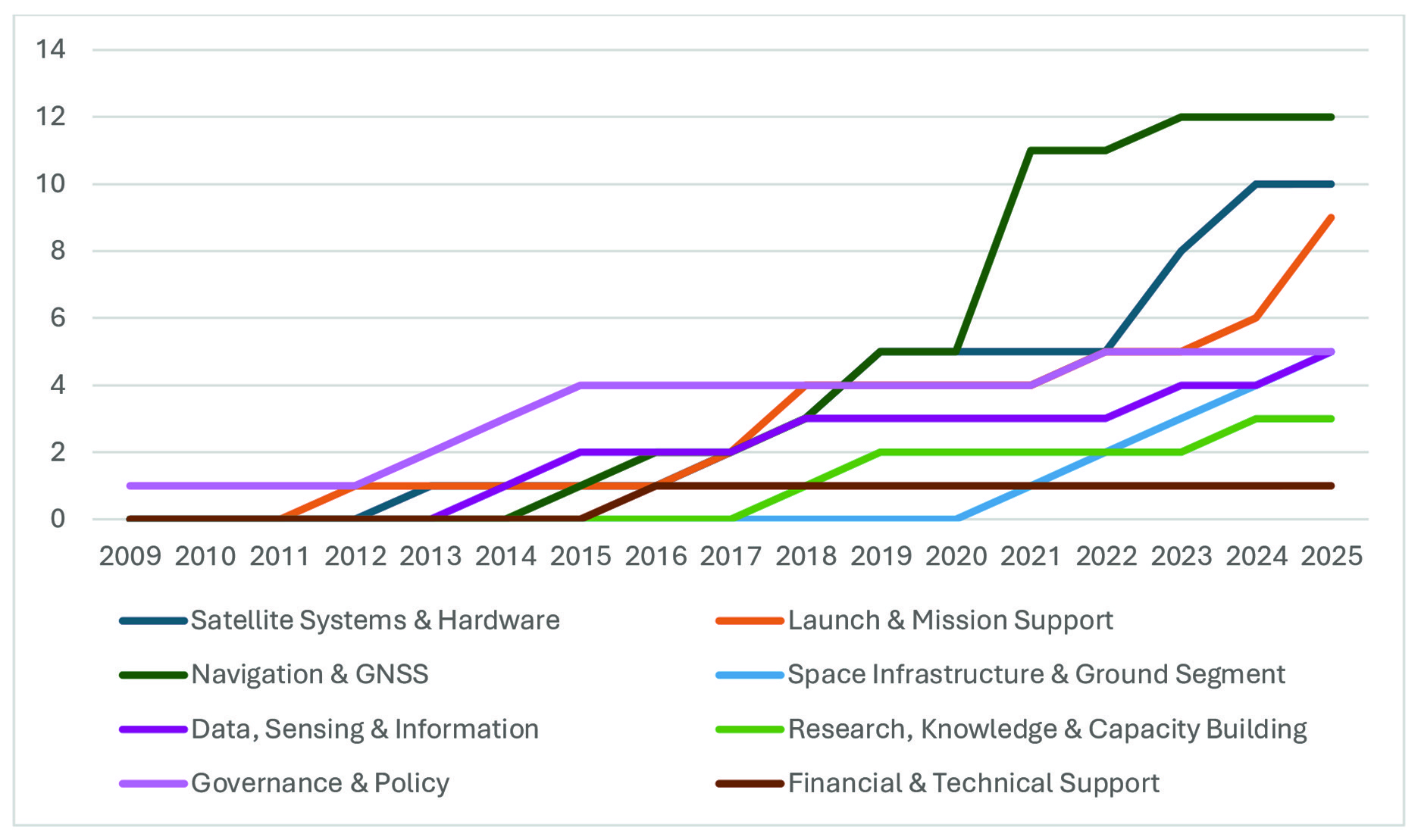
Figure 2 maps the distribution of China-MENA space cooperation by project type over the 2010–25 period, revealing a cooperation portfolio weighted heavily toward hardware and infrastructure. Navigation and GNSS projects constitute the largest share at 24%, followed by Satellite Systems and Hardware at 20% and Launch and Mission Support at 18%—together accounting for over three-fifths of all recorded activity. Space Infrastructure and Ground Segment; Data, Sensing, and Information; and Governance and Policy each represent 10%, while Research, Knowledge, and Capacity Building (6%) and Financial and Technical Support (2%) occupy a comparatively smaller portion of the overall portfolio. This distribution suggests that China’s engagement with the region has been primarily driven by the transfer of tangible, system-level capabilities rather than softer forms of cooperation. As demonstrated in figure 3, one trend in recent years is a marked increase in hardware-focused projects (satellite-related projects), alongside a slight increase in knowledge-based engagements. The categories in figure 2 encompass satellite projects (for example, Egypt’s MisrSat-2), infrastructure (Egypt’s AITC, Tunisia’s BeiDou Center), BeiDou navigation integration (Oman 2018, Saudi MoU), data sharing, and training (UAE astronaut survival training).
Figure 2. China-MENA cooperation by project type (2009–25). Figure by authors.
Thus, the data suggest that China has expanded its hardware-intensive cooperation, while gradually layering in complementary knowledge-transfer and infrastructure agreements. The significance of this approach is that once states adopt Chinese-built satellites, launch services, or navigation infrastructure, they are more likely to deepen ties with Beijing for maintenance contracts, periodic upgrades to new generations of satellites or navigation systems, and data access, deepening cooperation and reinforcing China’s strategic position in the region over time. Knowledge-transfer and training initiatives also embed Chinese standards and expertise into local institutions, ensuring that even as national capabilities grow, they remain aligned with Chinese systems and practices.
Figure 3. Cumulative growth of cooperation by type. Figure by authors.
Most space-related initiatives—satellite launches, facility construction, research labs, and BeiDou deployments—are concentrated in four MENA states (see fig. 4). For the purposes of this article, however, we focus on three of them, all of which are core actors in the Middle East: Egypt, the UAE, and Iran. These states cooperate on complex projects—such as full satellite-assembly centers, lunar-research agreements, and institutional R&D collaboration—making them a useful set of case studies on which to focus in more depth. A focus on these three states also underscores their strategic importance, and allows analysts to explore their capacity for cooperation or use of technological assistance. These states each possess functioning space agencies, established technical infrastructure, and sustained government interest, which enables them not only to sign agreements but also to implement projects and benefit from Chinese assistance.
Figure 4. Distribution of China-MENA space projects by country. Figure by authors.
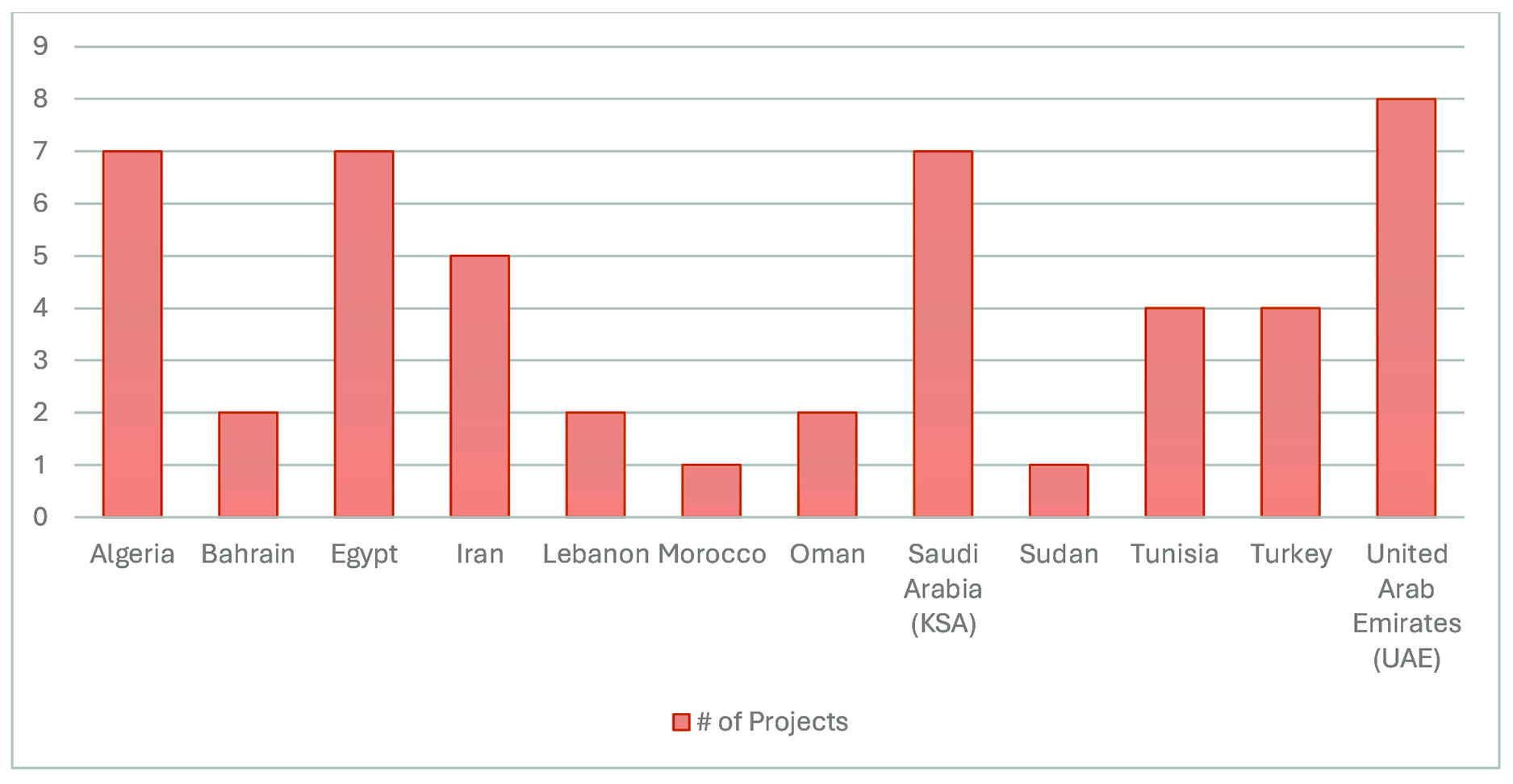
In contrast, smaller MENA states may lack the institutional or financial capacity to translate such agreements into operational outcomes. China’s partnerships with these countries tend to focus on narrower functions—such as data sharing or BeiDou integration—as seen with Lebanon, Morocco, and Oman. Meanwhile, less developed countries like Sudan and Oman have received their first satellites via turnkey Chinese assistance—complete with launch services, operations support, and training.55
These differences indicate that Beijing does not adopt a “one-size-fits-all” approach, but instead adjusts the depth of engagement and type of cooperation to match the partner’s needs, resources, and institutional maturity. Perceived strategic value to the PRC, however, also plays a role. Wealthier or more politically influential states, such as the UAE and Egypt, appear to cooperate more often with China on offered large-scale projects and institutional partnerships. In comparison, smaller or less developed states receive functional forms of cooperation that meet their immediate needs without requiring extensive local infrastructure.
These two tiers—deep engagement with regional leaders and functional ties with smaller partners—suggest a calculated model of space diplomacy, where China tailors its approach based on both recipient capacity and strategic payoff. Beijing concentrates its space-related investments in a few pivotal nodes, like Abu Dhabi and Cairo, rather than in diffuse efforts evenly across all countries. These patterns suggest that the PRC invests more heavily where cooperation can generate influence, while offering lighter, lower-cost forms of engagement where states lack the means to sustain large-scale projects and broad strategic benefits of cooperation are lower. The result is a tiered strategy that allows China to build regional influence through space diplomacy while optimizing resource allocation.
Descriptive data on projects alone do not allow us to state with certainty why particular countries are such a focus for China, but shared characteristics among the countries suggest a few possible explanations. On the supply side, it could be that China views these countries as more strategically important for its space diplomacy. Many of the countries with whom China does its most intensive space cooperation are powerful actors and can act as regional gateways (economically, culturally, or geographically).
It is unlikely that China is gaining much technologically from these countries, given how much more advanced its space program is than countries in the region—which suggests that the benefits to China lie elsewhere. The UAE has sent a probe to Mars, but since it lacks indigenous launch capabilities, it did so with Japanese assistance.56 Any technological benefits to China would likely come only indirectly, as China could potentially gain access to technology used by other countries—primarily the United States.
Overall, our data show that Chinese space diplomacy has steadily increased across leading MENA partners, such as Egypt, the UAE, and Saudi Arabia, as well as across smaller states in the region, including Algeria, Iran, Turkey, and others. China’s space cooperation is diverse and flexible, in ways that suggest that its outreach is driven by a combination of Chinese strategic considerations and the characteristics of partner states.
Egypt
Egypt’s strategic priorities, regional role, and development goals shape its space cooperation with China. For decades, Egypt has viewed itself as the leader of the Arab world, a claim rooted in its status as the most populous Arab state and its historic role as a birthplace of Arab nationalism and political Islam. Even as its regional influence has arguably waned, this self-perception remains strong.57 Following the Nasser era’s (1954–70) tendency toward ambitious and often overreaching power projection, Egypt adopted a more status quo–oriented approach.58 Amid economic challenges and political instability, however, Cairo has continued to seek ways to reclaim regional clout and reaffirm its role in regional leadership.59
Egypt’s motivation for establishing a modern space program centers around the twin goals of national economic development and prestige.60 Although its roots trace to an aborted missile program in the 1950s and ’60s, Egypt’s modern space activities began with telecommunications. The launch of Egypt’s first satellite to support telecommunications in 1998 (Nilesat-101) was followed by the launch of a remote sensing satellite in 2012, facilitated through various international collaborations.61 In January 2018, Egypt elevated the National Authority for Remote Sensing & Space Sciences (NARSS) to the Egyptian Space Agency (EgSA).62 One of the main stated justifications for establishing the EgSA was to achieve the National Sustainable Development Strategy (Egypt-SDS 2030) goals.63 Chief among these goals is to promote sustainable development and “revive” Egypt’s role in regional leadership.64 Egypt also views its space program as a means to enhance its regional prestige and stimulate economic development, with plans to build a “space city” by 2026.65 This complex, located in New Cairo, includes technical facilities and hosts the Egyptian and African Space Agencies, communicating Egypt’s purported leadership role on the African continent.66
Egypt has deepened cooperation with China to advance its broader foreign-policy goals and its space program. This relationship builds on historic ties. Egypt was the first Arab and Muslim country to recognize China, and both countries have sought leadership in organizations such as the Non-Aligned Movement (NAM) and BRICS. In 1999, Egypt became the first country in the Middle East to establish a strategic partnership with China, and in 2014, Egypt signed a comprehensive strategic partnership with China—one of only a few Middle East states to do so at the time.67 China and Egypt celebrated this strategic partnership by announcing 2014 as the “Egypt-China Partnership Year,” hosting several events to enhance bilateral cooperation.68
The growth of Egypt-China relations from 2014 to 2024, known as the “Golden Decade” culminating in the “Year of the Egyptian-Chinese Partnership,” illustrates the breadth of these ties.69 Egypt and China have engaged in significant collaboration across multiple sectors. China has invested over $1.7 billion in development projects in Egypt, including infrastructure, electricity, health, education, and vocational training. Egypt has also played an important role under the BRI as a strategic transit hub through the Suez Canal Economic Zone, while expressing support for China’s GDI and GSI.70 Chinese companies have been actively involved in Egypt’s transportation sector, developing high-speed rail, new administrative capital projects, and industrial zones. In addition, China and Egypt have increased military and technological cooperation, including joint training exercises and defense procurement.71
“Egypt has deepened cooperation with China to advance its broader foreign-policy goals and its space program.”
During this period, China has also advanced Egypt’s space ambitions through technical collaboration, financial support, and knowledge transfer. This cooperation intensified around the time Egypt formally established EgSA in 2018. One of the earliest significant contributions was the EgyptSat-A project, in which a $45 million Chinese grant supported Egypt’s acquisition of a remote sensing Earth observation satellite, built by a Russian firm.72 Most significantly, China announced the MisrSat-2 project alongside the development of Egypt’s Assembly, Integration, and Testing Centre (AITC), which was implemented with Chinese assistance through CASC.73 China also provided a $92 million grant to support the development of MisrSat-2, which was assembled and tested at the AITC.74 This is significant because they aim to develop infrastructure through building capacity and knowledge transfer.
In 2023, the PRC launched Horus-1 and Horus-2 from China’s Jiuquan Satellite Launch Center.75 That same year, China established the China-Africa Cooperation Centre on Satellite Remote Sensing Application. During the inauguration, it signed an MoU between EgSA and the Chinese Land Satellite Remote Sensing Application Centre (LASAC) to provide Egypt with greater access to remote sensing data.76 The remote sensing satellite EgyptSat-2 was launched on December 4, 2024, at China’s Taiyuan Satellite Launch Center.77
Egypt signaled its commitment to deepening its space collaboration with China in December 2023, by announcing an MoU under which Egypt will join China’s ILRS. The MoU covers joint research on lunar and deep space exploration, spacecraft development, and satellite applications, including Egyptian participation in the BRICS Remote Sensing Satellite Constellation.78 Shortly after, China launched the MisrSat-2, an advanced remote sensing satellite designed to support Egypt’s developmental goals in areas such as water and land management, agriculture, and urban planning.79
Chinese state media outlets have explicitly tied these space projects to the BRI, emphasizing the benefits that space cooperation provides to “BRI partner” countries.80 Egypt further expanded its cooperation in 2024 by signing several MoUs, such as one to implement the BeiDou Navigation System—which, as discussed above, enhances Egypt’s satellite navigation capabilities while reducing its dependence on Western alternatives and locking in technical aspects of Egypt’s cooperation with China.81
China’s support for Egypt’s space program serves multiple strategic objectives. Beijing gains another point of entry to the MENA region to enable the cultivation of new partnerships through space diplomacy. China also secures broader economic and diplomatic influence, gains access to critical data and satellite imagery, and establishes a long-term, on-the-ground presence in the local space sector.82 Notably, some of the Chinese-built Egyptian satellites launched in 2023 could grant China access to their data, thereby enhancing China’s global power-projection capabilities through access to additional sensitive information. Although the satellite belongs to Egypt, China’s state-owned enterprise, the China Aerospace Science and Technology Corporation, “monitors the data and the images it collects,” though CNSA official Yang Xiaoyu states that despite its data-sharing agreements China “has never, and will never” use such data for military purposes.83 An overarching objective is that space diplomacy is one tool among others that can expand China’s influence, particularly if the United States pulls back or limits its space cooperation with international partners.84
For Egypt, collaboration with China offers substantial benefits. Establishing EgSA in 2018 was part of a broader ambition to drive economic development and assert regional leadership in Africa. Key pillars of Egypt’s Vision 2030, released in 2016, included many UN Sustainable Development Goals and national development goals that would benefit directly from robust space cooperation with China, as noted by former EgSA CEO Dr. Sharif Sedky.85
This cooperation also helps Egypt in pursuing regional and global institutional leadership roles. The EgSA CEO also serves as president of the Arab Space Cooperation Group and is the current chair of the UNCOPUOS (UN Committee on the Peaceful Uses of Outer Space), while the EgSA offices are down the street from the African Space Agency headquartered in Egypt’s space city, highlighting Egypt’s regional role. Chinese support has jump-started Egypt’s space industry, providing a baseline from which Cairo hopes to develop indigenous capabilities and funding streams through commercial endeavors. Egypt’s space partnership with China bolsters its prestige in the region, allows Cairo to promote itself as a space leader in Africa, and provides opportunities for leadership roles in global governance, while Egypt’s well-respected diplomatic corps could play an important role in leveraging the space sector to revive the country’s soft power. Beyond a technical partnership, Egypt’s space cooperation with China reflects a broader geopolitical match, allowing both countries seek to pursue strategic objectives through space, technology, and diplomacy.
United Arab Emirates
The UAE’s broader strategic orientation and its domestic and security priorities—including, notably, its close ties with the United States—shape its relationship with China in the space domain. The UAE pursues a regional order that focuses on protecting regime security and defending against perceived threats to sovereignty, as well as ideas that may undermine regime rule.86 Externally, the UAE’s largest security threats are from Iran’s nuclear program, regional instability, and perceived US retrenchment from the region, which could exacerbate the first two threats.87 The UAE has pursued a foreign-policy approach that emphasizes strategic autonomy and combines military expansion and a willingness to project power with a diversified foreign policy. Under that diversified foreign policy, the UAE has strengthened ties with China and Russia while maintaining its close partnership with the United States.88 This approach is motivated by the need to diversify revenue sources and a desire to capitalize on the benefits to long-term development that countries like China provide. For the last two decades, the UAE has also made significant efforts to diversify its economy and reduce its dependence on fossil fuels—goals that are central to the national development plans enshrined in its Vision 2071.89
The UAE has sought to advance its national security, economic development, and even identity-driven interests through investing heavily in its space program.90 The United Arab Emirates Space Agency (UAESA), one of the region’s most ambitious, was established in 2014 to promote economic diversification, heighten the UAE’s geopolitical impact, and consolidate and regulate space activities.91 The UAE’s national space strategy, released two years later, provides a framework for guiding space initiatives in both the public and private sectors through 2030, aligned with the development objects outlined in Vision 2021 and Centennial 2071.92
The UAE’s technological accomplishments demonstrate its aspirations to further develop its space program, economy, and indigenous capabilities. In 2018, the UAE launched the KhalifaSat, an Earth-observation satellite that was—for the first time—designed and built by an Emirati team (collaborating with South Korean engineers).93 With this assistance, the UAE became the first Arab country to manufacture its own satellite (Israel was the first in the region). In 2019, Hazza al-Mansouri became the first Emirati (and Arab) astronaut to reach the International Space Station (ISS).94 This milestone marked the UAE’s entry into the “space club,” and demonstrated its ability to participate in the global space community.95 In 2023, the Emiratis sent Sultan al-Neyadi on a six-month mission to the ISS.96 The UAE was also the first Arab nation, and the fifth globally, to reach Mars with the Hope Probe, which launched in 2020 and entered Mars’s orbit in 2021; the Hope Probe was built in collaboration with international partners, including researchers from the United States, and was launched aboard a Japanese rocket.97
“The UAE has sought to advance its national security, economic development, and even identity-driven interests through investing heavily in its space program.”
The UAE is also active in lunar exploration, a practical objective for international collaboration and one that is highly symbolic from a prestige standpoint. The UAE was instrumental in the creation of the Artemis accords, and joined in 2020 as the eighth member.98 The Rashid Rover, launched in 2022 to study the moon’s surface, thermal properties, and soil composition, marked another step in the UAE’s broader goal of establishing a lunar research station, though communication was lost before its landing.99 Additionally, the UAE is collaborating with NASA and other international partners on the Lunar Gateway Station, where it is responsible for developing the Crew and Science Airlock to support future lunar and Martian missions.100 Beyond Mars and the moon, the Emirates’ “Mission to the Asteroid Belt” aims to visit seven asteroids and land on one in 2028, exploring the potential for resource extraction; if successful, the mission will be another way the UAE has added to global knowledge about the solar system.101 Finally, as part of its Mars 2117 Strategy, the UAE is currently constructing Mars Scientific City, a 1.9-million-square-foot complex designed to simulate the Martian environment, with an AED 500-million investment to support research on future Mars habitation.102
The UAE perceives its space activities (orbital, lunar, and Martian) as a way to increase the country’s prestige and influence. Officials highlight the UAE’s role as a “space hub” and convener for regional space activities. The UAE began hosting the biannual Abu Dhabi Space Debate starting in 2022, and the annual Dubai Airshow proudly displays the country’s growing space economy. The UAE has also sought to play a more prominent role in international organizations and global space governance, acting as a past chair (2022–23) for the UN Committee on the Peaceful Uses of Outer Space (COPUOS).103
Despite its close military ties and active space cooperation with the United States, the UAE has built strong bilateral relations with China in the last decade—a development that has required careful navigation of technological restrictions and political sensitivities in US-China relations. In 2018, the UAE and China upgraded their relationship to a comprehensive strategic partnership, and China is now the UAE’s largest trading partner.
In parallel, space collaboration between the UAE and China has grown steadily. Joint satellite missions, co-investment in a remote sensing R&D center in Abu Dhabi, and lunar research initiatives reflect this expanding partnership. In 2023, the two countries agreed to establish a Space Tech Centre in Abu Dhabi to co-develop satellites and space telescopes.104 This project builds on earlier deals involving Chinese satellite purchases and technical integration.
An important decision point testing the boundaries of the China-UAE relationship came in September 2022, when the UAE signed an MoU to send its Rashid 2 Rover on China’s Chang’e 7 lunar mission. This was significant because the UAE is also a founding signatory of the US-led Artemis Accords and, according to lead architect of the Accords, Mike Gold, the UAE advocated for the Accords to be broadly inclusive as an example for multilateral space governance.105 While the Accords do not prohibit participation in China’s ILRS, the MoU highlighted the UAE’s strategic balancing act. American diplomats raised concerns that US-made components in the Rashid 2 Rover could be compromised if launched on a Chinese rocket,106 citing US International Traffic in Arms Regulations (ITAR), which restrict the export of sensitive technologies. The UAE ended up withdrawing from the Chang’e 7 mission, reflecting the constraints placed on cooperation with China given US efforts to limit China’s access to advanced technologies via third-party collaborations.
Nonetheless, the UAE has found alternative pathways to engage with China’s lunar ambitions and satisfy its own. In November 2023, the University of Sharjah signed an MoU with China’s Deep Space Exploration Laboratory, and in September 2024, UAE-based private aerospace company, Orbital Space, agreed to develop payloads for ILRS missions.107 These indirect collaborations via universities and private firms demonstrate how countries may seek to circumvent formal restrictions to pursue strategic interests.
The UAE’s space diplomacy is part of a broader foreign-policy agenda that seeks to pursue productive relations with the United States and China simultaneously. Space cooperation parallels UAE choices in other areas, such as AI investment; the Microsoft-G42 agreement sought to decouple sensitive technologies and investments from China’s activities.108 This agreement secured US government approval of Microsoft’s $1.5 billion investment in G42, the leading Abu Dhabi–based AI and cloud-computing technology holding group, after the firm agreed to stop using Chinese hardware (Huawei). How the UAE has navigated space cooperation demonstrates its agency to choose how it interacts with both the United States and China to advance its interests. Another area of cooperation was China’s support for the Arab Satellite 813, a proposed joint Arab project whose name references the beginning of the Islamic Golden Age. From 2023 through its planned launch by China in 2025, the UAE’s National Space Science and Technology Center (NSSTC) worked under an MoU with the Shanghai Engineering Center for Microsatellites (SECM) to develop a high-performance hyperspectral satellite optimized for weight, volume, and capability.
Iran
Iran’s broader strategic orientation has also shaped its space cooperation with China. Like the UAE and Egypt, Iran has prioritized regime security and sought to suppress internal dissent, pursuing a grand strategy driven by the interactions of domestic politics and the geopolitical environment.109 Since the establishment of the Islamic Republic, Tehran’s security concerns have centered on the United States and its allies, including Israel and Saudi Arabia as well as Iraq prior to 2003.110 In addition to its tangible security benefits, Iran has also framed its space program as a tool of regime legitimacy and prestige. Satellite launches have been portrayed domestically as demonstrations of technological sovereignty and resilience in the face of Western sanctions, reinforcing the regime’s narratives of self-sufficiency and resistance.111
Iran’s grand strategy has emphasized the concept of “strategic depth” to spread its influence beyond its borders, and operationalized this through a “forward defense” military doctrine designed to preempt “penetration of symmetric and asymmetric threats inside Iran’s borders.”112 Until and throughout much of the regional war sparked by Hamas’s attack on Israel on October 7, 2023, Iran’s regional posture also included a “ring of fire” network of allies and proxy forces (for example, Hezbollah, Houthis, Hamas, and Iraqi Shi‘a militias) to implement its grand strategy,113 with remote sensing and communications satellites that align with this doctrine supporting the coordination across proxy forces abroad.114
Years of hostility between the United States and Iran created opportunities as well as constraints for Chinese space diplomacy. Actions by the United States, including the Trump administration’s withdrawal from the JCPOA during President Trump’s first term and friction with China over trade and security issues strained Washington’s relations with both Tehran and Beijing, indirectly pushing Iran and China closer together.115 Iran’s diplomatic and economic isolation, exacerbated by decades of sanctions, have also constrained its technological development.
“Years of hostility between the United States and Iran created opportunities as well as constraints for Chinese space diplomacy.”
Iran’s space ambitions have been tied closely to its national security aims, a history that provides important context for its strategic rationale and developmental trajectory. Its space program has origins in the country’s aeronautical sector.116 Iran was one of the founding members of the United Nations Committee on the Peaceful Uses of Outer Space in 1958, signed the Outer Space Treaty in 1967, and received assistance from the United States to build a satellite receiving station in the 1970s.117 However, its space program also has significant military dimensions, and national security has received the bulk of spending for Iran’s space program.118 Some of Iran’s rocket capabilities can be traced back to the Iran-Iraq War’s “War of the Cities” (1980–88) and Iraq’s missile attacks on Iranian cities, which exposed Iran’s vulnerabilities—namely, the lack of an air force. This experience pushed Iran to develop indigenous missile capabilities, which later developed into space-launch capabilities.119 The Iranian Space Agency was formally established in 2013 for the purpose of “designing and manufacturing research and operational satellites and developing and expanding space applications across the country.”120 Beyond strategic utility, Iran’s space capabilities have provided an important symbolic boost to demonstrate what Iran can achieve technologically.
Iran subsequently became the second country in the Middle East (after Israel), and the ninth globally, to achieve indigenous launch capability. Iran developed space capabilities that bolstered its intelligence, surveillance, and reconnaissance (ISR) capabilities, augmented information control and data sovereignty, and enhanced the integration of delivery and targeting systems for its missiles. The Islamic Revolutionary Guard Corps (IRGC) launched and operated three of its own satellites, and maintained its own space program.121 The IRGC’s space and satellite research center, which was closely linked to the Iranian Space Agency, was targeted by Israeli airstrikes in March 2026.
Geopolitical pressures have driven Iran to seek partnerships with non-Western powers—including Russia, North Korea, India, and China—as part of a strategic “Eastward turn” aimed at securing trade, investment, and technological cooperation.122 While Russia historically supported Iran’s space ambitions, China’s role has grown steadily in recent years. Space cooperation with China has offered Iran access to dual-use technologies and launch capacity unavailable from Western sources, including propellant precursors, guidance and navigation systems (including BeiDou), high-resolution remote sensing, and surveillance-satellite subsystems. Chinese firms specializing in remote sensing have enhanced the IRGC’s ISR capabilities. Since at least 2015, Chinese assistance has reportedly improved the accuracy of Iran’s missiles and drones through satellite-based targeting, guidance systems, and possibly launch support. These capabilities have supplemented Iran’s indigenously built launch vehicles, filling gaps in precision, durability, or reliability that Iran could not easily address under sanctions.
Iran and China have collaborated through the Asia-Pacific Space Cooperation Organization (APSCO), engaging in initiatives on topics such as space situational awareness, capacity building, and space law. In 2021, China and Iran signed a twenty-five-year cooperation agreement that paved the way for expanded political, economic, and military collaboration, including in the space domain. More recently, in 2024, Iran joined China’s ILRS, and announced that it would participate in the Chang-8 lunar mission, signaling deeper strategic alignment in space.123
The benefits to Iran of bilateral military, economic, and scientific cooperation with China are clear: China has enabled Tehran’s technological modernization, been an important trade partner for Iran, and contributed to Iran’s ability to survive Western sanctions. For its part, the PRC has long pursued a dual-track policy of selective cooperation with Iran, while maintaining the distance necessary to avoid alienating other important regional states, such as Saudi Arabia and the UAE.124 For Beijing, Tehran is important for its own security and geopolitical objectives: Iran supplies discounted crude oil, at a time when Beijing remains sensitive to its own energy security vulnerabilities,125 and the more the United States remains tied down in the Middle East, the fewer resources it can marshal to confront China in East Asia.126
Despite these interests, China has managed its relationship with Iran carefully, to avoid alienating key regional actors such as Saudi Arabia and running afoul of international and American sanctions,127 and despite often-lofty rhetoric, practical outcomes in the bilateral relationship, including in space cooperation, have remained more modest than some predictions suggested.128 Although Tehran has sought more-robust assistance in the past—launch technologies, high-precision imaging capable of identifying military targets, or satellite systems designed explicitly for missile guidance—publicly available information indicates that China has restrained its cooperation to somewhat less sensitive domains, such as navigation services (BeiDou), remote sensing via civilian satellites, and training or data sharing.129 Nonetheless, China’s space cooperation with Iran contributes to concerns in the United States and Israel, particularly in the context of heightened concern in recent years over the Iranian nuclear program.
Conclusion and Policy Implications
China appears to pursue a two-tiered approach to space diplomacy in the Middle East and North Africa: high-priority and deeper investment in space cooperation with countries it views as geographic or political gateways in the broader region, and more limited, targeted investment in cooperation with smaller states that is scoped to the intersection of Chinese strategic interests and recipient country interests and capacity. China’s efforts focus predominantly on countries with the most infrastructure, development agendas, and diplomatic clout to act as conduits for more broadly increasing China’s influence in the region. Even among priority countries for China, however, there is considerable variation, as China’s activity also depends on the interests and capacities of local states.
The case studies in this paper illustrate that variation. While the UAE is arguably China’s high-capability partner in the region when it comes to space cooperation, China has actually played a greater role in and cooperated most extensively with Egypt, developing Egyptian capacity through technology transfer and capital that have funded Egypt’s space program and led to Egyptian participation in the ILRS.
“Space diplomacy presents an important means by which China seeks to cultivate influence in the Middle East and North Africa.”
China has also built space cooperation across countries with varying degrees of alignment with the United States. Egypt and the UAE both have close relationships with the United States, but China has played the most pronounced role in shaping Egypt’s space program—probably due to the capacity issues discussed above. Notably, American concerns about advanced technology transfer have placed some limits on the UAE’s cooperation with China to date, but also reveal that the UAE has used creative strategies to evade American pressure and still procure the technological benefits that can be gained from space cooperation with China. In Iran, where the United States has the least influence, China has played a crucial role in supporting Iran’s space ambitions; even here, however, Beijing has proceeded with caution to avoid inflaming tensions with other strategically critical actors in the region.
Space diplomacy presents an important means by which China seeks to cultivate influence in the Middle East and North Africa. PRC expansion of space cooperation in the region has occurred in the context of decreasing US space cooperation. As the United States shifts its patterns and methods of engagement around the world, space diplomacy acts as a tool for China to build cooperation with and influence in countries across the region. Such cooperation, as it institutionalizes, may create new coalitions and even dependencies.
It would be a mistake, however, to assume that regional states are merely passive pawns in great-power competition. To achieve its goals using space diplomacy as a tool, China must tailor its approach to different capacities and underlying security strategies. The Middle East and North Africa are a complicated geopolitical environment for China to navigate, especially when it comes to the PRC’s partnership with Iran. The case of the UAE, perhaps most of all, shows that MENA states maintain the agency to choose their place in the great-power orbit, using creative and sometimes indirect strategies to pursue cooperation with multiple great powers to advance their interests.
This article is an early effort to characterize the scope and nature of Chinese space diplomacy in the region. While we have focused on Chinese space diplomacy, future research would benefit from comparing these efforts with other tools of China’s growing global outreach, and comparing the MENA region to Chinese space diplomacy in other parts of the world. Moreover, while our study has described the extent of Chinese space diplomacy and probed the drivers of these efforts, future work should assess the relative effectiveness of these efforts, especially in comparison to American and Russian space cooperation and outreach.
R. Lincoln Hines is an assistant professor at the Sam Nunn School of International Affairs at the Georgia Institute of Technology and a Wilson China Fellow at the Woodrow Wilson Center.
Lawrence Rubin is an associate professor at the Sam Nunn School of International Affairs at the Georgia Institute of Technology, codirector of the GTDC: Pathways to Policy Program, and associate fellow at the International Institute for Strategic Studies.
Georgia Institute of Technology, Atlanta, GA, USA, email: lawrence.rubin@inta.gatech.edu.
Dayana Alagirova is a PhD student at the Sam Nunn School of International Affairs at the Georgia Institute of Technology, a Fulbright scholar, and a graduate of the Moscow State Institute for International Affairs (MGIMO), with a focus on space policy and security.
Acknowledgments: The authors would like to thank the anonymous reviewers and the editors for their helpful comments.
Image: Shujianyang, CC0, via Wikimedia Commons.130