Podcast overview with the author
After the collapse of the Soviet Union, the United States emerged as the sole world superpower. American political scientist Francis Fukuyama famously called this period “the end of history,” as he believed that without a communist foil, liberal democracy would naturally spread around the world as the dominant form of governance. For the five remaining communist countries—China, Cuba, North Korea, Laos, and Vietnam—the collapse of the Soviet Union posed an existential crisis. Many Western observers believed it was only a matter of time until these party-states, propelled into a US-led international liberal order and capitalist world system, would undergo democratic reform, or even collapse.
While the collapse of the Soviet Union did not greatly impact the economic trajectory of post-Maoist China, the non-reformed command economies, such as those in Cuba and North Korea, withstood difficult periods of mass famine and severe economic stagnation. On the political level, all of these Marxist-Leninist governments remained committed to single-party rule and viewed the demise of the Soviet Union as an important lesson from which to draw to improve their own regimes’ resilience. Political scientists and historians have devoted considerable time to understanding the lessons these communist governments, most notably China, took from the collapse of the Soviet Union.1 Chinese researchers and scholars, too, sought to learn why the birthplace of state socialism collapsed so suddenly and to inform their own party cadres and military officers with these lessons.
Much less is known about how the other regimes assessed and learned from the Soviet collapse. Like their communist counterparts in Beijing, officials and leaders of the Korean Workers’ Party (KWP) intensively studied and commented on the collapse of the Soviet bloc to inform and shape the future of the Kim family regime. Yet unlike the impact of the Soviet collapse on the Chinese Communist Party (CCP), the lessons North Korea drew from the Soviet collapse have surprisingly not been systematically examined by scholars in the West.
Based on North Korean newspapers, periodicals, and writings from North Korean leadership, this article argues that the main lesson the KWP drew from the Soviet collapse was that ideological indoctrination needed to be strengthened and that the authoritarian socialist system needed to be maintained at all costs. Moreover, the lessons of Soviet collapse solidified the notion in the minds of leaders in Pyongyang that self-defense in the form of an indigenous nuclear weapons program, rather than relying on a foreign nuclear umbrella, was paramount to the long-term security of the Kim family regime. The military, not the traditional working class in Marxist orthodoxy, should be the vanguard of socialist construction in North Korea.
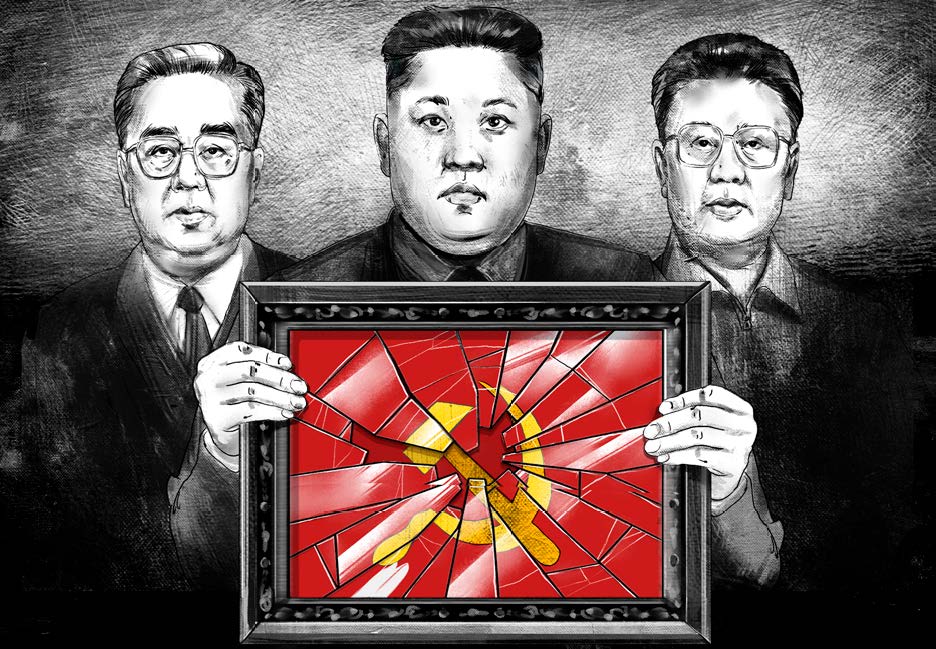
The North Korean government drew three distinct lessons from the Soviet collapse: the continued need for an indigenous, non-imported form of socialism (sociopolitical lesson); the idea of the Korean People’s Army (KPA) as the spearhead of the socialist revolution (military lesson); and dynastic politics as a resolution of the succession crisis in communist theory (leadership lesson). These three lessons have significantly influenced the political and ideological direction of post–Cold War North Korean leadership. Much like the CCP, lessons derived from Soviet disintegration have shaped decision-making and behavior in the KWP, which aims to avoid the same fate that beset the Communist Party of the Soviet Union (CPSU).
Studying the North Korean reaction to the fall of the Soviet Union can provide insight into the similarities and differences between the opaque political systems of China and North Korea. Both governments continued to adhere to structures and norms of Leninist governance, including the belief in a revolutionary vanguard party with a monopoly on power. Nonetheless, North Korea’s hereditary succession, from its founding leader Kim Il Sung to his son Kim Jong Il, was unorthodox within the global communist movement. This process paved the path for the Democratic People’s Republic of Korea (DPRK) to be the first and only communist dynasty in the world. In the wake of Soviet collapse, North Korean authorities claimed that the continuation of Kim family rule solved the succession crisis within Marxist-Leninist theory and stabilized the international proletarian movement. Although hereditary succession was already underway in North Korea by 1991, the leadership in Pyongyang exploited the downfall of the USSR to present the dynastic transition as a necessary safeguard against regime collapse.
By examining North Korea’s response to the Soviet collapse, analysts and policymakers can view authoritarian resilience from a non-Sinocentric perspective. Within the literature on authoritarian resilience, the People’s Republic of China is typically the model example.2 The North Korean case, however, illuminates the adaptability and durability of an even more extreme form of authoritarianism. Unlike China, the DPRK government never abandoned its grandiose personality cult or its totalitarian system. This divergence highlights the unique mechanisms of survival employed by the Kim family regime, such as its dynastic succession and severe curtailment of information flows from the outside world. Studying the North Korean case also challenges assumptions that opening up trade with the West is a prerequisite for regime stability. While China became more interconnected with the global economy in the 1980s and 1990s, the North Korean regime retained its autarkic model and continued to restrict the vast majority of its citizens from traveling abroad or actively participating in the global economy.3 Under Kim Jong Un, the North Korean government has carried out some half-hearted market-oriented reforms, but they were incomplete attempts primarily focused on maintaining political stability, rather than generating bottom-up economic growth.4
Comparing North Korea and China
In China, government-funded research centers and university institutes once devoted to studying the Soviet model of socialist governance have focused extensive analysis on why that system failed. In 2006, the leading CCP-backed think tank, the Chinese Academy of Social Sciences (CASS), produced a classified eight-part, four-hour-long DVD documentary titled “Be Vigilant in Peacetime: The Historical Lessons of the Death of the Communist Party of the USSR.” The CCP disseminated this documentary internally within the Marxism Research Institute and the Center for Research on World Socialism of CASS. It was meant to shock and intimidate party cadres and apparatchiks into becoming more loyal to the mission of the CCP. The core message of the film was that the CPSU and the last Soviet leader, Mikhail Gorbachev, betrayed the tenets and traditions of Marxism-Leninism, such as the revolutionary commitment to a vanguard party and Stalinist-style repression.5
The CCP chiefly attributed the Soviet collapse to political liberalization within the CPSU. According to CCP ideologues, the “historical nihilism” of Soviet reformists, chiefly Gorbachev’s clique, rendered the CPSU weak and directionless amid internal pressures. The CCP believed that Soviet leadership’s criticisms of Stalin resulted in “historical nihilism,” which portrayed Stalin’s policies as worse than they were. Moreover, post-Mao China, with its embrace of market reforms in the 1980s and 1990s, could not singularly point out capitalism as the culprit behind the disintegration of the world’s first “workers’ state.” Therefore, the CCP linked the Soviet collapse to Moscow’s temporary acceptance of Western-style political ideas under Gorbachev. The CCP viewed Gorbachev as a Western lackey and the CPSU as having betrayed Leninist political concepts such as “democratic centralism” and “dictatorship of the proletariat.” The CCP leadership believed that ideological discipline within the party-state needed to be strictly maintained, as Western-influenced leadership could quickly destroy the political system. The PRC leadership therefore denied opportunities for intra-party criticisms of the system as well as systematically limiting options for the general public to voice opposition to the party-state. Beijing doubled down on political centralization and upholding the supremacy of one-party rule.
While more liberal analysts and scholars in Chinese academia during the early 2000s blamed the Soviet Union’s economic troubles for its collapse, the CCP’s intellectual establishment identified ideological corrosion as the root cause of the Soviet collapse. In 2000, Chinese leader Jiang Zemin blamed the collapse of the Soviet Union on Western ideological penetration and the abandonment of communist values within the USSR. Supported by CCP leadership, Chinese publishers translated books from Russian into Chinese that discussed the fall of the Soviet state.6 These translated books, most notably The Third World War: Information and Psychological Warfare and On the Manipulation of Consciousness, blamed the Soviet collapse on the encroachment of Western universal values and the gullibility of the pro-Western lackey Mikhail Gorbachev.7
“The CCP leadership believed that ideological discipline within the party-state needed to be strictly maintained, as Western-influenced leadership could quickly destroy the political system.”
In late fall 2012, the newly inaugurated leader of the CCP, Xi Jinping, visited the southern cities of Shenzhen, Zhuhai, Foshan, and Guangzhou. As his first trip outside the capital city of Beijing, Xi’s tour of these southern cities symbolized to international audiences a new age of Chinese governance. For foreign observers, Xi’s visit to Shenzhen, a special economic zone in China’s early experiments with capitalism, signified that he would bring forth a more liberalized political system. This symbol of reformism caught the attention of Western audiences and liberal observers.8 In a secret speech to party cadres during this same southern tour, however, Xi expounded on the need for the CCP to heed the lessons of Soviet disintegration and resist any attempt to reform the political system. In this internal party speech, Xi said: “Why did the Soviet Union disintegrate? Why did the Soviet Communist Party collapse? An important reason was that their ideals and beliefs had been shaken.” Xi continued: “It’s a profound lesson for us! To dismiss the history of the Soviet Union and the Soviet Communist Party, to dismiss Lenin and Stalin, and to dismiss everything else is to engage in historic nihilism, and it confuses our thoughts and undermines the party’s organizations on all levels.”9 More than a decade after this southern tour, Xi’s commitment to a Leninist party-state system has remained resolute and steadfast.
In 2023, Li Shenming, a prominent CCP ideologue and former vice president of CASS, wrote a three-part paper on Chinese lessons from the Soviet collapse. In this paper, Li identified a number of issues within the Soviet socialist experience that ultimately brought down the Communist Party there. First, Li argued that a conservative bureaucratic class, which ballooned during Leonid Brezhnev’s reign, betrayed the essence of class struggle and became “opposed to any changes involving their own interests.” Li then argued that Lenin and Stalin were the only progressive leadership forces of the CPSU, and that subsequent leadership betrayed their revolutionary legacies. For example, Li wrote: “When Khrushchev and Brezhnev were the senior leaders, the CPSU failed to clearly see the nature of imperialism and downplayed class struggle on an international scale.” But above all, Li warned of the dangers of Western cultural and ideological infiltration. Invoking Mao’s theory of “peaceful evolution,” Li instructed party cadres to be wary of Western influences and of a “fifth column” that dilutes the party’s legitimacy.10
The CCP’s analysis of the Soviet downfall remains a largely ideologically driven interpretation. China’s leaders largely attribute the Soviet collapse to ideological, rather than military or economic, decay from Western influences. The CCP understand the failure of the Soviet political project from a distinctly Leninist lens. As Steve Tsang explains, the CCP’s “consultative Leninism,” which blends Leninist political control with Chinese nationalism and economic growth, emerged out of concerns over the Tiananmen Square massacre and the Soviet collapse.11
Unlike the CCP, the North Korean government has an additional ideological factor to consider: hereditary succession. In contrast to the more traditional Leninist political structure of the CCP, ideologues within the KWP must also assert how their dynastic political process, a practice widely considered by Marxist orthodoxy as feudalistic, helped them avoid Soviet-style disintegration. Paradoxically, the timing of the Soviet collapse gave an opportunity for North Korean propagandists to institutionalize the Kim family as the permanent saviors and protectors of the Korean nation. This, in turn, bolstered the personality cult of the Kim family regime and paved the way for its post–Cold War resilience.
Sociopolitical Lessons
The ability to defend itself from foreign domination has long been a major concern to North Korean leadership. The history of Japanese colonialism and US intervention in the Korean War made the Kim family regime paranoid about its own security. Coupled with the collapse of the Soviet Union in 1991 and subsequent economic maladies, North Korean authorities renewed their anti-Westernism in the post–Cold War period. Pyongyang firmly believed that the penetration of Western influence into the body politic of the USSR was one of the main reasons why the CPSU fell. According to the KWP, Western universal ideas, such as human rights and rule of law, debilitated the revolutionary essence of the CPSU and weakened its commitment to socialist construction. Therefore, the KWP adopted an even more virulent anti-Western stance in the 1990s than it previously asserted.
During the Cold War, the North Korean government shifted its political orientation between the Soviets and Chinese for maximum diplomatic and economic support. Nonetheless, there was an uneasiness among the North Korean political elite that their country could never truly be independent while depending on larger foreign powers.12 As a result, the regime embraced self-defense as one of the pillars of the state ideology of juche.13 In 1967, North Korea’s founding leader Kim Il Sung established the main principles of the juche ideology as economic self-sufficiency (charip), political self-reliance (chaju), and military independence (chawi).14 Some scholars, most notably B. R. Myers, have argued that juche serves as a façade for the regime’s true ideology, which they characterize as radical ethno-nationalism.15 Others contend that juche forms the core of the Kim family’s ideological architecture and significantly shapes the KWP’s decision-making processes.16 Juche represents a utopian vision for Pyongyang, rooted in the regime’s aspiration for a self-reliant unified Korea and the practical need to uphold national unity amid Soviet-Sino competition.17 Like the Marxist ideal of a truly egalitarian classless society, however, this dream of total independence for the DPRK has proven unattainable. It fails to align with the realities of a divided Korean peninsula and North Korea’s geographic limitations as a rugged, mountainous country that has routinely struggled to fulfill the caloric needs of its citizens. Unlike their former Maoist comrades in the CCP leadership, however, the North Korean government never abandoned utopian ideology.
During the Cold War period, North Korea viewed juche through a distinctly anti-colonial and anti-imperialist framework. North Korean ideologues and propagandists argued that juche was Marxism-Leninism with Korean characteristics: a philosophy of autarky and independence best suited for Korean conditions, but one that could be studied and implemented in other semi-colonized and colonized Third World countries. For example, at a 1983 Non-Aligned Movement conference in Pyongyang, attendees complained that their North Korean hosts “forcefully pressured the guests to place the adulation of the ‘all-encompassing wise leadership’ of Comrades Kim Il Sung and Kim Jong Il, and the acceptance of the ‘international applicability of the juche [idea],’ in the focus of their presentations and utterances.”18 But once Soviet socialism collapsed, the KWP reinterpreted juche for a different geopolitical context and era, and juche emerged as a defiant mentality of Korean national exceptionalism.19 It became a catch-all term used to justify and explain North Korea’s perseverance and national autonomy in the post–Cold War world.
“Juche represents a utopian vision for Pyongyang, rooted in the regime’s aspiration for a self-reliant unified Korea and the practical need to uphold national unity amid Soviet-Sino competition.”
One of the major lessons Pyongyang drew from the Soviet collapse was that juche socialism was more authentic, and therefore better, than Soviet-style socialism. Juche, with its assertion of self-determination and national autonomy, was seen by North Korean propagandists as the primary ideological medium that helped the DPRK survive the disintegration of the Eastern Bloc. Since North Korea survived the Soviet collapse while other socialist states within the Eastern Bloc had not, ideologues in Pyongyang argued that their version of socialism was more indigenous and legitimate. As a 1997 article in North Korea’s main newspaper, Rodong Sinmun, put it: “Socialism in east European countries, in essence, was not socialism which they built with their own faith and strength but an ‘imported socialism.’” The article continued: “Because they [referring to Eastern European countries] fell short of faith and failed to maintain independence, they sided with ‘reforms’ and ‘restructuring’ carried out by the former Soviet Union, without giving thoughts to whether the trend was in their favour or not.”20 Despite the loss of Soviet patronage, North Korean official rhetoric in the post-Soviet period contained a sense of triumphalism and patriotic zeal. Once dismissed by their communist allies during the Cold War as counterrevolutionary and revisionist, the North Korean government championed juche ideology as a cornerstone of its national resilience and continued survival.
During the 1990s, Pyongyang’s propagandists spent a lot of time denouncing the “flunkeyism” of Eastern European socialist satellite states, such as Bulgaria, East Germany, and Hungary. North Korean ideologues blamed the collapse of these countries on their slavish devotion to an external power center in Moscow. The DPRK government believed that these satellite states quickly collapsed because they had blindly followed the Soviet Union and did not develop their own national style of socialism, such as juche. They had looked too much to the center of global socialist power, the Kremlin, for both political guidance and economic assistance. This led the socialist periphery to quickly collapse once the Soviet center disintegrated. In a 1992 speech to senior officials of the KWP’s Central Committee, North Korean leader Kim Jong Il said: “The parties of some countries yielded to the pressure of the great powers and acted under the baton of others, and the result of this was that they meekly accepted revisionism when the big countries took to revisionism and accepted ‘reform’ and ‘restructuring’ when others did so.”21
Ignored in the North Korean narrative is the fact that many of these satellite states abhorred Russian control, and Moscow often forced these Eastern European satellite states to firmly remain under Soviet domination in a way that it did not attempt with North Korea. Efforts among political elites in Eastern European satellite states to reform into a different type of non-Soviet socialism were often met with Soviet heavy-handedness and Kremlin-approved coups.22 The demise of the Soviet Union was a blessing to many in Eastern European satellite states, who had grown to loathe their Russian overlords.
North Korean ideologues and leaders viewed the collapse of Eastern European socialist satellite states through a triumphalist lens. Note, however, that Pyongyang did not castigate Hungarians for failing to embrace the supposed greatness of juche thought or criticize East German apparatchiks for not intensively studying the extensive works of Kim Il Sung. Instead, North Korean propagandists argued that the collapse of the satellite states was due to their leaders blindly following Soviet ideology and not establishing their own distinct national brand of socialism. In other words, they too rigidly emulated Soviet-style socialism, and therefore were not truly independent. As a Korean-language secondary-school textbook from the DPRK explains: “The socialism of the former Soviet Union and Eastern Europe was based on Marxism-Leninism, the revolutionary ideology of the working class. However, Marxism-Leninism had historical limitations.” The textbook continues: “Our country’s socialism is a unique socialism of our style that is the best in the world, based on the most scientific and revolutionary juche idea.”23 Under the guidance of their “Great Leader,” North Koreans attributed their post-Soviet survival to their capacity to adapt and tailor socialism to their distinct national conditions under the rubric of juche.
One might expect that, after the Soviet collapse and China’s rapid economic rise, North Korea would reconsider its stagnant politico-economic system and implement reforms of its own. While the North Korean government has signaled a willingness to carry out some minor economic reforms, these measures were often incomplete or reinforced party-state control over market activities.24 North Korea doubled down on the perceived righteousness of its peculiar version of juche socialism, asserting that the scientifically determined process of socialism was destined to prevail over global capitalism. In their view, the Soviet Union collapsed because it weakened its ideological commitment to these historical laws and scientific processes. As a North Korean book on juche explains: “The poverty of ideology leads to a poverty of politics. This is proved by the fact that the Soviet Union and the Eastern European socialist countries collapsed because of neglecting ideology.”25
The Kim family regime viewed the demise of the Soviet Union not as a failure of collectivism or central planning, but as a result of ideological erosion and a lack of revolutionary fervor. During the immediate post-Soviet era, the North Korean leadership articulated a theory of national survival that stressed the uniqueness of “our-style socialism [uri-sik sahoejuui]” while at the same time placing much of the blame for the collapse of the Soviet Union on “bureaucratism.” In the rhetoric of the Kim regime, this referred to selfish and corrupt bureaucrats within the Soviet Union who had become too pro-Western, too self-absorbed, and therefore uncommitted to the party and the revolution. They had betrayed a mass-centered approach to governance decisions and abused their positions of power for individualistic ends.
“The Kim family regime viewed the demise of the Soviet Union not as a failure of collectivism or central planning, but as a result of ideological erosion and a lack of revolutionary fervor.”
In a 1992 domestic speech to party cadres, Kim Il Sung said: “The collapse of the ruling socialist parties and the frustration of socialism in the Soviet Union and several East European countries in recent years were mainly due to the fact that officials misused their authority and behaved bureaucratically.” He added: “This had the result that the parties in these countries lost the support of the popular masses. A party, divorced from the popular masses and forsaken by them, is doomed to collapse.”26 His son and successor Kim Jong Il explained the same line of thinking when he said that the Soviet Union collapsed because “their officials neglected work with the people, abused their power, and behaved bureaucratically.”27 The North Korean government castigated Soviet bureaucrats for their greedy capitalist behaviors and for the ideological weakening of the Soviet system. Kim Il Sung urged his own party cadres to uphold the tenets of collectivism and work for the benefit of the masses, not just for themselves.
In addition to castigating Soviet bureaucrats, the North Korean press also singled out Soviet intellectuals as counterrevolutionaries. They blamed Soviet intellectuals for abandoning socialism and “taking the lead in destroying culture.”28 On November 19, 1997, the Rodong Sinmun published an article that declared: “Intellectuals of the former Soviet Union, who had ardently advertised the advantages of socialist economy, completely changed their position and slandered the socialist economic system.”29 North Korea’s remedy for wayward academics and scholars was to “working-classize” intellectuals into a revolutionary group. In other words, there would be no special privileges or rewards for intellectuals. They would be subject to the same political education and ideological indoctrination as others. In fact, given their educational attainment and curiosity for outside knowledge, intellectuals were often under tighter scrutiny from North Korean officials. While the KWP flag features a brush at its center to symbolize the importance of intellectuals—unique among communist hammer-and-sickle emblems—this gesture ultimately serves as a red herring, obscuring the broader suppression of intellectual life within the party-state.
After the collapse of the Soviet Union, Pyongyang proudly promoted anti-hegemonism and Korean-style socialism, including through revolutionary slogans such as Kim Jong Il’s “Let Us Live Our Own Way!”30 In 1992, the DPRK Constitution was also revised to eliminate references to Marxism-Leninism, affirming juche as the regime’s sole philosophical basis.31 This zealous preservation of a national self-determination and utopian ideology, North Korean leadership believes, is a key reason why the DPRK survived the collapse of the Soviet Union while so many other small European socialist states did not. This hubristic mentality and national chauvinism has only intensified since the 1990s.
After the collapse of the Soviet Union, North Korea rhetorically positioned itself as the newfound torchbearer of the international communist movement, proclaiming itself “the fortress of socialism.”32 Due to its resistance to ideological contamination from the West, Pyongyang promoted itself as the newfound citadel of revolutionary zeal and socialist fervor. DPRK state media argued that, having overseen the downfall of the Soviet Union, the United States was now aiming to bring about the total collapse of global socialism, with North Korea as its next target. In fact, a panel of CIA experts predicted in 1997 that the North Korean regime was set to collapse within the next five years.33
Despite these predictions, North Korea managed to endure the economic and financial hardships of the 1990s. During the immediate post-Soviet era, the DPRK faced a confluence of internal and external crises, including the loss of Soviet subsidies, the death of its founding leader Kim Il Sung in 1994, and a devastating famine. While the mass famine was primarily caused by gross government mismanagement, severe weather conditions—floods and droughts—further exacerbated the situation. Nearly 600,000 North Koreans perished during the famine of the 1990s, an event officially referred to in DPRK discourse as the “Arduous March.”34 As the DPRK state media explains: “It was at this time that the [KWP] and the Korean people sustained the greatest loss in their history, that is, the demise of the President. In the manifold hardships Korea experienced the unprecedentedly hard time dubbed Arduous March and forced march.”35 The public distribution system, a cornerstone of North Korean socialism, collapsed during this period, which led to the rise of a black-market economy. The government, though initially resistant, reluctantly tolerated these nascent markets out of necessity.
North Korean ideologues and propagandists believed that the Soviet Union veered off the proper socialist path after Stalin’s death. Since Khrushchev’s rule, Pyongyang believed the Soviets had advanced revisionist tendencies within the world communist movement. The DPRK government, with its own cult of personality and anti-revisionist stance, believed Pyongyang, not Moscow, was carrying the mantle of Stalinism after Stalin. The North Koreans believed that they were the true torchbearers of international socialism and that the post-Stalinist USSR betrayed the revolutionary spirit of Stalin, which ultimately led to the end of the Soviet project. Kim Il Sung said: “The former Soviet Union was ruined by Gorbachev, but it began to be undermined from the time of Khrushchev.” He added: “Khrushchev viciously vilified Stalin, allegedly to oppose the ‘personality cult’ and denied the role played by the leader in the revolutionary struggle. Since then, the Party of the Soviet Union has lost the centre of its leadership.”36 According to Kim, a strong, unencumbered leader was necessary for socialist construction and the advancement of the international proletarian revolution.
Despite what some scholars have said, the North Korean government has never officially abandoned its commitment to socialist principles and values. In his 1993 work, The Abuses of Socialism Are Intolerable, Kim Jong Il said: “Our socialism is unshakable, whatever the storm.”37 After the “storm” that was the Soviet collapse, Pyongyang believed it was now the rightful torchbearer of the international proletarian movement. In April 1992, the North Korean government hosted a large gathering of socialist and communist parties from around the world.38 At this summit, the various foreign guests signed the Pyongyang Declaration, officially titled “Let Us Advance the Cause of Socialism,” which vowed to continue class struggle and the world communist movement despite the collapse of the world’s first socialist state.39 Notably, representatives from China, Cuba, Vietnam, and Laos did not attend the gathering or sign the declaration. In a defiant manner, Kim Il Sung stated: “Whether or not the socialist parties in power sign the Pyongyang Declaration does not matter. It is necessary to let the world know that many revolutionary parties aspire after socialism, although they have not yet come to power.”40 Kim Il Sung viewed the DPRK as the vanguard of anti-revisionist socialism.
Military Lessons
According to North Korean state media, the downfall of the Soviet Union was not due to economic issues, but rather Moscow’s ideological turn toward Western sociocultural beliefs and ideas. In Marxist terms, this was a collapse of the superstructure rather than the materialist base. The DPRK’s perspective is radically different from the Western academic narrative, which largely attributes the Soviet collapse to economic mismanagement. Historian Chris Miller explains that the Soviet system “entrusted vast political power to groups that had every reason to sabotage efforts to resolve the country’s economic dilemmas.”41 While Pyongyang stressed Western sociocultural contamination of Soviet society as the main cause of the USSR’s rapid demise, Western experts such as Stephen Kotkin saw the USSR collapse as the slow-marching “death agony of an entire world of non-market economics and anti-liberal institutions” that began in 1970 and ended in 2000.42 In other words, communist ideology caused too many contradictions and internal issues, and so the Soviet system inevitably ate itself from within. This viewpoint is radically different from the DPRK’s framing of the USSR collapse, which largely placed the blame on weakened ideological commitment.
North Korea believed that anti-colonialism and anti-imperialism formed the cornerstone of revolutionary thought. The governments of the Soviet bloc, according to the North Koreans, had been too permissive in allowing counterrevolutionary imperialist ideas to circulate within their societies. As North Korean authorities explained in a 1999 state media article: “The former Soviet Union and east European socialist countries collapsed not because their military and economic potentials were weak [or that] the level of their cultural development was low. It was entirely because they opened the door wide for the imperialist ideological and cultural poisoning.” The article added: “Corrupt ideas spread by the imperialists are more dangerous than atomic bombs for the countries in the process of socialist construction.”43 For the North Korean government, anti-imperialism was not just a political stance, but a means of ensuring national survival and the long-term legitimacy of the KWP.
“North Korea believed that anti-colonialism and anti-imperialism formed the cornerstone of revolutionary thought.”
Pyongyang advocated a peculiar form of socialism—one that positioned the military as the main revolutionary force in society to defend against imperialism and colonialism. This emphasis on the military as the vanguard of the revolution was heretical to Marxist orthodoxy, which traditionally placed workers and peasants as the foremost representatives of socialist construction. By contrast, the North Korean government proudly proclaimed that Kim Jong Il was advancing “the socialist cause by strengthening the motive force of revolution with the Korean People’s Army as its core and main force.”44 After the demise of the USSR, North Korean propagandists proudly boasted that their army came before the establishment of the party. During a 1997 speech to senior party officials, North Korean leader Kim Jong Il said: “Most other countries founded the party first and then the army. This was the case with the Soviet Union.” He added: “But President Kim Il Sung, with a scientific insight into the requirements of our developing revolution, founded the revolutionary army first, liberated the country by driving out the Japanese imperialist aggressors by force of arms, and then founded the Party.” This notion ran contrary to traditional Marxist theory, which theorized the party as the wellspring of the revolutionary process. After the collapse of the Soviet Union, the Kim Jong Il regime elevated the KPA as the central revolutionary force in society.
It is important to not take North Korea’s official military-first discourse as accurate history. In an attempt to bolster Kim Il Sung’s revolutionary credentials and independent stance, North Korean propagandists regularly fabricated historical facts. For example, North Korean historiography stated that the colonial-era Korean People’s Revolutionary Army (KPRA), led by Kim Il Sung, defeated Imperial Japan and single-handedly freed Korea from Japanese colonialism. In reality, the KPRA was fabricated by Pyongyang’s propagandists, and did not actually exist. The only professional military force fighting Japanese colonialists in Korea at that time was the Soviet Red Army, which is often given short shrift in official North Korean texts.45 North Korean propaganda discounts historical facts that contend with the state-approved narrative of the staunchly independent DPRK and the ever-victorious Kim family.
With the demise of the Soviet Union and its nuclear umbrella, Pyongyang felt that it had become more vulnerable to US military machinations and cultural infiltration. Much of this was paranoia, but from North Korea’s perspective, its largest trade partner and political ally had collapsed in a relatively short time period. For the small and economically weak North Korean state, Soviet disintegration posed an existential threat to the leadership’s survival—largely on ideological grounds.
Pyongyang argued that the Soviet military, despite its massive size and financial resources, was inherently weak in ideological fortitude. A 2012 North Korean book explains: “It is well-known that the former Soviet Union had put a very heavy emphasis on its national defense buildup during the Cold War era. But the army had been quite indifferent to everything except the national defense.” The book continued: “The DPRK, however, has placed a special emphasis on the KPA’s role and increased it not only in defending the country but also in building up the revolutionary forces and propelling the socialist construction.”46 Based on the collapse of the Soviet Union, the Kim family regime emphasized total ideological control of the KPA, as it worried about the military becoming an alternative source of political power.
The North Korean government interpreted the Soviet collapse as, in part, a failure of the Soviet military to safeguard and sustain its role as the armed forces of the party. In 2016, the [North] Korean Association of Social Scientists (KASS) published an article that said: “The Soviet army which was disarmed politically and ideologically could not check the collapse of socialism in the USSR. This proves clearly that Korea who has built, strengthened and developed the KPA into the army of the KWP and the revolution is correct.”47 Unlike the Soviet military, the KPA was and still remains deeply involved in nonmilitary development projects, such as construction work and harvest processing. According to the North Korean government, the KPA’s involvement in national development projects makes them into truly revolutionary subjects, and thus insulates them from the machinations of Western imperialism.
In the mid-1990s, North Korean propagandists also focused media attention on the US military’s bombing campaign in the former Yugoslavia. DPRK sources argued that the US had conducted brutal aerial bombardment because these countries lacked a nuclear deterrent. This lack of security left the Serbs vulnerable to US air attack, which had once wreaked havoc on North Korea during its own war from 1950 to 1953. A 2012 North Korean book explains: “Considering that the military strength of then-Yugoslavia got weak in the aftermath of the dissolution of the socialist camp, the US started the war in disregard of global peace, conscience and international law as the country refused to accept its brigandish demand.” It concluded: “Yugoslavia was defeated in the war[,] subjected to unilateral attack by the opponents, as they had no means of striking enemy warplanes flying at an altitude of 12,000 meters and aircraft carriers and other warships launching missiles from 300 kilometers away.”48
Pyongyang’s focus on Serbia was not out of any particular fondness for the Serbs or for Slobodan Milošević, but rather an indirect way to explain why Pyongyang needed nuclear weapons. The scenes of US air strikes in Serbia likely rekindled some distant traumatic memories of the Korean War, when US aerial bombardment obliterated the bridges and roadways of the DPRK. During the immediate post–Cold War period, the Kim family regime believed that the US was destined to invade the DPRK and bring about the total demise of global socialism.49 North Korea could not let US aircraft attack again, and in the era of US unipolarity, nuclear weapons would be the most consequential deterrent to US airpower.
North Korea’s conceptualization of its unique role in the global history of socialism is not separable from its decision to acquire nuclear weapons. After the Soviet collapse, the North Korean media articulated an ideological line that positioned Pyongyang as a “beacon of hope for progressive humankind.”50 In Pyongyang’s thinking, socialism was in peril, and the North Koreans needed to save it for the sake of humanity. North Korea’s development of nuclear weapons was not just for national security purposes, but also a means of preserving the international communist movement. The long-time lodestar of socialist internationalism, the USSR, had collapsed, leaving the North Korean leadership with a revolutionary duty to preserve global socialism for future generations. A nuclear bomb was the only guarantee of deterring an invasion by US-led South Korean forces. As a 2018 commemorative piece on Kim Jong Il in the Rodong Sinmun said: “A powerful bomb of revolution has been prepared that will crush the stronghold of anti-socialism, which was full of lies, slander, and vicious schemes.”51 After the collapse of the Soviet Union, the North Korean government suspected that “imperialists” would have invaded the DPRK had Pyongyang not acquired its “powerful bomb of revolution.”
North Korea’s decision to pursue nuclear weapons was also framed by state propagandists as part of Kim Jong Il’s effort to advance the post–Cold War world communist movement rather than allow it to dissolve. By adopting a military-first approach (songun politics), Kim Jong Il was reinvigorating Marxist-Leninist doctrine for the realities of a post-Soviet world order, and theoretically contributing to the canon of socialist thought. A 2002 book on the DPRK’s historical achievements explained: “To give top priority to the army is a far-sighted scientific socialist policy in that it promises a bright future and ensures independent politics by which to pave the road of revolution using this internal driving force.”52 Six years later, a different North Korean book recalled: “Songun politics was formulated in accurate reflection of the demand of the rapidly changing situation. Entering the 1990s, socialism collapsed in the former Soviet Union and the East European countries, giving rise to a great change in the world political structure and balance of forces.”53 In other words, the North Korean development of nuclear weapons was not only an act of self-defense amid what Pyongyang viewed as US-led capitalist encirclement, but it was also framed by DPRK state media as a bulwark against imperialist motives to destroy the last bastion of socialism—and therefore, Kim Jong Il’s adherence to songun politics contributed to a new frontier of communist theory.
The timing and motivations behind North Korea’s decision to develop its own nuclear weapons remain the subject of ongoing academic debate and inquiry.54 However, Gorbachev’s ascent to power in the USSR, and his subsequent perestroika and glasnost reforms, seem to have triggered Pyongyang’s nuclear anxiety. Prior to the 1980s, North Korea’s nuclear program had been heavily geared toward producing radioactive isotopes for industrial production; in other words, it was developed not for overtly military purposes, but for economic concerns. As scholar Donghyun Woo argues: “In their endeavours to create a socialist regime with an affluent, self-reliant economy, North Korean scientists concentrated their research capabilities on how to apply isotopes and radiation technologies to industry in order to boost production.”55 This finding runs counter to prevailing scholarship on North Korea’s nuclear program, which tends to cast Pyongyang as seeking nuclear technology for nefarious purposes since the state’s founding in 1948.
“Gorbachev’s ascent to power in the USSR, and his subsequent perestroika and glasnost reforms, seem to have triggered Pyongyang’s nuclear anxiety.”
Prior to the 1980s, North Korea’s pursuit of nuclear technology was heavily economically motivated, but also linked to matters of international prestige. For example, in 1977, the Hungarian Embassy in Moscow reported to the Foreign Ministry in Budapest that the North Koreans had directly asked the Soviets to build a nuclear power plant for them for “reasons of prestige.”56 Prior to the late 1980s, North Korea’s nuclear program was largely framed in terms of economic development and technological self-sufficiency rather than weapons acquisition. However, the reforms of Mikhail Gorbachev and the subsequent collapse of the Soviet Union—the DPRK’s principal security guarantor—triggered a decisive shift in Pyongyang’s strategic calculus, leading the leadership to conclude that only an independent nuclear deterrent could ensure regime survival. Moreover, the Soviet Union’s collapse proved to the Kim family regime that a military is more than its atomic weapons and resources; to survive, the military must be “revolutionary” and remain ideologically committed to the ruling party.
The purpose of the Kim family regime’s development of nuclear weapons was for securing the future existence of the DPRK, as well as securing the continuation of the international communist movement. In a 2012 book, North Korea’s current leader Kim Jong Un wrote: “When socialism collapsed in several countries in the previous century, the imperialist reactionaries made a big fuss about the ‘end’ of socialism, but socialism of our style is here to stay even amid the worldwide political turmoil, and further, it is bringing about epoch-making changes in all the political, military, economic and cultural fields.”57 North Korea’s pursuit of nuclear weapons was and continues to be an ideologically charged endeavor.
The Leader Lesson
By 1991, the hereditary succession of Kim Jong Il was a foregone conclusion. As early as the mid-1970s, East German diplomats in the DPRK noticed the systematic grooming of Kim Jong Il to be his father’s successor.58 Moreover, scattered evidence strongly suggests that the old-guard revolutionaries, who fought alongside Kim Il Sung in the anti-Japanese guerilla movement, advocated for Kim Jong Il to succeed his father as leader of the DPRK.59 As Edward Goldring and Peter Ward’s recent article argues, the North Korean regime prepares for leadership succession by building a power base of elite support outside the inner circle, and in the case of North Korea’s second succession from Kim Jong Il to Kim Jong Un, accelerated those preparations as the elder Kim’s mortality became increasingly apparent.60 During the immediate aftermath of the Soviet collapse, however, North Korean propagandists strategically leveraged that collapse to legitimize North Korea’s first, unorthodox, dynastic political transition (from Kim Il Sung to Kim Jong Il) as a guarantor of stability, while denouncing post-Stalin Soviet leadership as traitors to the socialist cause.
One of the main North Korean interpretations of the Soviet collapse was that its more permissive information environment, enabled by Gorbachev’s leadership, allowed undue Western “imperialist” influence to enter Soviet society. This seepage of Western culture then weakened the revolutionary will and morale of the Soviet people and eroded the foundations of the regime. Learning from the Soviet experience, the North Korean government sought to strengthen information blockades to keep out Western culture. A 1999 North Korean state media article said: “It is imperative to set up a mosquito net in all realms of social life. It is important to thoroughly block, first of all, the channels through which the imperialist ideological and cultural poison can infiltrate.”61 This call for the hardening of information channels also aligned with heightened anti-capitalist rhetoric in the post–Cold War DPRK.
“North Korean writers routinely criticized Gorbachev as a weak and feeble leader who single-handedly brought about the end of socialism in Russia.”
Denunciations of capitalism and bourgeois tendencies were nothing new in North Korea, but this discourse went into overdrive in the immediate post–Cold War period. In a 1999 book, North Korean propagandist Jo Song Baek wrote: “Gorbachev, who once played the role of the vanguard of communism, introduced capitalism in the Kremlin and ruined the great empire of the Soviet Union, which once seethed with red revolution.”62 In North Korean propaganda, capitalism was associated with alcoholism, homelessness, poverty, and robbery. During the 1990s, depictions of post-communist societies as fiefdoms of beggars, drunkards, and drug addicts were common in North Korean newspapers and magazines.63 North Korean propagandists explained that alcoholism was so rampant in late Soviet society that even the once-vaunted Soviet Red Army became an incompetent institution. A 2014 North Korean book lambasted the Red Army for “stumbling fully drunken at the critical time in which the country fell, even being deprived of the name of their army.”64 The North Korean government argued that a “mosquito net” against Western cultural infiltration was required in order to prevent degradation of social cohesion.
While Leon Trotsky was seen as a treacherous figure in Soviet history, the North Korean propaganda machine held extreme disdain for Gorbachev. He was upheld in North Korean propaganda as the primary example of a counterrevolutionary and revisionist enemy, and received much of the blame for the USSR’s collapse. In addition to deriding him as “the renegade of socialism,” North Korean propagandists argued that Gorbachev aimed to establish capitalism in Russia. North Korean writers Sin Hyon Suk and Kim Chang Gyong wrote: “The then Soviet people’s ideology was too vague to properly judge the true nature of Gorbachev. Taking this opportunity, Gorbachev accelerated the degeneration process of the socialist ideology in the mind of the people.”65 Moreover, North Korean ideologues derided Gorbachev’s promotion of socialism with a human face as merely capitalism by another name. In his 2014 book, Kim Song Gwon explained: “When we recall ‘all human value’ trumpeted by Gorbachev in the Soviet Union, we can understand that such ‘value’ apart from class interest does not exist and that is [a] mere signboard to restore capitalism against the interest of the socialist working masses. This is told by historical fact.”66 By depicting Gorbachev as a cancer on socialism, the North Koreans were able to place much of the blame on a single person rather than on an entire ideological system.
North Korean writers routinely criticized Gorbachev as a weak and feeble leader who single-handedly brought about the end of socialism in Russia. They denigrated Gorbachev as a selfish leader who “betrayed the tradition of Lenin and the socialist Soviet Union, yielded to imperialism, and committed the great crime of destroying socialism and reviving capitalism.”67 The timing of the Soviet collapse in 1991, with Gorbachev as the symbolic culprit, bolstered the hereditary succession process of Kim Jong Il, who formally ascended to the leadership after his father’s death in July 1994. While other communist parties regarded hereditary succession as feudalistic and backwards, the KWP revised its own doctrine to frame hereditary succession as a source of strength and stability.
Kim Jong Il castigated the CPSU for disrespecting revolutionary predecessors such as Marx, Lenin, and Stalin. Such criticism was a thinly veiled attempt to bolster his own hereditary succession process as legitimate, since North Korea’s own rhetoric had previously been implicitly critical. In his December 25, 1995, Rodong Sinmun article, titled “Respecting the Forerunners of the Revolution Is a Noble Moral Obligation of Revolutionaries,” Kim Jong Il wrote: “In several countries that had built socialism in the past, opportunists occupying the leadership of the parties and states defamed their revolutionary predecessors and obliterated their achievements.” He continued: “In consequence of their traitorous acts, the reputation of communists has been damaged, the image of socialism clouded, and the socialist system itself has ended in collapse.”68 Paying proper tribute to revolutionary predecessors was regarded as a noble and appropriate act, and the North Korean government attributed the collapse of the global communist movement, in part, to the inadequate veneration of past revolutionary heroes, such as Lenin, Stalin, and most of all, Kim Il Sung.
North Korea held up Kim Jong Il as a contrast: a moral figure who respected his communist predecessors. As North Korean Jo Song Baek wrote: “As he regards respect for revolutionary seniors as a moral credo, Kim Jong Il bitterly grieved over the death of the great President Kim Il Sung, who is respected and adored highly by mankind.”69 North Korean propaganda also focused on the role of youth in practicing loyalty toward the successor of the “Great Leader.” As a 1986 North Korean youth education book explains: “Successor to the leader is the personifier of the leader’s distinguished ideology, tested leadership art and noble communist virtues; he is a great guide of the revolution who takes over and carries through the revolutionary cause of the leader.”70 While some analysts may see this generational loyalty toward the Supreme Leader as a continuation of pre-modern Confucian cultural traditions, external events in fellow communist nations also shaped North Korean acceptance of dynastic succession.
North Korean propaganda reserved particular scorn for Trotsky, the leader of the Soviet Red Army in the 1930s who vied with Stalin for control of the USSR after Lenin’s death. The North Korean media portrayed Trotsky as the original traitor to socialism and a uniquely deceitful figure in the history of global communism. North Korean writer Park Song-yong wrote: “Trotsky’s act of betrayal shows that loyalty that is not converted to faith, loyalty that is not based on noble morality and pure conscience, cannot be considered solid loyalty to the leader.”71 North Korean ideologues’ vitriolic hatred of Trotsky can be read as a signal that these individuals did not believe that their political system could handle a Trotsky-type figure. Indeed, in North Korean propaganda, Kim Jong Il’s rise to power was framed not as a dynastic succession—an idea many Marxist-Leninists viewed as a regressive, feudal practice—but as a result of his ideological purity and revolutionary commitment to advancing the policies and ideas of his father, Kim Il Sung.
Beyond the succession problems that followed Stalin’s death, North Korea appears to have closely tracked high-level political events in post-Mao China and quickened Kim Jong Il’s rise after the fall of the Gang of Four and Mao’s chosen successor, Hua Guofeng. Historian Joseph Torigian notes: “In 1980, Kim even expressed concern to the Chinese leadership that Hua’s departure from the leadership would damage the PRC’s stability.”72 Although there is no “smoking gun” document or piece of evidence to suggest that the North Koreans directly adopted dynastic succession after witnessing chaotic events in post-Lenin Russia and post-Mao China (given lack of access to archival records from this period in North Korean history), scattered evidence does suggest that neighboring communist countries served as important laboratories of socialist succession for the KWP leadership. This isn’t without precedent. As Ed Goldring and Sheena Chestnut Greitens explain: “In 1989, China’s leaders were more concerned about diffusion of regime collapse from single-party regimes in Eastern Europe than from geographically proximate regimes experiencing similar contention in East Asia.”73 The KWP sought to avoid the succession issues that they witnessed post-Lenin with Trotsky, and post-Mao with Hua. Thus, after being an onlooker to these historical and regime-threatening events in the USSR and China, the KWP senior leadership aggressively pursued Kim Jong Il’s hereditary succession.
While North Korean propagandists and ideologues paid homage to past heroic leaders, such as Lenin and Stalin, they also argued that these leaders made a critical mistake by not addressing the succession issue. In October 1980, the editor in chief of Rodong Sinmun told a leading Soviet journalist that “the classical figures of Marxism made a mistake when they did not address the issue of a proper succession of their cause.”74 During the 1980s, North Korean propaganda went to great efforts to laud the revolutionary credentials and exploits of Kim Jong Il in order to justify his role as his father’s successor. North Korean media emphasized Kim Jong Il’s time in the military, as well as his supposed reputation abroad as a great communist theorist. In July 1982, a Polish diplomat in Pyongyang reported: “The propaganda focuses its efforts in order to convince the population that the son, a genius theorist and practitioner, is accepted worldwide as a leader of the Korean people, and that only the DPRK resolved the succession issue properly.”75 The collapse of the Soviet Union ironically bolstered Kim Jong Il’s hereditary succession, reinforcing the narrative that the DPRK’s choice of a dynastic path was correct because it safeguarded the regime from the risk of Gorbachev-style reformists or Trotskyists undermining and collapsing the entire socialist system.
Amid the hereditary succession process of Kim Jong Il, North Korean propaganda also began to emphasize the bloodline of the Kim family. Mount Baekdu, which straddles the Sino-DPRK border and is known as Changbaishan in Chinese, was supposedly the home of Kim Il Sung’s guerilla band during the 1930s anti-Japanese armed struggle, and the site of the log cabin where Kim Jong Il was allegedly born in 1942. In the 1980s, drawing on enduring Korean nationalist mythology that surrounds Mount Baekdu, the regime began to propagate the notion of the Kim family as the “Baekdu bloodline.”76 Association between the sacred mountain and the Kim family strategically advanced the regime’s political interests during the tumultuous period of Gorbachev’s reforms. The official formation of the “Baekdu bloodline” narrative helped to consolidate the political power of the Kim family and legitimize the succession process of father to son to a domestic audience. After the Cold War era, the institutionalization of the Kim family into a royal bloodline became a pillar of regime stability.
By the time the red flag came down at the Kremlin in late 1991, hereditary succession was embedded in the political trajectory of the North Korean system, as the KWP had framed Kim Jong Il as the only political figure capable of preserving the revolutionary roots of the North Korean regime. The Soviet collapse, however, provided a convenient external justification, allowing Pyongyang to portray dynastic continuity as a safeguard against the chaos and delegitimization that had engulfed other socialist states. The North Koreans were especially worried that a Western-minded Gorbachev-style reformer would rise in the KWP structure and dismantle their political system from within. In this sense, the regime’s promotion of Kim Jong Il as the continuation of Kim Il Sung–ism was less a reaction to the USSR’s rapid demise than an opportunistic validation of a politico-ideological path the KWP leadership had already chosen.
Conclusion
After the collapse of the Soviet Union, the North Korean regime has shown few signs of susceptibility to internal collapse. Drawing lessons from the Soviet demise, the North Korean leadership emphasized ideological cohesion, rather than economic development, as the foundation of regime resilience and national survival. Under the forum of juche, the North Koreans exaggerated the uniqueness of their particular style of socialism vis-à-vis Soviet forms, and emphasized the military as the centerpiece of party building and mass politics. This ideological fine-tuning by the North Korean government in the 1990s helped the regime to survive the difficult post-Soviet period and institutionalize the hereditary dictatorship of the Kim family. Despite the contribution of economic issues to the Soviet Union’s demise, Pyongyang prioritizes continued commitment to patrimonialism and regime stability over economic progress.
On the one hand, Pyongyang’s emphasis on certain issues, such as the need to eliminate Western and South Korean cultural influence, suggests potential weak points in the regime’s pursuit of security. For example, North Korea’s restrictions on the global internet and blockade of outside information suggest that the regime continues to see external influence as a security vulnerability. On the other hand, the succession process of Kim family rule is framed as contributing to regime stability, rather than as a potential destabilizing force within North Korean politics—very different from recent Western speculation over North Korea’s succession risks.77 The global community should therefore be prepared for Kim Jong Un to hand power over to another member of the “Mount Baekdu revolutionary bloodline” in an institutionalized and orderly fashion.
Dr. Benjamin R. Young is an assistant professor of intelligence studies at Fayetteville State University. He was previously a Stanton Foundation Nuclear Security fellow at the RAND Corporation from 2024 to 2025. He is the author of the book Guns, Guerillas, and the Great Leader: North Korea and the Third World (Stanford University Press, 2021). His second book, Reds, Revolutions, and Rebellions: How China, Cuba, and Vietnam Transformed Guerilla Warfare, is coming out in July 2026 with Cornell University Press. He has published more than a dozen peer-reviewed articles on North Korea, East Asian politics, and US foreign policy in academic journals. He has also written journalistic pieces for COMPACT magazine, Foreign Policy, The American Conservative, The National Interest, The Hill, and The Washington Post. He holds a PhD in Asian history from George Washington University, an MA in history from SUNY Brockport, and a BS in history from SUNY Brockport.
Fayetteville State University, Fayetteville, NC, USA, email: byoung16@uncfsu.edu.
Acknowledgments: Research for this article was made possible by the generous support of the Stanton Foundation Nuclear Security Fellowship and the RAND Corporation. Many thanks to Karl Mueller for reading and providing feedback on an earlier version of this article.
Image: Mark Fahey from Sydney, Australia, CC BY 2.0, via Wikimedia Commons.78